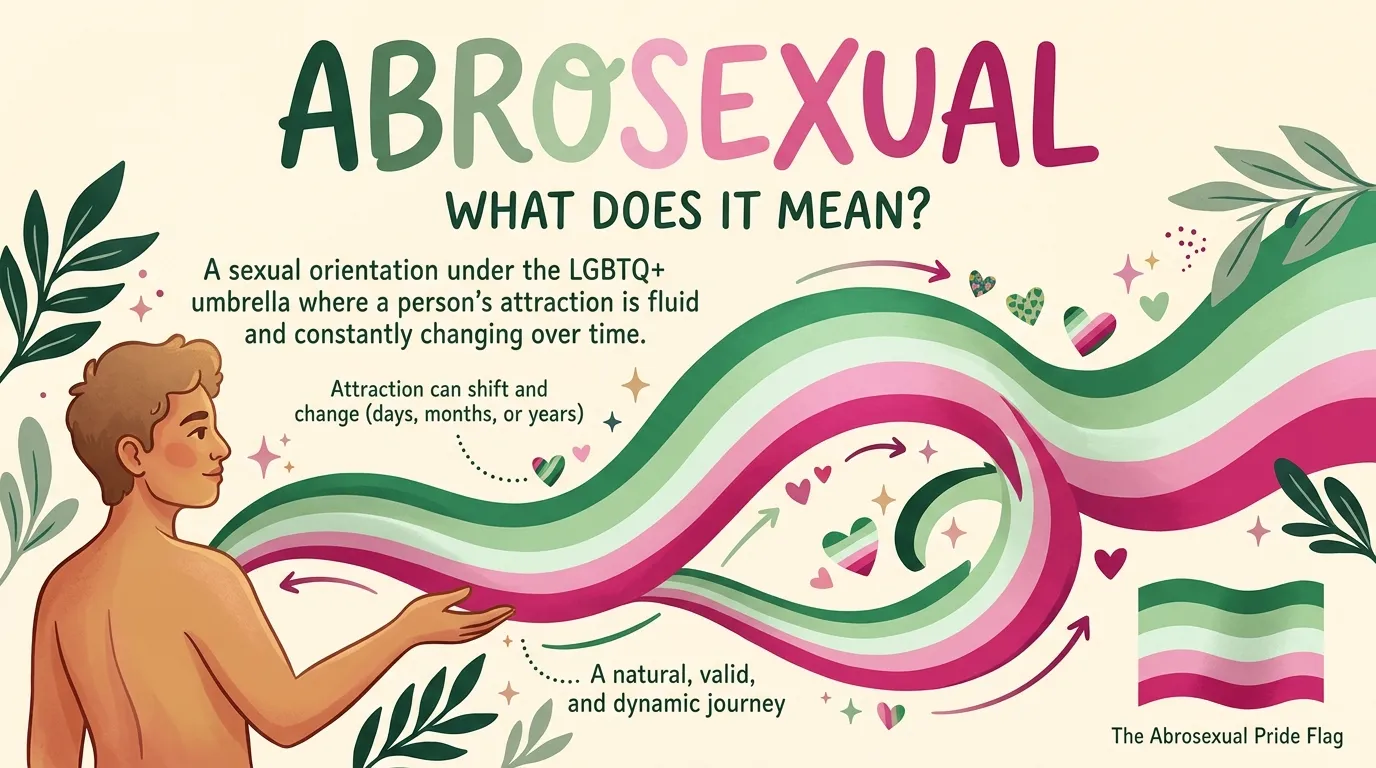
Have you ever noticed that the way you feel attracted to people can change over time? You may feel attracted to one gender at one point in your life, then feel attracted to different genders later. At another time, you may not feel much sexual attraction at all.
There is a word that some people use to describe this experience: abrosexual.
The abrosexual meaning relates to a sexual orientation in which a person’s sexual attraction can change over time. These changes may happen slowly or quickly. They may also affect which genders a person feels attracted to.
In this guide, you will learn what abrosexual means, how this identity works, and what it can feel like in daily life. We will also explore the abrosexual flag, common signs, and the difference between abrosexuality and bisexuality.
Most importantly, you will learn that changing feelings do not make your identity less valid. You do not need to rush to choose a label. Your feelings and your comfort matter most.
Quick Answer
Abrosexual means having a sexual orientation that changes over time. An abrosexual person may feel attracted to one gender, several genders, or no gender at different points in life. These changes can happen at different speeds and do not follow one fixed pattern.
Definition & Meaning
Abrosexual is a term for a person whose sexual attraction changes over time. It falls under the wider umbrella of sexual fluidity.
The word describes a changing pattern of sexual attraction, not a fixed list of genders someone must like.
For example, an abrosexual person might feel attracted to men for some time. Later, they may feel attracted to women or people of other genders. Their attraction may also become weak or disappear for a while.
Every abrosexual person can have a different experience.
The key point is simple: their pattern of sexual attraction can shift over time.
Abrosexuality is a valid identity term. People may use it when it helps them explain their feelings and understand themselves.
How Does Abrosexuality Work?
Abrosexuality does not follow one set pattern. Each person may experience changes in a different way.
For some people, their attraction changes over several months or years. For others, it may change more often.
Here are some ways it can work.
1. Attraction Can Shift Between Genders
An abrosexual person may feel attracted to men during one period of life. Later, they may feel attracted to women or people of other genders.
These feelings may change without any clear reason. The person does not need to make the change happen.
2. Attraction Can Become Stronger or Weaker
Some abrosexual people do not always change the gender they feel attracted to. Instead, the strength of their attraction may change.
For example, someone may feel strong sexual attraction one month. A few months later, those feelings may become much weaker.
3. Attraction Can Disappear for a While
Some abrosexual people may go through periods when they feel little or no sexual attraction.
Later, they may feel sexual attraction again. This can be part of their experience of a changing orientation.
The University of Massachusetts glossary also describes abrosexual experiences as changes in the presence or strength of sexual attraction over time.
Common Signs of Being Abrosexual
There is no official test that can tell you whether you are abrosexual. Only you can decide which label feels right.
However, some experiences may help you understand this identity.
Your Sexual Attraction Changes Over Time
You may notice that your attraction does not stay the same. The people you find sexually attractive may change during different periods of your life.
You Experience Different Patterns of Attraction
You may feel attracted to one gender at one point and more than one gender at another point.
Your attraction may also shift toward people without much focus on gender.
You Sometimes Experience Little or No Attraction
There may be times when you do not feel sexual attraction toward anyone.
Later, those feelings may return. This experience can also fit within the wider asexual spectrum.
Your Previous Labels No Longer Feel Right
You may have used labels such as straight, gay, bisexual, or asexual in the past.
Over time, you may feel that another label explains your experience better.
This does not mean your earlier identity was false. It may simply reflect how your feelings have changed.
You Find It Hard to Describe Your Attraction
You may struggle to explain your sexuality with one fixed word.
The term abrosexual may help you describe this changing experience in a simple way.
Important: These signs are not a diagnosis or a checklist you must pass. Sexual attraction can be complex, and people experience it in different ways.
Real-Life Examples of Abrosexuality
Examples can make the abrosexual definition easier to understand. The following situations are fictional and show possible experiences, not rules that every abrosexual person must follow.
Example 1: Changing Attraction Between Genders
Alex feels sexually attracted to men for several months.
Later, Alex notices that this attraction has changed. Alex now feels more attracted to women.
After some time, the pattern changes again.
Alex may use the term abrosexual because their sexual attraction shifts over time.
Example 2: Moving Between Attraction and No Attraction
Jordan feels sexual attraction to other people during one period.
A few months later, Jordan notices that these feelings have almost disappeared.
Jordan does not feel the same attraction as before. Later, those feelings return.
The term abrosexual may help Jordan explain these changes.
Example 3: Changes in Attraction Strength
Taylor often feels attracted to people of different genders.
However, the strength of that attraction changes. Sometimes it feels strong, while at other times it feels very weak.
Taylor may find the term abrosexual useful when describing this pattern.
These examples show that abrosexuality can involve changes in the direction, presence, or strength of sexual attraction.
Abrosexual vs. Bisexual: What Is the Difference?
Abrosexuality and bisexuality are different terms, but they are not always opposites.
Bisexuality generally describes attraction to more than one gender.
Abrosexuality describes a sexual orientation that changes over time.
A bisexual person may experience attraction to multiple genders without their orientation changing. An abrosexual person may experience shifts in the types or strength of attraction.
Some people may also identify with both terms if they find that both describe their experience.
| Feature | Abrosexual | Bisexual |
| Main meaning | Sexual orientation changes over time | Attraction to more than one gender |
| Attraction pattern | May shift between different patterns | May include attraction to multiple genders |
| Attraction strength | May change over time | May stay steady or change |
| Attraction to no gender | May occur during some periods | Can also occur in individual experiences |
| Identity | Describes fluidity | Describes the genders someone may feel attracted to |
Neither identity is better or more valid than the other. They describe different aspects of attraction.
Abrosexual vs. Pansexual
Abrosexual and pansexual are also different.
A pansexual person may feel attraction to people regardless of their gender. Gender does not limit who they may find attractive.
An abrosexual person experiences changes in their sexual orientation over time.
For example, someone may feel attracted to people of many genders during one period. Later, their attraction may become more limited or disappear for a while.
A person may also use both labels if they feel they describe different parts of their experience.
Abrosexual vs. Asexual
Asexuality and abrosexuality can overlap, but they do not mean the same thing.
An asexual person generally experiences little or no sexual attraction to other people.
An abrosexual person experiences a changing sexual orientation. This change may include periods of asexuality and periods of sexual attraction.
For example, a person may feel no sexual attraction for several months. Later, they may feel attracted to one or more genders.
This is one reason some people connect abrosexuality with the asexual spectrum.
OXFORD UNIVERSITY LGBTQ+ SOCIETY+1
What Is the Abrosexual Flag?
The abrosexual flag is a symbol of visibility and pride for people whose sexual orientation changes over time.
It usually has five horizontal stripes:
- Dark green
- Light green
- White
- Light pink
- Dark pink
The colors move from green through white to pink. This design is often used to represent the changing nature of abrosexuality.
You may also see this flag at LGBTQ+ events, online communities, and pride celebrations.
The flag can help people feel seen and connected to others with similar experiences. However, not every abrosexual person uses it or feels a need to display it.
What Is the Difference Between Abrosexual and Abroromantic?
These two terms sound similar, but they describe different kinds of attraction.
Abrosexual describes changes in sexual attraction.
Abroromantic describes changes in romantic attraction.
Sexual attraction relates to who someone feels sexually attracted to. Romantic attraction relates to who someone may want to form a romantic connection with.
These feelings do not always change together.
For example, a person may feel romantic attraction toward one gender while their sexual attraction follows a different pattern.
Someone can also be both abrosexual and abroromantic.
Stonewall includes both terms under its broader description of fluid sexual and romantic orientations.
Is Abrosexuality a Real Sexual Orientation?
Yes. Abrosexuality is a term that people use to describe a real experience of changing sexual attraction.
It appears in LGBTQ+ glossaries and educational resources. For example, Stonewall and the University of Massachusetts include definitions of abro-related identities in their terminology resources.
However, it is important to understand what this means.
Not every person uses the same label. Some people may describe their changing attraction as sexual fluidity. Others may prefer abrosexual.
There is no need for everyone to use one specific word.
A person’s identity does not become less valid because other people do not know the term. Labels are tools that help people describe their own experiences.
Is Abrosexuality the Same as Changing Your Mind?
No. Changing your mind and experiencing fluid sexual attraction are not the same thing.
Changing your mind usually means making a new choice or forming a different opinion.
Abrosexuality describes changes in sexual attraction. These feelings may shift without a person choosing or planning them.
For example, someone may feel attracted to a certain gender for a long time. Later, their feelings may change even though they did not try to change them.
It is also important not to assume that every change in attraction means someone is abrosexual.
People can experience changes in attraction for many reasons. A person should choose their own label rather than having someone else assign one to them.
How to Understand and Explore Your Sexuality
If you think you may be abrosexual, you do not need to find every answer right away.
Understanding your feelings can take time. These simple steps may help.
1. Notice Your Feelings
Pay attention to your patterns of attraction.
You may notice that your feelings change over time. You do not need to judge those changes.
2. Give Yourself Time
Do not rush to choose a label.
You can take time to understand your feelings. You can also change the words you use to describe yourself.
3. Learn About Different Identities
Read about sexual fluidity, bisexuality, pansexuality, and the asexual spectrum.
Learning about these terms may help you find language that fits your experience.
4. Talk to Someone You Trust
If you feel comfortable, talk with a trusted friend or an LGBTQ+-affirming counselor.
Choose someone who respects your privacy and does not pressure you to use a certain label.
5. Choose the Label That Feels Right
You can use abrosexual if it helps explain your experience.
You can also use another label or no label at all. You do not owe anyone a detailed explanation of your identity.
Abrosexual Quick Reference Checklist
Use this table to understand the main ideas in one place.
| Topic | Quick Explanation |
| Meaning | Sexual orientation that changes over time |
| Attraction | May shift between genders |
| Intensity | Can become stronger or weaker |
| No attraction | May happen during some periods |
| Related term | Abroromantic |
| Pride symbol | Five-color green, white, and pink flag |
| Personal choice | You decide which label fits you |
FAQs:
1. What does abrosexual mean in simple words?
Abrosexual means having a sexual orientation that changes over time. A person may feel attracted to one gender, several genders, or no gender during different periods. The changes can happen slowly or quickly.
2. Can an abrosexual person be attracted to both men and women?
Yes. An abrosexual person can feel attracted to men and women. They may also feel attracted to people of other genders. Their attraction may change over time, so their experience does not have to remain the same.
3. Can you be both bisexual and abrosexual?
Yes. Some people may identify as both bisexual and abrosexual. Bisexual describes attraction to more than one gender, while abrosexual describes changes in sexual orientation. Both terms can explain different parts of someone’s experience.
4. Does abrosexual mean you are asexual?
No. Abrosexual and asexual do not have the same meaning. However, an abrosexual person may experience periods with little or no sexual attraction. They may also experience sexual attraction at other times.
5. How often does an abrosexual person’s attraction change?
There is no fixed time for these changes. Some people may notice changes over months or years. Others may experience them more often. Every person has a different pattern, and there is no required schedule.
6. Is there an abrosexual pride flag?
Yes. The abrosexual pride flag has five horizontal stripes in dark green, light green, white, light pink, and dark pink. It represents the changing nature of sexual attraction and helps create visibility for abrosexual people.
7. How do I know if I am abrosexual?
You may relate to this identity if your sexual attraction changes over time. You might notice changes in the genders you feel attracted to or in the strength of your attraction. There is no test for this identity. You can explore the term and decide whether it feels right for you.
Conclusion:
Understanding the abrosexual meaning can help you learn more about sexual attraction and identity.
Abrosexual describes people whose sexual orientation changes over time. These changes may affect the genders they feel attracted to or the strength of their attraction.
Remember that everyone has a different experience. You do not need to follow a set pattern or prove your identity to anyone. Take your time, learn about different terms, and use the label that feels right to you.
If this guide helped you, explore more LGBTQ+ terms to better understand the many ways people experience attraction and identity.

Hello, I am Daniel Brooks a passionate writer and educator with a deep love for language and creative expression. My work on similiezmeta.com focuses on helping kids and students explore the beauty of words through playful examples and practical explanations.


