Have you ever solved a math problem and got a different answer from someone else? The problem may not be the math itself. You may have used a different order of steps.
That is where PEMDAS helps.
The PEMDAS meaning is a simple rule that tells you which part of a math problem to solve first. It helps you work through problems in the right order and reach the correct answer.
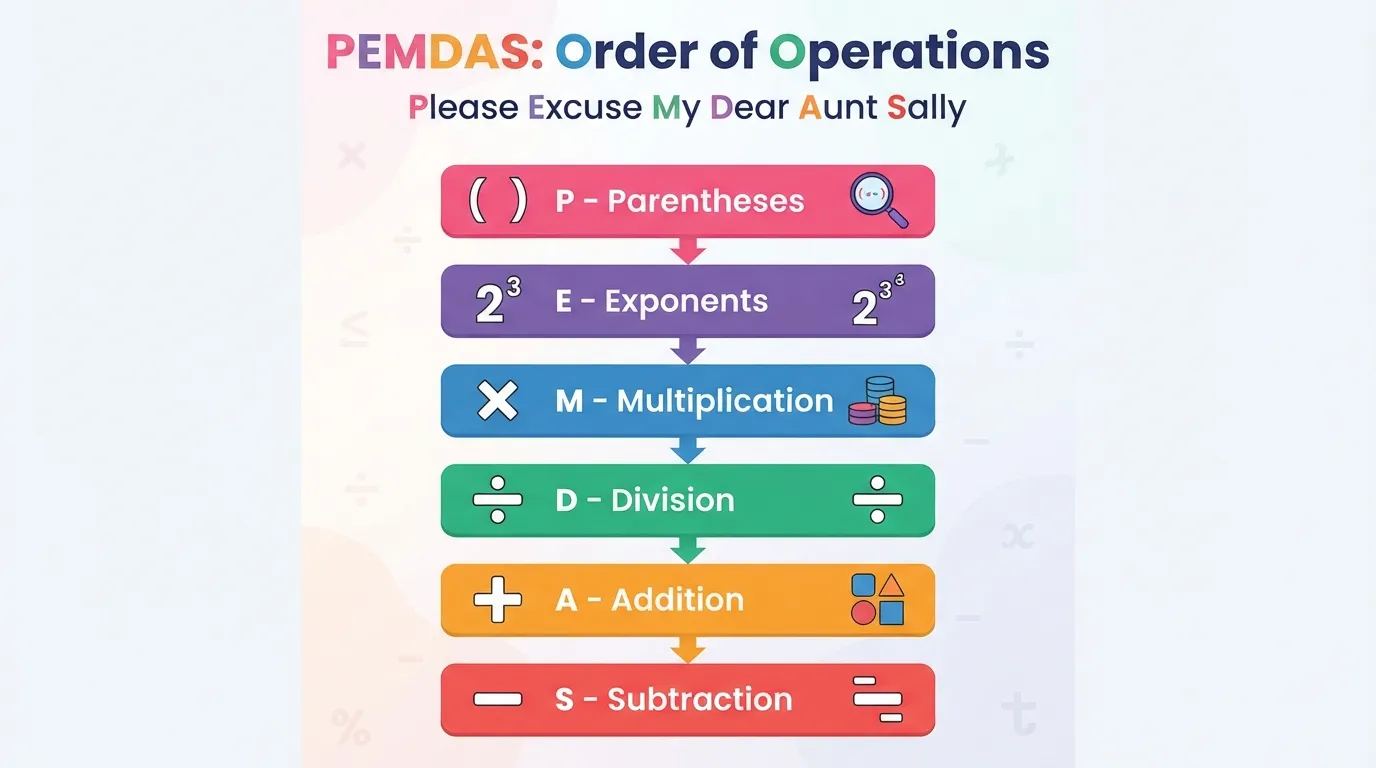
PEMDAS stands for Parentheses, Exponents, Multiplication, Division, Addition, and Subtraction.
You may see PEMDAS in school math, homework, tests, and online math questions. It can look hard at first, but the rule is easy once you break it into small steps.
In this guide, you will learn what PEMDAS means, how the order of operations works, how to solve examples, and which common mistakes to avoid.
Quick Answer
PEMDAS is a math rule used to decide the order in which you solve parts of an expression. It means Parentheses, Exponents, Multiplication, Division, Addition, and Subtraction. Multiplication and division have the same priority, as do addition and subtraction, so you solve them from left to right.
Definition & Meaning
The PEMDAS meaning is the order of operations used to solve many math expressions.
The letters stand for:
- P = Parentheses
- E = Exponents
- M = Multiplication
- D = Division
- A = Addition
- S = Subtraction
The key idea is simple: do the higher-priority operations before the lower-priority ones.
For example:
2 + 3 × 4
If you add first, you get:
2 + 3 = 5
5 × 4 = 20
But PEMDAS tells you to multiply first:
3 × 4 = 12
2 + 12 = 14
So the correct answer is 14.
This rule keeps math problems clear. Without a shared order, two people could solve the same expression in different ways.
What Does PEMDAS Stand For?
PEMDAS is an acronym. Each letter represents a step in the order of operations.
Parentheses
Solve expressions inside parentheses first.
Example:
5 × (2 + 3)
First solve the parentheses:
2 + 3 = 5
Then multiply:
5 × 5 = 25
Exponents
Next, solve exponents.
An exponent tells you how many times to multiply a number by itself.
For example:
3² = 3 × 3 = 9
So:
2 + 3²
becomes:
2 + 9 = 11
Multiplication
After parentheses and exponents, solve multiplication.
For example:
4 + 5 × 2
Multiply first:
5 × 2 = 10
Then add:
4 + 10 = 14
Division
Division has the same priority as multiplication.
This point matters a lot.
You do not always multiply before you divide. If multiplication and division appear together, work from left to right.
Example:
24 ÷ 6 × 2
Start on the left:
24 ÷ 6 = 4
Then:
4 × 2 = 8
The answer is 8, not 2.
Addition
After multiplication and division, solve addition.
Example:
7 + 4 × 3
First:
4 × 3 = 12
Then:
7 + 12 = 19
Subtraction
Subtraction has the same priority as addition.
Solve addition and subtraction from left to right.
Example:
20 – 5 + 2
Start from the left:
20 – 5 = 15
Then:
15 + 2 = 17
The answer is 17.
How Does the Order of Operations Work?
A common mistake is to think PEMDAS means you must complete every multiplication before every division.
That is not how it works.
Multiplication and division are on the same level. You solve them from left to right.
Addition and subtraction also share the same level. You solve them from left to right.
Think of PEMDAS as a list of levels:
- Parentheses
- Exponents
- Multiplication and division, from left to right
- Addition and subtraction, from left to right
This is one of the most important parts of learning the order of operations.
How to Use PEMDAS Step by Step
Let us solve a longer problem.
8 + 2 × (6 – 3)²
Step 1: Solve parentheses
Inside the parentheses:
6 – 3 = 3
Now the problem is:
8 + 2 × 3²
Step 2: Solve the exponent
3² = 9
Now:
8 + 2 × 9
Step 3: Solve multiplication
2 × 9 = 18
Now:
8 + 18
Step 4: Solve addition
8 + 18 = 26
So the final answer is 26.
The best way to use PEMDAS is to work one step at a time. Do not try to solve the whole expression in your head.
PEMDAS Examples You Can Practice
Here are several simple examples.
Example 1: Addition and Multiplication
6 + 4 × 2
Multiply first:
4 × 2 = 8
Then add:
6 + 8 = 14
Example 2: Parentheses
(6 + 4) × 2
Parentheses come first:
6 + 4 = 10
Then:
10 × 2 = 20
Notice how adding parentheses changed the answer.
Example 3: Exponents
5 + 2³
Solve the exponent:
2³ = 8
Then:
5 + 8 = 13
Example 4: Division and Multiplication
18 ÷ 3 × 2
Move from left to right:
18 ÷ 3 = 6
6 × 2 = 12
Example 5: Addition and Subtraction
15 – 6 + 4
Move from left to right:
15 – 6 = 9
9 + 4 = 13
Example 6: A Mixed Problem
10 + 12 ÷ 3 × 2
Start with division:
12 ÷ 3 = 4
Then multiplication:
4 × 2 = 8
Then addition:
10 + 8 = 18
The correct answer is 18.
Common PEMDAS Mistakes
PEMDAS is easy to remember, but some parts can cause confusion.
| Common Mistake | Correct Way |
| Always multiply before dividing | Multiplication and division have equal priority. Go left to right. |
| Always add before subtracting | Addition and subtraction have equal priority. Go left to right. |
| Ignore parentheses | Solve inside parentheses first. |
| Treat an exponent as regular multiplication | Solve the exponent before multiplication or division. |
| Solve from top to bottom without checking priority | Follow the order of operations. |
| Try to solve a long problem in one step | Work through one operation at a time. |
| Assume PEMDAS means M always comes before D | M and D are the same level. |
The biggest mistake is often the belief that the letters always mean one operation must finish before the next.
For example, M does not always come before D.
In:
16 ÷ 4 × 3
you divide first because division appears first from the left.
16 ÷ 4 = 4
4 × 3 = 12
Why Multiplication and Division Go Left to Right
This rule often surprises students.
Look at:
48 ÷ 6 × 2
If you multiply first, you might do:
6 × 2 = 12
Then:
48 ÷ 12 = 4
But that changes the expression. The correct method is to move from left to right.
48 ÷ 6 = 8
8 × 2 = 16
The answer is 16.
The same idea applies to addition and subtraction.
For:
30 – 10 + 5
Start from the left:
30 – 10 = 20
20 + 5 = 25
Do not add first just because addition appears in the PEMDAS acronym before subtraction.
PEMDAS vs BEDMAS and BODMAS
You may see other versions of the same math rule.
Some places use BODMAS. Others use BIDMAS or BEDMAS.
The letters may differ, but the main idea stays the same.
For example:
- PEMDAS: Parentheses, Exponents, Multiplication, Division, Addition, Subtraction
- BODMAS: Brackets, Orders, Division, Multiplication, Addition, Subtraction
- BEDMAS: Brackets, Exponents, Division, Multiplication, Addition, Subtraction
Do not focus too much on the acronym.
Focus on the actual priority:
Grouping → powers → multiplication/division → addition/subtraction
That is what helps you solve the expression correctly.
Is PEMDAS Always Used in Math?
PEMDAS is used for expressions where you need a standard order of operations.
It helps make written math clear.
However, real math can include other rules and structures. Fractions, functions, absolute values, roots, and other symbols may require extra steps.
For example, a fraction bar can act like a grouping symbol. You may need to simplify the top and bottom parts before completing the full expression.
So PEMDAS is important, but it is not the only rule in mathematics.
How to Remember PEMDAS
A simple memory trick can help.
The first letters spell:
P E M D A S
You can also remember the groups instead of the letters:
Grouping → Powers → Multiply/Divide → Add/Subtract
This method can be easier because it reminds you that multiplication and division belong together.
The same is true for addition and subtraction.
When solving a problem, ask yourself:
“What level am I on?”
First check grouping symbols.
Then check powers.
Then handle multiplication and division.
Finally, handle addition and subtraction.
Quick PEMDAS Reference
Use this table when you need a fast reminder.
| Step | What to Do | Simple Example |
| 1 | Parentheses or grouping | (4 + 2) → 6 |
| 2 | Exponents | 3² → 9 |
| 3 | Multiplication and division, left to right | 12 ÷ 3 × 2 → 8 |
| 4 | Addition and subtraction, left to right | 10 – 3 + 2 → 9 |
This quick reference is useful for homework, practice, and basic math review.
A Simple PEMDAS Checklist
Before you write your final answer, check each step.
PEMDAS Checklist
- Did I solve the parentheses or other grouping symbols?
- Did I solve the exponents?
- Did I solve multiplication and division from left to right?
- Did I solve addition and subtraction from left to right?
- Did I check each calculation?
- Did I avoid changing the original expression?
- Did I write the final answer clearly?
This small check can prevent many simple errors.
Why PEMDAS Matters
PEMDAS is not just a trick for school tests.
It gives people a shared way to read and solve mathematical expressions.
Imagine that a written expression had no order of operations. One person might multiply first. Another might add first. They could get different answers from the same numbers.
PEMDAS removes that confusion.
It also teaches an important math skill: following a clear process.
When a problem looks hard, you do not need to solve everything at once. Break it into steps and follow the correct order.
Tips for Solving PEMDAS Problems Faster
You do not need to rush.
Accuracy matters more than speed.
Try these habits:
Circle grouping symbols. This helps you see what comes first.
Underline exponents. Powers can be easy to miss.
Work from left to right. Use this rule for multiplication and division, then again for addition and subtraction.
Write every major step. Small written steps can prevent large mistakes.
Check your answer. If the result looks strange, review the order before doing all the math again.
With practice, these steps become natural.
FAQs:
What does PEMDAS mean in math?
PEMDAS means Parentheses, Exponents, Multiplication, Division, Addition, and Subtraction. It gives you the order to use when solving many mathematical expressions.
What comes first in PEMDAS?
Parentheses come first. After that, solve exponents. Then solve multiplication and division from left to right. Finally, solve addition and subtraction from left to right.
Does multiplication come before division in PEMDAS?
No. Multiplication and division have the same priority. You solve them from left to right. For example, 18 ÷ 3 × 2 equals 12.
Does addition come before subtraction?
No. Addition and subtraction also have the same priority. Solve them from left to right. For example, 20 – 5 + 2 equals 17.
What is an example of PEMDAS?
A simple example is 4 + 3 × 2. First multiply 3 × 2 to get 6. Then add 4. The final answer is 10.
Is PEMDAS the same as BODMAS?
PEMDAS and BODMAS describe the same basic order of operations. The letters differ because different regions use different terms, such as parentheses versus brackets and exponents versus orders.
How can I get better at PEMDAS?
Practice short problems and write each step. Pay special attention to multiplication and division, because they must be handled from left to right. Then check your final answer.
Conclusion:
The PEMDAS meaning is simple: it is a rule that helps you solve math expressions in the correct order. Start with parentheses, then exponents, followed by multiplication and division from left to right. Finish with addition and subtraction from left to right.
The most important thing to remember is that multiplication does not always come before division. Addition does not always come before subtraction. These pairs have equal priority.
When a problem looks difficult, slow down and solve one step at a time. Use the checklist, check your work, and practice with simple examples. Once the order becomes familiar, PEMDAS becomes much easier to use.

Hello, I am Ethan Carter a dedicated content creator and storyteller with expertise in literary techniques and language learning. At similiezmeta.com, my crafts engaging articles on similes, idioms, and figurative language designed specifically for children and beginners.