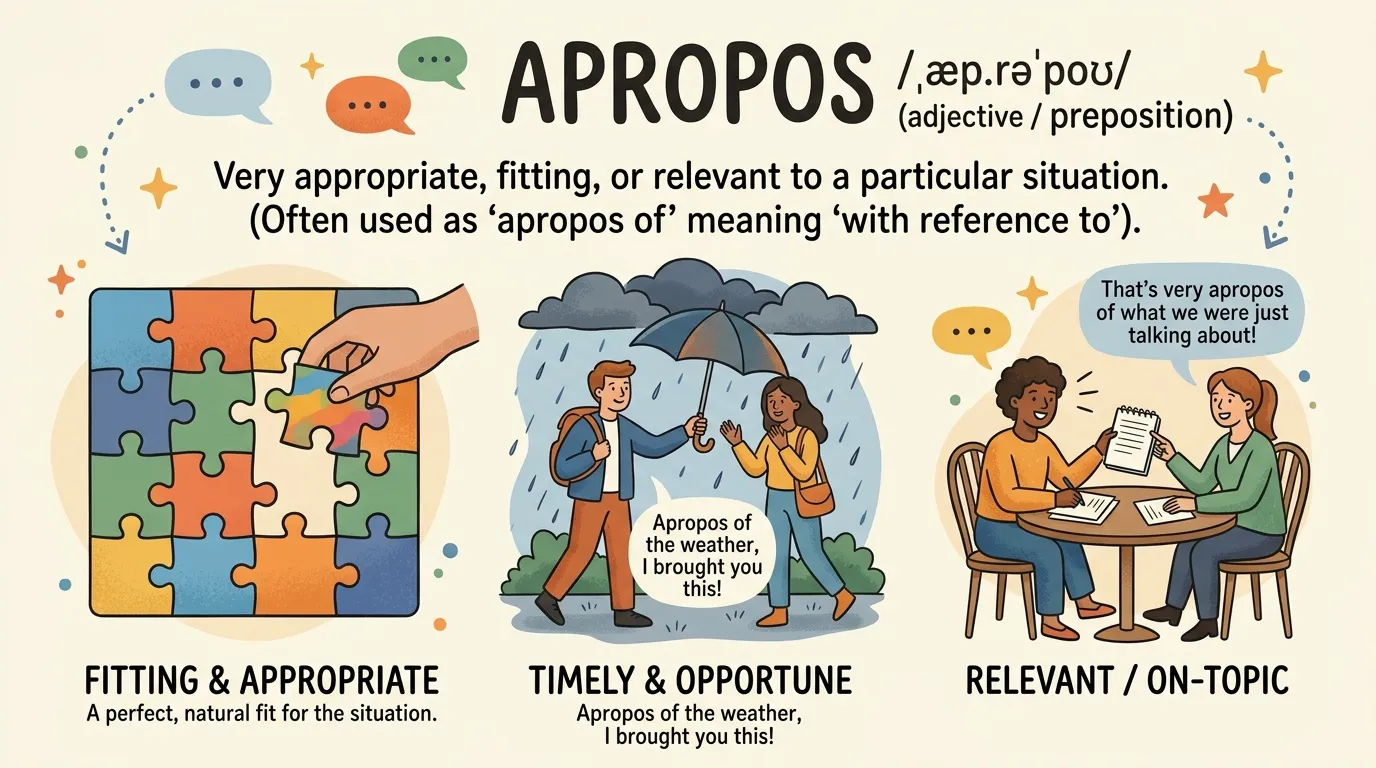
Have you ever read a word that sounds familiar but feels hard to use? Apropos is one of those words. You may see it in books, news stories, formal emails, or careful speech. It can look fancy, but its main idea is simple.
The apropos meaning is usually related to what was just mentioned or suitable for a certain situation. It can also mean “about” or “concerning” when used in the phrase apropos of.
For example, if someone talks about summer, and you mention your beach plans, your comment may be apropos because it relates to the topic.
This guide explains the word in plain English. You will learn the apropos definition, pronunciation, common uses, examples, and the difference between apropos and appropriate. You will also see when the word sounds natural and when a simpler word like “relevant” or “suitable” may work better.
Quick Answer
Apropos means related to the topic being discussed or suitable for a particular situation. It is a formal word. In the phrase apropos of, it often means “about” or “concerning.” For example, “Apropos of your question, I have an answer.”
Cambridge lists apropos as an adverb, preposition, and adjective. It also marks the word as formal.
Definition & Meaning
The basic apropos meaning has two closely related uses.
First, apropos can mean that something is connected to the subject being discussed.
For example:
Her comment was apropos.
This means her comment was relevant to the topic.
Second, apropos can mean that something is suitable for a certain time or situation.
For example:
His joke was apropos.
Here, the joke fit the situation well.
The word is often used in formal English. In everyday American English, people may choose simpler words such as relevant, suitable, fitting, or related.
Cambridge gives the adjective meaning as “suitable in a particular situation or at a particular time.” It also defines the adverb and preposition use as introducing something connected to what was just said.
What Does Apropos Mean in Simple English?
In simple English, apropos can mean:
- related to the topic
- relevant
- fitting
- suitable
- about or concerning, especially in “apropos of”
Think of it this way:
Apropos = it fits the topic or situation.
If your friend talks about cooking and you mention a new recipe, your comment is apropos.
If your friend talks about a wedding and you mention wedding clothes, your comment is also apropos.
The key idea is connection or suitability.
Apropos Pronunciation
The American English pronunciation of apropos is:
/ˌæp.rəˈpoʊ/
The main stress falls on the last part of the word. Cambridge gives this as the U.S. pronunciation and lists /ˌæp.rəˈpəʊ/ for British English.
You may hear the word in formal conversations, lectures, interviews, books, and news writing.
If you are learning English, do not worry about sounding overly formal when you use it. The important thing is to use it when something clearly connects to the topic or fits the situation.
How to Use Apropos in a Sentence
You can use apropos in several ways.
One common pattern is:
Apropos of + noun
Example:
Apropos of your email, I wanted to ask one more question.
Here, apropos of your email means about your email or regarding your email.
You can also use apropos as an adjective:
That was an apropos comment.
This means the comment was suitable or relevant.
Another example is:
Her advice was apropos to the situation.
The advice fit the situation.
A very useful form is:
apropos of nothing
This means someone suddenly mentions something that has no clear connection to the current topic.
For example:
Apropos of nothing, did you ever visit New York?
The speaker suddenly changes the subject.
Cambridge lists apropos of something as a formal phrase used to introduce something related to what was just said. It also gives apropos of nothing as a way to introduce an unrelated thought.
Apropos of Meaning
Apropos of means about, concerning, or in connection with something.
For example:
Apropos of our meeting, I have one more question.
This means:
About our meeting, I have one more question.
Another example:
Apropos of your message, I think we should wait.
This means:
Regarding your message, I think we should wait.
The phrase can sound formal. In casual conversation, about or regarding often sounds more natural.
For example:
Formal:
Apropos of your request, we need more information.
Simple:
About your request, we need more information.
Both communicate the main idea, but the second version is more direct.
Apropos of Nothing Meaning
Apropos of nothing means without any clear connection to the current conversation.
Imagine two people talking about work.
One person suddenly says:
Apropos of nothing, I really want a new car.
The car comment does not connect clearly to the work discussion. That is why the phrase works.
It can also be used in a playful way when someone changes topics suddenly.
For example:
Apropos of nothing, have you seen my keys?
This use is common enough to be worth learning, especially if you read formal or polished English.
Apropos vs Appropriate
One of the most common questions about apropos meaning is whether it means the same thing as appropriate.
The words are related in meaning, but they are not always interchangeable.
Appropriate usually means right or suitable for a particular person, place, time, or situation.
Apropos often means relevant to the subject or suitable for the situation.
Here is a simple comparison:
| Word or use | Meaning | Example |
| Apropos | Related or relevant to the topic | Her comment was apropos. |
| Apropos of | About or concerning | Apropos of your question, I agree. |
| Appropriate | Right or suitable for a situation | That outfit is appropriate for work. |
| Relevant | Directly connected to the subject | His answer was relevant. |
| Fitting | Suitable or right for the moment | Her speech was fitting for the event. |
A useful trick is to ask what you mean.
If you mean “connected to the topic,” try apropos or relevant.
If you mean “right for the situation,” try appropriate or suitable.
There can be overlap, but the words do not always carry the same focus.
Apropos vs Relevant
Relevant is often the easier word for everyday English.
Consider these sentences:
Her answer was relevant.
Her answer was apropos.
Both can mean that her answer connected well with the subject.
The main difference is style. Relevant is common and direct. Apropos sounds more formal and can feel more literary.
For most casual conversations, relevant is the safer choice.
For formal writing, polished speech, or a context where you want a more refined word, apropos may fit well.
Apropos vs Suitable
These two words can also overlap.
Suitable focuses on whether something is a good fit for a person, purpose, place, or situation.
Apropos can focus on whether something fits the subject or moment.
Compare:
This dress is suitable for the wedding.
The dress is right for the event.
Her comment was apropos of the wedding.
Her comment was connected to the wedding topic.
The difference becomes clearer when you look at the object of the sentence.
Common Examples of Apropos
Here are some simple examples that show how the word works in real sentences.
His answer was apropos.
His answer fit the topic.
That was an apropos question.
The question was relevant to the situation.
Her story was apropos to the discussion.
Her story connected to the discussion.
Apropos of your email, I have a quick question.
Regarding your email, I have a quick question.
Apropos of the meeting, we should review the notes.
About the meeting, we should review the notes.
His advice was perfectly apropos.
His advice fit the situation very well.
Apropos of nothing, I suddenly remembered your old story.
The speaker suddenly remembered something without a clear link to the current topic.
These examples show why context matters. The word often works best when there is a clear link between two ideas.
When Should You Use Apropos?
Use apropos when you want to say that something is relevant, connected, or suitable.
It can work well in:
- Formal writing
- Essays
- Professional communication
- Books and articles
- Formal conversations
- Thoughtful or polished speech
For example:
Her question was apropos to the discussion.
That sentence sounds formal but clear.
You should not feel that you must use apropos whenever you mean “relevant.” English has many simple choices.
In a casual message, this may sound more natural:
That is relevant to what we are talking about.
Instead of:
That is apropos to what we are talking about.
The second sentence is not wrong, but it sounds more formal.
When Should You Avoid Apropos?
Avoid apropos when a simple word makes your meaning clearer.
For example, if you are texting a friend, you probably do not need:
Apropos of your message, I will call you later.
A simpler version is:
About your message, I will call you later.
Or:
Regarding your message, I will call you later.
Clear writing does not need difficult words.
Apropos is useful because it has a specific tone and meaning. It should not be used just to make a sentence sound more intelligent.
Common Mistakes With Apropos
Many learners make small mistakes when they first learn this word.
Mistake 1: Treating apropos and appropriate as identical
They can overlap, but they have different common uses.
Better:
Her comment was apropos of the discussion.
This means the comment related to the discussion.
Mistake 2: Using “apropos of” without a clear connection
The phrase normally introduces something connected to another subject.
If there is no connection, apropos of nothing may be the better choice.
Mistake 3: Using it in every casual sentence
Apropos is formal. Words like about, relevant, and suitable often sound more natural in everyday speech.
Mistake 4: Thinking apropos only means “appropriate”
That misses an important part of the word’s meaning.
Apropos can also introduce a related topic, especially in apropos of.
| Common mistake | Better choice |
| Using apropos only to mean “appropriate” | Remember its “related to” meaning too |
| Using it in every casual message | Use simple words when they sound more natural |
| Forgetting the meaning of “apropos of” | Remember: “about” or “concerning” |
| Changing the subject without understanding the phrase | Use “apropos of nothing” for a sudden unrelated thought |
| Using it to sound smarter | Use it only when it fits the sentence |
Apropos Quick Reference
The easiest way to remember the word is to connect each form with one simple idea.
| Form | Simple meaning | Example |
| apropos | relevant or suitable | Her comment was apropos. |
| apropos of | about or concerning | Apropos of your question, I agree. |
| apropos of nothing | without a clear connection | Apropos of nothing, I need a vacation. |
| appropriate | right or suitable | That behavior is appropriate. |
| relevant | connected to the topic | His answer was relevant. |
| suitable | good for a purpose or situation | This room is suitable for meetings. |
Easy Tips to Remember Apropos
Try these simple memory tips.
1. Think “connected.”
When something connects well to the topic, apropos may work.
2. Remember “apropos of.”
This phrase often means about or concerning.
3. Remember “apropos of nothing.”
This means a person suddenly brings up something unrelated.
4. Do not confuse it with appropriate.
The meanings can overlap, but apropos often has a stronger link to relevance or the current topic.
5. Check the tone.
Apropos is formal. In casual English, a simpler word may sound better.
Is Apropos Formal or Casual?
Apropos is formal.
Cambridge labels the word as formal in its dictionary entry.
That does not mean it is wrong in everyday speech. It simply means that words such as about, relevant, and suitable may feel more natural in casual settings.
For example, in a work report:
The recommendation was apropos to the issue.
This can work well.
In a text to a friend:
Your comment was relevant.
This is simpler and more natural.
Choosing the right word is not only about grammar. It is also about tone.
What Is the Origin of Apropos?
Apropos comes from French. English adopted the word and uses it as a formal term connected with relevance, relation, or suitability.
You do not need to know its history to use it correctly. The most useful thing to remember is its modern English meaning.
Think:
apropos = connected, relevant, or fitting
And:
apropos of = about or concerning
That simple rule will cover most situations you meet.
FAQs:
What does apropos mean in simple words?
Apropos means related, relevant, or suitable. It can describe something that fits the topic or situation. In apropos of, it often means about or concerning.
Is apropos a positive word?
Not by itself. Apropos mainly describes a connection or fit. It does not automatically mean that something is good or bad. The context tells you whether the thing being described is useful, funny, helpful, or otherwise suitable.
Is apropos the same as appropriate?
Not always. Appropriate usually means right or suitable for a situation. Apropos can mean suitable, but it can also mean related or relevant to a topic. This makes the two words similar in some sentences but different in others.
What does apropos of mean?
Apropos of usually means about, concerning, or in connection with. For example, “Apropos of your question, I have an answer” means “Regarding your question, I have an answer.”
What does apropos of nothing mean?
It means without a clear connection to what was just being discussed. Someone may suddenly change the subject and say, “Apropos of nothing, I want a new car.”
Is apropos a formal word?
Yes. Dictionaries such as Cambridge label apropos as formal. It is common in formal writing and polished speech, but simple words like “relevant” or “about” may sound more natural in casual conversation.
How do you use apropos in a sentence?
You can use apropos to describe something relevant or suitable: “Her comment was apropos.” You can also use apropos of to mean “about”: “Apropos of your email, I have one question.”
Conclusion:
The apropos meaning is simple once you see how the word works. It can mean related, relevant, or suitable, and apropos of often means about or concerning. The phrase apropos of nothing describes a sudden comment with no clear connection to the current topic.
Remember that apropos is a formal word. Use it when it fits the tone and meaning of your sentence. In casual English, relevant, about, suitable, or appropriate may sound more natural.
The best way to learn the word is to use it in context. Start with simple sentences, check the connection between ideas, and choose clarity over fancy language.

Hello, I am Ethan Carter a dedicated content creator and storyteller with expertise in literary techniques and language learning. At similiezmeta.com, my crafts engaging articles on similes, idioms, and figurative language designed specifically for children and beginners.