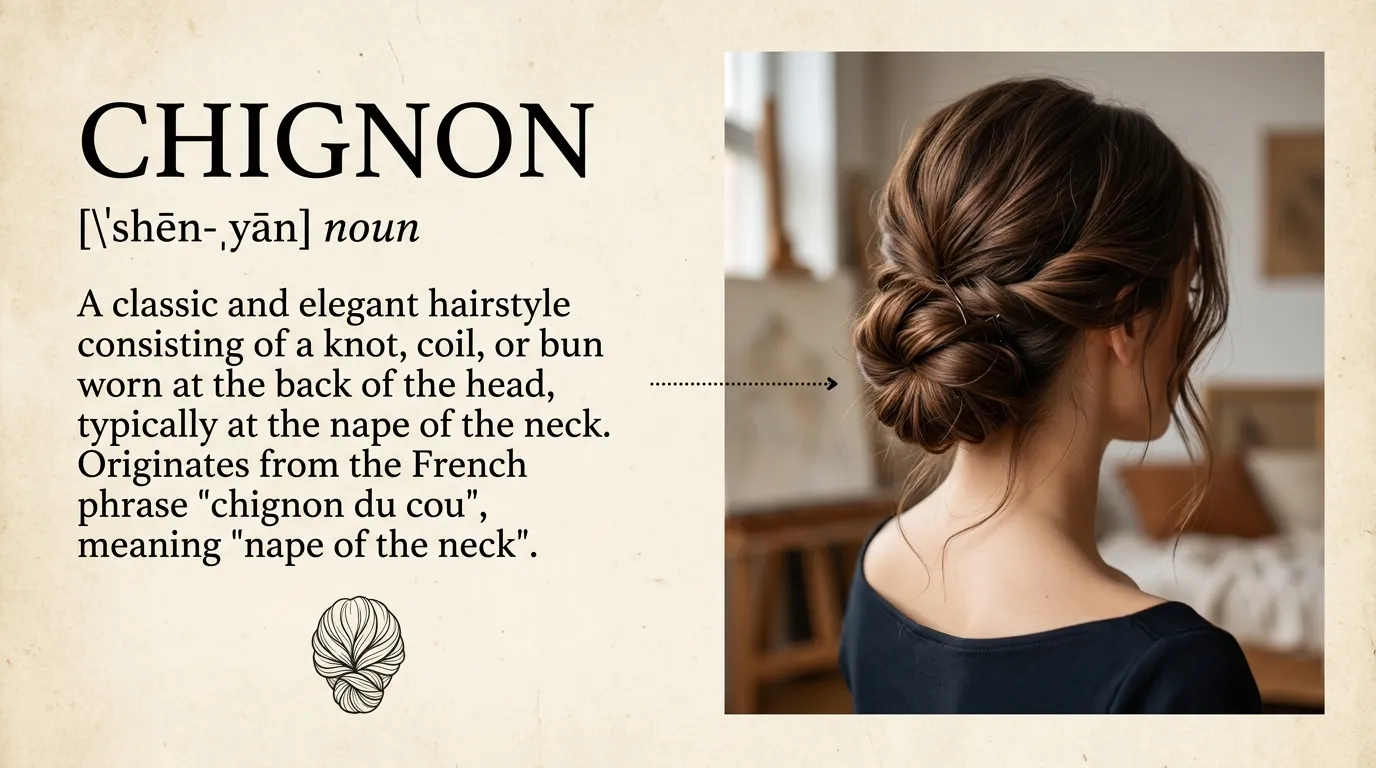
Have you ever seen someone wear a neat, low bun at the back of their neck? It may look simple, but this classic hairstyle has a special name: chignon. You may have seen it at a wedding, school dance, dinner, or formal event.
The chignon meaning is a hairstyle in which a person gathers their hair into a bun at the back of the head or near the neck. The style often looks smooth, neat, and elegant. It can also look loose and relaxed.
The word comes from French and has become common in English. People use it when they talk about classic hair styles, bridal looks, and formal beauty.
In this guide, you will learn what chignon means, how to say it, where the word comes from, and how to create one. You will also see popular styles, simple examples, and common mistakes to avoid.
Quick Answer
A chignon is a bun made by gathering and pinning the hair at the back of the head, often near the neck. It is a classic French hairstyle that can look neat, soft, simple, or elegant.
Definition & Meaning of Chignon
The word chignon refers to a hairstyle in which someone pulls the hair back and forms it into a bun. The bun usually sits at the nape of the neck, which is the area where the head meets the back of the neck.
A chignon can be tight or loose. Some styles look smooth and polished. Others have soft strands around the face and a relaxed shape.
People often choose this hairstyle for:
- Weddings and bridal events.
- Formal dinners and parties.
- School dances and special events.
- Work meetings and professional events.
- Everyday looks when they want their hair off their face.
A chignon does not need to be complex. You can make a simple version with a hair tie and a few pins.
How Do You Pronounce Chignon?
The word chignon has a French sound, so its spelling may look harder than it is.
Oxford gives two English pronunciation forms:
- British English: /ˈʃiːnjɒn/
- American English: /ˈʃiːnjɑːn/
The first sound is like the beginning of the word she. The rest has a soft French-style sound.
Simple tip: Do not try to say every letter as it appears in English spelling.
What Is the French Chignon?
The word chignon comes from French. In French, it first referred to the back of the neck, also called the nape.
Over time, the word came to describe hair gathered and held at the back of the head. English later adopted the word for this hairstyle.
The French Academy’s dictionary records the older meaning and explains the modern use as hair raised and held above the nape.
This history helps explain why people often connect a chignon with a low bun. The style draws attention to the back of the head and neck.
Today, people use the word in fashion, beauty, and hair care. You may see it in bridal guides, salon menus, and fashion magazines.
What Does a Chignon Hairstyle Look Like?
A chignon looks like a bun made from hair gathered at the back of the head. It often sits low, just above the neck.
The hair may wrap around itself, twist into a knot, or form a smooth roll. Hairpins hold the shape in place.
Here are some common features:
- Low position: The bun often rests near the neck.
- Twisted hair: The hair may twist around itself.
- Pinned shape: Hairpins help keep the bun in place.
- Smooth or soft finish: The hair can look neat or relaxed.
- Classic look: The style works well with both simple and formal clothes.
Not every chignon looks the same. Some have a small, tight knot. Others have a large, loose shape.
Types of Chignon Hairstyles
There are many ways to wear a chignon. You can choose a style based on your hair length, outfit, and event.
1. Classic Low Chignon
This is one of the best-known styles. You pull the hair back, twist it, and pin it near the neck.
It has a clean and simple look. It works well for weddings, formal dinners, and office events.
2. Messy Chignon
A messy chignon has a soft and loose shape. You do not need to make every strand smooth.
You can leave a few small strands near your face. This gives the style a relaxed look.
3. Braided Chignon
For this style, you braid the hair before you wrap it into a bun.
The braid adds shape and detail. It can make a simple hairstyle look more special.
4. Side Chignon
A side chignon sits behind one ear instead of in the center.
It gives a different look without changing the basic idea. It can work well with dresses that have one bare shoulder.
5. Sleek Chignon
A sleek chignon has a smooth finish. You brush the hair back and use a little styling gel or spray to control loose strands.
This style is a good choice for formal events and professional settings.
6. Twisted Chignon
A twisted chignon uses sections of hair that you twist before pinning them into a bun.
It can look simple or detailed. You can make it with one large twist or several small ones.
Chignon vs. Regular Bun: What Is the Difference?
A chignon and a regular bun are close in meaning. Both styles gather the hair and hold it in one place.
However, they do not always look the same. A regular bun can sit high, low, or on top of the head. A classic chignon usually sits at the back of the head, often near the neck.
| Feature | Chignon | Regular bun |
| Position | Often low at the neck | Can sit anywhere |
| Shape | Often twisted, rolled, or pinned | May be a simple coil |
| Look | Often classic and polished | Can be casual or formal |
| Best for | Weddings and special events | Daily wear and events |
| Finish | Smooth or soft | Any finish |
Important: A chignon is a type of bun. The two terms can overlap, so the difference is not always strict.
How to Make a Chignon at Home
You do not need to visit a salon to make a simple chignon. With a few basic tools, you can create one at home.
What You Need
Gather these items before you start:
- A hairbrush or wide-tooth comb.
- One hair tie.
- Four to eight hairpins or bobby pins.
- A small amount of hair gel or styling cream.
- Hairspray, if you want extra hold.
The number of pins depends on your hair length and thickness.
Step 1: Brush Your Hair
Brush your hair to remove knots. Make sure you can move your hair without pulling it.
You can start with dry hair. If your hair slips out of place, a little styling cream may help.
Step 2: Make a Low Ponytail
Gather your hair at the back of your head. Place the ponytail near the nape of your neck.
Use a hair tie to hold it in place. Keep the ponytail loose enough to avoid discomfort.
Step 3: Twist Your Hair
Hold the ponytail and twist the hair in one direction.
Keep twisting until the hair starts to wrap around itself. Do not pull too hard.
Step 4: Form the Bun
Wrap the twisted hair around the base of the ponytail.
Tuck the ends under the bun. Use your fingers to shape it into a neat knot.
Step 5: Secure the Chignon
Push hairpins into the bun to hold it in place.
Use more pins if your hair is thick or long. Check that the bun feels secure before you leave it.
Step 6: Finish the Style
Look at the back and sides with a mirror.
Tuck in loose ends. You can pull out a few soft strands if you want a relaxed look.
Add a light spray if needed. Avoid using too much product, as it may make your hair feel stiff.
Wella’s styling guide also uses a low ponytail, a twisted bun, pins, and loose face-framing strands to create a soft chignon.
What Hair Length Works Best for a Chignon?
Hair length affects how you make a chignon. Long hair gives you more hair to twist and wrap. Medium hair can also work well.
Here is a simple guide:
- Long hair: You can make large, braided, twisted, or loose chignons.
- Medium hair: A classic low chignon is often a good choice.
- Short hair: A small chignon may work if your hair is long enough to gather and pin.
- Layered hair: Extra pins can help hold short layers in place.
If your hair is too short to form a full bun, you can use a hair accessory or a small bun maker. You can also ask a stylist to suggest a style that suits your hair.
When Should You Wear a Chignon?
A chignon is useful when you want to keep your hair away from your face and neck.
It also works well when you want a neat hairstyle without leaving your hair loose.
Here are some common occasions:
- Weddings: Brides and wedding guests often choose a chignon for a classic look.
- Proms: A loose or braided chignon can match a formal dress.
- Work events: A sleek bun can look neat and professional.
- Dinner parties: A simple low bun can add a polished touch.
- Family events: A soft chignon can look nice without feeling too formal.
- Daily wear: A basic version can help keep long hair out of the way.
You do not need a special event to wear one. Choose a simple style if you want to wear it during the day.
Chignon Hairstyle: Pros, Cons, and Common Mistakes
A chignon has many good points, but it may not suit every person or hair type in the same way.
| Pros | Cons |
| Keeps hair away from the face | May need several pins |
| Works for formal events | Can take practice |
| Offers many style choices | Very short hair may not work |
| Can look neat or relaxed | Tight styles may feel uncomfortable |
| Works with many outfits | Loose layers may fall out |
Common Mistakes to Avoid
Pulling the hair too tight: A tight bun can cause discomfort. Keep the style firm but not painful.
Using too few pins: A bun may fall apart if you do not secure it well. Add pins where the hair feels loose.
Skipping the brush: Knots can make the final style look uneven. Brush your hair before you begin.
Making the bun too large: The shape should suit your hair and head. Do not force all your hair into a size that feels awkward.
Using too much hairspray: Heavy product can make the hair stiff. Start with a small amount and add more only if needed.
Chignon Quick Reference Checklist
Use this table when you want to choose or create a chignon.
| Your need | Best choice or action |
| Classic formal look | Sleek low chignon |
| Soft and relaxed look | Messy chignon |
| More detail | Braided chignon |
| Different placement | Side chignon |
| Medium-length hair | Small low bun |
| Thick hair | Use extra strong pins |
| Loose hair strands | Add a little styling cream |
| Extra hold | Use light hairspray |
| Daily hairstyle | Simple twisted chignon |
This guide can help you choose a style before you start. The best option is one that feels secure and suits your hair.
Is a Chignon the Same as a French Bun?
No. A chignon and a French bun are related, but they are not always the same style.
A chignon usually forms a bun or knot at the back of the head. A French twist, often called a French roll, gathers the hair and rolls it upward along the back of the head.
Both styles can look elegant. However, their shapes and methods are different.
What Does Chignon Mean in Different Contexts?
The word chignon mainly refers to a hairstyle. You may see it used in different settings.
- In fashion: It describes a classic hairstyle worn with formal clothes.
- In beauty: It refers to a hair-up style created with twists, rolls, and pins.
- In weddings: It often describes a bridal bun with a smooth or soft finish.
- In everyday English: It means a bun or knot of hair worn at the back of the head.
The word does not usually describe a person’s hair color, hair type, or personality. It names the hairstyle itself.
FAQs:
1. What does chignon mean in simple words?
Chignon means a bun or knot of hair worn at the back of the head, often near the neck. People often choose this hairstyle for weddings, parties, and formal events.
2. Is chignon a French word?
Yes. Chignon comes from French. It first referred to the back of the neck. Later, it became the name for hair gathered and held at the back of the head.
9e édition+1
3. Is a chignon the same as a bun?
A chignon is a type of bun, but not every bun is a chignon. A regular bun can sit high or low on the head. A classic chignon often sits low near the neck.
4. Can you make a chignon with short hair?
Yes, if your hair is long enough to gather and pin. You may need extra hairpins or a small bun accessory. A hairstylist can also help you choose a style that works with your hair length.
5. Is a chignon good for a wedding?
Yes. A chignon is a popular choice for bridal hairstyles. It can look smooth, soft, or braided. You can also add flowers, clips, or other hair accessories.
6. What is the difference between a chignon and a French twist?
A chignon forms a bun or knot at the back of the head. A French twist rolls the hair upward and holds it in a long, vertical shape. Both are classic updos, but their shapes are different.
7. What is the plural of chignon?
The plural of chignon is chignons. You use it when talking about more than one hairstyle.
For example: “The bride looked at several chignons before choosing her wedding hairstyle.”
Conclusion:
The chignon meaning is simple: it is a bun or knot of hair worn at the back of the head, often near the neck. The word comes from French and has a long link to classic hair styling.
You can wear a chignon in many ways. Choose a sleek, messy, braided, or side style based on your hair and the event. You can also make a simple version at home with a brush, hair tie, and a few pins.
If you want a neat and timeless hairstyle, a chignon is worth trying. Pick a style that feels comfortable and suits your look.

Hello, I am Ethan Carter a dedicated content creator and storyteller with expertise in literary techniques and language learning. At similiezmeta.com, my crafts engaging articles on similes, idioms, and figurative language designed specifically for children and beginners.


