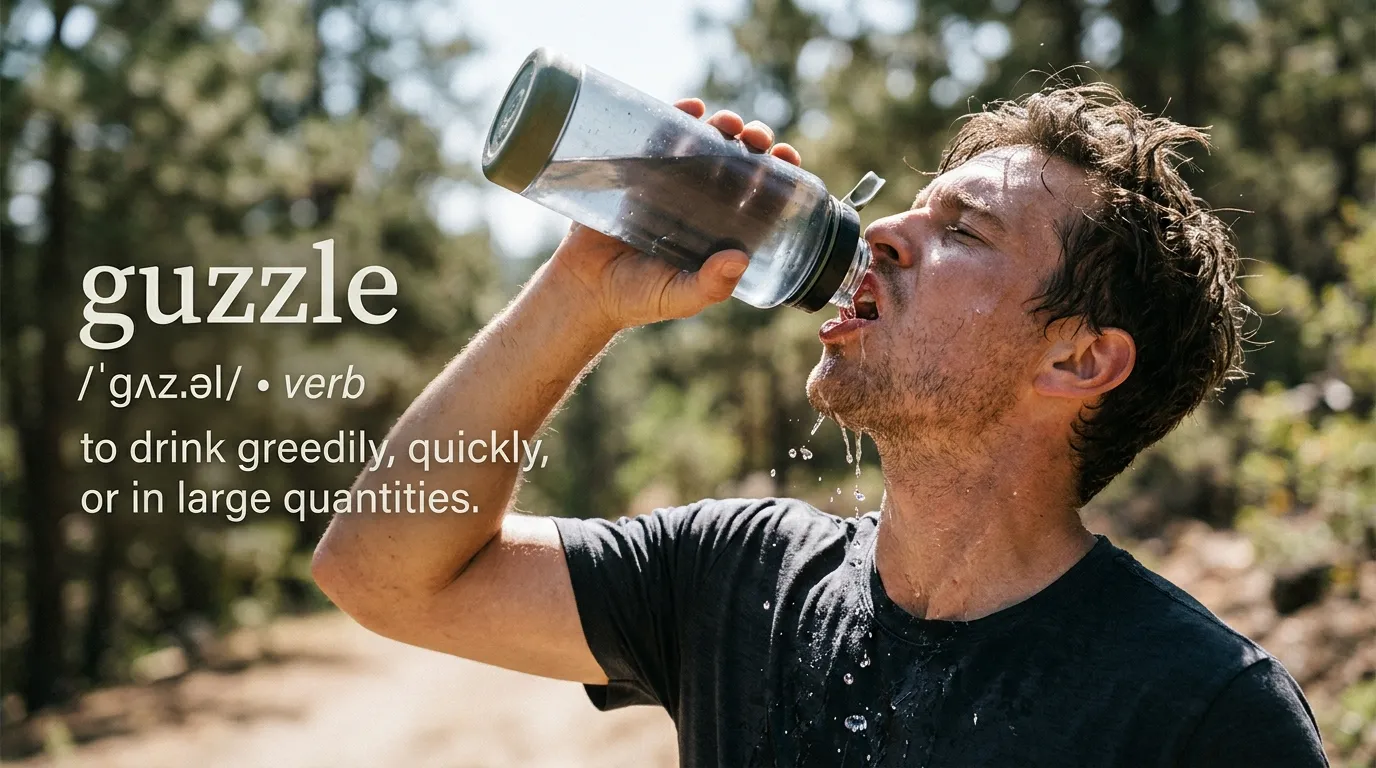
Have you ever seen someone finish a large glass of water in a few seconds? Or heard someone say that a car guzzles gas? The word guzzle describes these actions. It is a common English word that people use when they talk about eating, drinking, or using something in large amounts.
The guzzle meaning is to eat or drink something quickly and eagerly, often in large amounts. It can also describe something that uses too much fuel, water, or another resource. For example, you might say, “The thirsty boy guzzled his cold drink after the game.”
Guzzle is an informal verb. It often suggests that someone consumes more than they need or does so in a greedy way. However, its tone can change with the situation.
In this guide, you will learn the full meaning of guzzle, its pronunciation, word forms, synonyms, common uses, and simple examples. You will also learn how to use it in daily talks and writing without making common mistakes.
Quick Answer: What Does Guzzle Mean?
Guzzle means to eat or drink something quickly, eagerly, or in large amounts. It can also mean to use a lot of something, such as gas or fuel.
For example:
- She guzzled a bottle of cold water.
- The children guzzled their juice after playing.
- This old truck guzzles gas.
In simple words, guzzle means to consume something fast or in a large amount.
Guzzle Definition and Meaning in English
Guzzle is an informal verb. It describes the act of drinking or eating with great speed or eagerness. It often gives the idea that a person consumes more than usual.
For example, imagine a person who has spent hours outside on a hot day. When they get home, they drink a large glass of water in a few seconds. You can say that they guzzled the water.
The word does not always describe bad behavior. A person may guzzle water because they feel very thirsty. But when someone guzzles too much food or drink, the word can sound critical.
Guzzle also has a wider meaning. People use it when something consumes a large amount of a resource.
For example, “My old car guzzles fuel” means that the car uses a lot of fuel.
So, the meaning depends on the thing being consumed and the situation in which someone uses the word.
How Do You Pronounce Guzzle?
The word guzzle has two syllables.
- Pronunciation: /ˈɡʌz.əl/
- First sound: G, as in “go.”
- Stress: The first syllable.
- Word type: Verb.
- English level: Common everyday vocabulary.
Say the first part with more force than the second part.
The pronunciation stays the same in common forms such as guzzles, guzzled, and guzzling.
Is Guzzle a Verb or a Noun?
Guzzle is mainly a verb in modern everyday English. It describes an action, such as drinking a large amount of water or eating food very quickly.
Here are its main verb forms:
| Word form | Example |
| Base form: Guzzle | I guzzle water after exercise. |
| Third-person: Guzzles | He guzzles soda. |
| Past tense: Guzzled | She guzzled her drink. |
| -ing form: Guzzling | They are guzzling juice. |
| Past participle: Guzzled | He has guzzled two bottles. |
You may also find guzzle as a noun in older or less common uses. In some older texts, it refers to a drink, a drinking session, or a person who consumes too much.
However, if you are learning modern English, focus on its use as a verb.
Different Ways to Use Guzzle in Everyday English
Guzzle has more than one common use. You can use it in different situations, depending on what someone eats, drinks, or consumes.
1. Guzzle Means to Drink Quickly
This is the most common use of the word.
When someone drinks something very fast or in a large amount, you can say they guzzle it.
Examples:
- The boy guzzled his milk before school.
- I was so thirsty that I guzzled two glasses of water.
- They guzzled cold lemonade on a hot afternoon.
- He guzzled his drink and asked for more.
These examples show how people use guzzle in daily conversations.
2. Guzzle Means to Eat Quickly
Guzzle can also describe eating. It often suggests that someone eats a lot of food in a short time.
For example, imagine a child who finishes a large plate of food in just a few minutes. You might say, “The child guzzled his dinner.”
More examples:
- The hungry dog guzzled its food.
- He guzzled the snacks during the movie.
- The children guzzled their lunch after playing outside.
In this sense, guzzle is close to words such as gobble and wolf down.
3. Guzzle Means to Use Too Much Fuel
Guzzle does not only describe people and food. It can also describe machines and vehicles.
When a car uses a large amount of fuel, people often say that it guzzles gas.
For example:
“My old SUV guzzles gas.”
This means the vehicle uses more fuel than the speaker would like.
You may also hear the phrase gas guzzler. It describes a vehicle that uses a lot of gasoline.
For example:
- That large truck is a gas guzzler.
- I want a car that does not guzzle fuel.
- Older cars may use more gas than some newer models.
4. Guzzle Means to Consume a Large Amount of a Resource
People also use guzzle in a wider sense. It can describe anything that uses a large amount of a resource.
For example:
- This machine guzzles electricity.
- The factory guzzles water.
- Our old heater guzzles energy.
This use is often figurative. It compares the use of a resource to the act of drinking something quickly.
Guzzle in a Sentence: 15 Simple Examples
The best way to learn a new word is to see it in real sentences. Here are 15 simple examples of guzzle in different situations.
- The thirsty runner guzzled a bottle of water.
- My brother guzzles soda every day.
- The dog guzzled its food in seconds.
- She guzzled her juice after school.
- The children guzzled cold drinks at the party.
- He guzzled his coffee before leaving home.
- The old truck guzzles too much diesel.
- Our car guzzles gas on long trips.
- The hungry boy guzzled his dinner.
- They guzzled water after the football match.
- That machine guzzles electricity.
- The puppy guzzled milk from its bowl.
- We watched him guzzle a large glass of lemonade.
- This old heater guzzles energy.
- The kids guzzled their drinks during the picnic.
Notice how the word describes fast or heavy consumption in each sentence.
Guzzle Synonyms: Words With Similar Meanings
Synonyms are words that have similar meanings. Learning them can help you understand guzzle and use better words in different situations.
Here are some useful synonyms:
- Gulp: To swallow something quickly, often in one large mouthful.
- Chug: To drink something quickly, often in large amounts.
- Swig: To take a large drink from a bottle or container.
- Swill: To drink a large amount, often in a rough or greedy way.
- Gobble: To eat food quickly and eagerly.
- Devour: To eat something with great hunger or speed.
- Wolf down: To eat food very quickly.
- Consume: To eat, drink, or use something.
- Suck down: To drink something quickly through a straw or directly.
- Slam: An informal term for drinking something quickly.
These words are not always interchangeable. For example, gobble usually relates to eating, while swig mainly relates to drinking.
Guzzle can describe both eating and drinking. It can also describe the heavy use of resources such as fuel and electricity.
Guzzle vs. Gulp vs. Gobble: What Is the Difference?
Guzzle, gulp, and gobble have similar meanings, but they do not always work in the same way.
| Word | Main meaning | Example |
| Guzzle | Eat or drink quickly or in large amounts | He guzzled the water. |
| Gulp | Swallow quickly, often in one large mouthful | She gulped down the juice. |
| Gobble | Eat food quickly and eagerly | The child gobbled his lunch. |
Choosing the right word makes your sentence clearer.
What Is the Difference Between Guzzle and Drink?
Drink is a neutral word. It simply means to take liquid into your body.
Guzzle has a stronger meaning. It suggests that someone drinks quickly, eagerly, or in a large amount.
Compare these sentences:
- “He drank a glass of water.” This gives no clear idea of his speed.
- “He guzzled a glass of water.” This suggests that he drank it quickly or eagerly.
The same difference applies to eating.
“She ate her lunch” sounds neutral, while “She guzzled her lunch” suggests fast or heavy eating.
Use drink when you want a simple description. Use guzzle when you want to show speed, eagerness, or a large amount.
Is Guzzle a Positive or Negative Word?
Guzzle is usually informal and can sound slightly negative or critical.
For example:
“He guzzles soda all day.”
This sentence may suggest that he drinks too much soda.
However, guzzle does not always carry a negative meaning. Context matters.
For example:
“The tired runner guzzled some water after the race.”
Here, the word simply shows that the runner was very thirsty.
When people describe a vehicle as a gas guzzler, they usually mean that it uses too much fuel. This is often a complaint.
Therefore, guzzle can sound playful, casual, or critical, depending on how you use it.
Common Mistakes to Avoid When Using Guzzle
Many English learners understand the basic meaning but still make small mistakes when using the word.
Here are some common mistakes and their correct forms.
| Common mistake | Correct use |
| He guzzle water. | He guzzles water. |
| She guzzling juice. | She is guzzling juice. |
| They guzzleds milk. | They guzzled milk. |
| My car guzzle gas. | My car guzzles gas. |
| He is guzzled water. | He is guzzling water. |
Remember these simple grammar rules:
- Add -s when the subject is he, she, or it in the present simple.
- Add -ed to form the regular past tense.
- Add -ing when you describe an action happening now.
- Use a helping verb such as is, am, or are before the -ing form.
You can use these rules to make clear and natural sentences.
Quick Reference: How to Use Guzzle Correctly
Use this table to review the meaning and common uses of guzzle.
| Situation | Meaning | Example |
| Drinking | Drink quickly or eagerly | She guzzled water. |
| Eating | Eat quickly or in large amounts | He guzzled his food. |
| Fuel use | Use a lot of fuel | This car guzzles gas. |
| Electricity | Use a lot of power | The machine guzzles electricity. |
| Past action | Something consumed quickly | They guzzled their drinks. |
| Ongoing action | Someone is consuming quickly | He is guzzling soda. |
Easy tip: Think of guzzle as consuming something fast, eagerly, or in large amounts.
What Is the Origin of the Word Guzzle?
Guzzle has been part of the English language since the late 16th century.
Its exact origin is not fully certain. One common theory links it to the Old French word gosillier, which relates to the throat or the act of passing something through the throat.
Another theory suggests that the word may imitate the sound of someone drinking eagerly.
Over time, its meaning grew beyond drinking. People began using it for eating large amounts of food and, later, for consuming resources such as fuel.
Today, the word remains common in informal English, especially in everyday speech and discussions about vehicles.
When Should You Use Guzzle?
You can use guzzle when you want to show that someone or something consumes a large amount quickly or eagerly.
Here are a few useful tips:
- Use it in casual conversations with friends and family.
- Use it to describe someone drinking quickly.
- Use it when someone eats food very fast.
- Use it to describe a vehicle that uses too much fuel.
- Use it in informal writing when the context supports it.
Avoid using guzzle in formal writing when a neutral word such as consume or use would be more suitable.
For example, in a formal report, “The machine consumes large amounts of electricity” may sound better than “The machine guzzles electricity.”
Choose the word that fits your audience and tone.
FAQs:
1. What does guzzle mean in simple words?
Guzzle means to eat or drink something quickly, eagerly, or in a large amount. It can also mean to use too much of a resource, such as fuel or electricity. For example, “He guzzled a bottle of water.”
2. Is guzzle a slang word?
Guzzle is an informal English word, but it is not simply internet slang. People have used it for centuries. It appears in everyday speech and informal writing to describe fast or heavy eating, drinking, or consumption.
3. What does guzzling mean?
Guzzling is the -ing form of guzzle. It describes someone who is eating or drinking quickly or in large amounts. For example, “The children are guzzling cold drinks.”
4. What is the past tense of guzzle?
The past tense of guzzle is guzzled. It is a regular verb, so you add -ed to form its past tense. For example, “She guzzled her juice after the game.”
5. What is another word for guzzle?
Some common synonyms include gulp, chug, swig, swill, gobble, devour, and wolf down. The best choice depends on the sentence. For example, gobble mainly describes eating, while swig describes taking a large drink.
6. What does gas guzzler mean?
A gas guzzler is a vehicle that uses a large amount of gasoline compared with other vehicles. People often use this phrase when they want to complain about a car’s high fuel use.
7. Can you use guzzle for food and drinks?
Yes. You can use guzzle for both food and drinks. For example, “He guzzled his milk” describes drinking, while “The hungry dog guzzled its food” describes eating. You can also use it for heavy resource use.
Conclusion:
The guzzle meaning is simple: to eat or drink quickly, eagerly, or in large amounts. It can also describe something that uses too much fuel, electricity, or another resource.
For example, a thirsty person may guzzle water, while an old car may guzzle gas. The word is informal and often carries a playful or critical tone.
Remember the difference between guzzle, gulp, and gobble. This will help you choose the right word in daily conversations. Try making a few sentences with guzzle to improve your English vocabulary and use the word with confidence.

Hello, I am Daniel Brooks a passionate writer and educator with a deep love for language and creative expression. My work on similiezmeta.com focuses on helping kids and students explore the beauty of words through playful examples and practical explanations.


