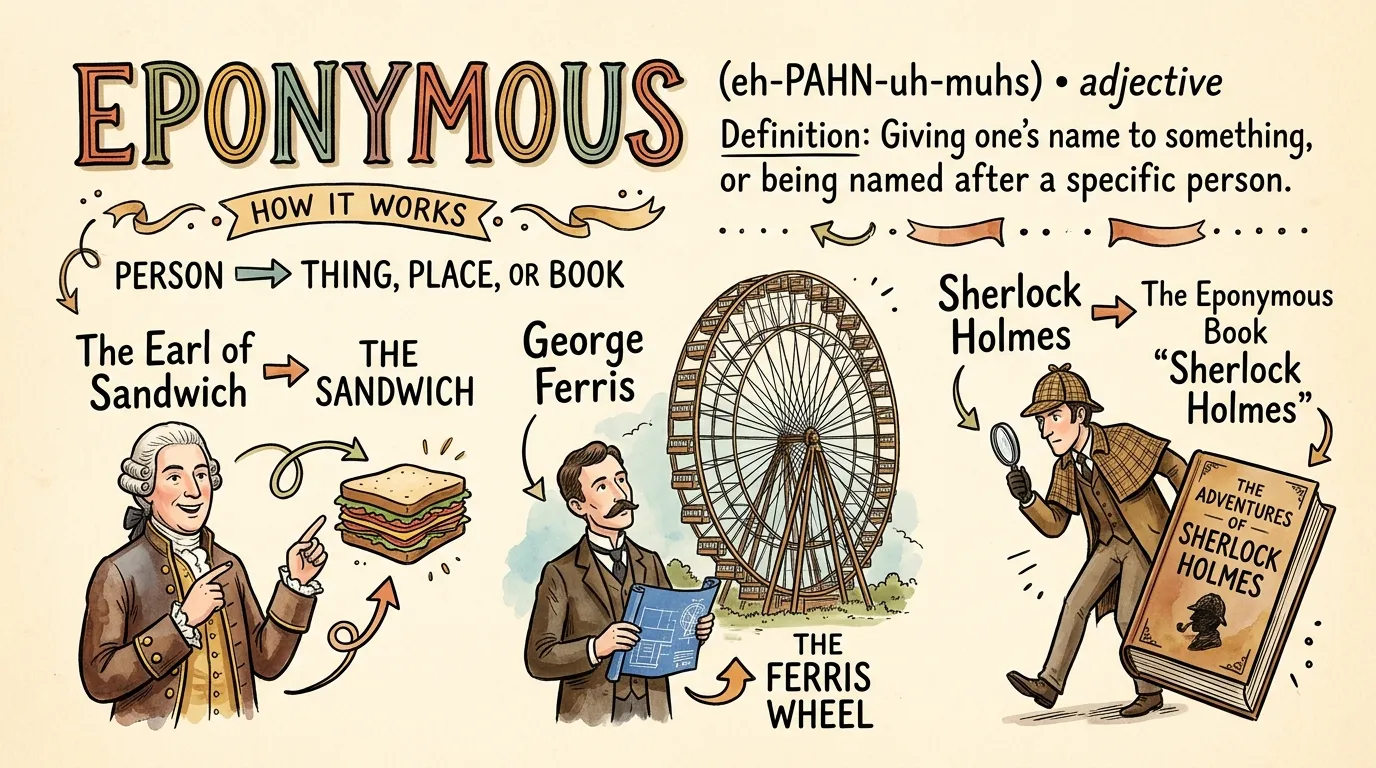
Have you ever watched a TV show named after its main character? Or heard about a book, song, or company that shares its name with its creator? There is a special word for this: eponymous.
The eponymous meaning can seem hard to understand at first. But the idea is quite simple. It describes a person, character, or thing that gives its name to something else, or something that takes its name from that person or character.
You may see this word in book reviews, music articles, films, history, and everyday writing. For example, when an album has the same name as its singer or band, people often call it an eponymous album.
In this guide, you will learn what eponymous means, where the word comes from, and how to use it in real sentences. You will also see common examples, similar words, and mistakes to avoid. By the end, you will know when this word fits and when a simpler word works better.
Quick Answer
Eponymous means having the same name as the person, character, or thing that the name comes from.
For example, if a singer releases an album with the same name as the singer, it is an eponymous album. The word can also describe a person or character who gives their name to a place, product, book, or other thing.
Definition & Meaning of Eponymous
The word eponymous is an adjective. It describes a link between a name and the person, character, or thing connected to that name.
In simple terms, something is eponymous when it shares a name with the person or character behind it.
Consider this example:
- A writer named Emma creates a book called Emma.
- The book shares the writer’s name.
- You can describe the book as eponymous.
There is one important detail: the word can work in both directions. It may describe the person who gives a name or the thing that receives that name. The context tells readers which meaning applies.
For example, an eponymous hero gives their name to a story. An eponymous story takes its name from its hero.
Origin and History of the Word Eponymous
The word eponymous has roots in ancient Greek. It comes from the Greek word eponymos, which means giving a name or being named after someone.
The word has two main parts:
- Epi: A Greek element that can mean upon or after.
- Onoma: A Greek word that means name.
The English word eponymous appeared in the 19th century. Eponymous and its related noun, eponym, became useful terms for talking about people, places, and things linked by names.
Etymology, Origin & Meaning+1
Today, writers use it in many fields. You may find it in music reviews, book reports, history lessons, and business news.
For example, a company may take its founder’s name. A book may take its name from its main character. Both cases can involve eponymous naming.
How to Pronounce Eponymous
The word may look hard to say, but it becomes easier when you break it into parts.
The American English pronunciation is:
ih-PON-uh-muhs
The stress falls on the second syllable.
Do not confuse its spelling with eponym. Both words share the same root, but they have different roles in a sentence.
What Is an Eponym?
An eponym is a person, place, or thing whose name becomes the name of something else. The word can also refer to the name that comes from that source.
For example, the word sandwich is linked to John Montagu, the 4th Earl of Sandwich. His title became part of the name used for the food.
Here is another way to understand the difference:
- Eponym: The name-giving source or the name based on it.
- Eponymous: An adjective that describes the naming link.
Think of the words this way: eponym is a noun, while eponymous is an adjective.
This small difference can help you use both words with care.
Eponymous Meaning in Books and Literature
Books offer some of the clearest examples of eponymous characters. A character is eponymous when the book takes its title from that character’s name.
For example, Jane Eyre tells the story of a character named Jane Eyre. Jane is the eponymous character because her name appears in the title.
Another example is Oliver Twist. Oliver is the main character, and the book takes its name from him.
You may also hear the phrase eponymous hero or eponymous heroine.
These phrases describe the main character whose name appears in the title.
Here are a few more examples:
- Emma : the title character gives the novel its name.
- Robinson Crusoe : the main character shares his name with the book.
- Jane Eyre : Jane is the eponymous heroine.
- Oliver Twist : Oliver is the eponymous character.
One useful point: the character does not always need to be the only person in the title. The key is the link between the character and the title.
Eponymous Meaning in Music and Albums
Music is another place where you will often see this word.
An eponymous album has the same name as the artist or band behind it. This is common with first albums, but artists can use the same naming style at any point in their careers.
For example, a band called Silver Roads releases an album called Silver Roads. You can call it an eponymous album.
The same idea applies to a singer who uses their own name as an album title.
Why do artists choose this name?
- It can introduce a new band or singer.
- It can show the artist’s identity.
- It can mark a fresh start.
- It can help listeners connect the album with its creator.
However, not every album named after a song or character is eponymous. The title must have a clear naming link to the artist, band, or relevant person.
Eponymous Meaning in Movies and TV Shows
Movies and TV shows also use names to build a link with their main characters.
Imagine a TV show called Mia. The story follows a girl named Mia. In this case, Mia is the eponymous character.
The word can also describe the show itself if it takes its name from its central character.
For example, a writer may say:
“The eponymous hero drives the story from start to finish.”
This tells readers that the hero shares a name with the title.
You may also see the term in movie reviews, film studies, and entertainment news.
It helps writers explain the connection between a title and the person at the center of a story.
Eponymous Examples in Everyday Life
You do not need to read novels or study music to understand this word. It also appears in business, food, history, and science.
Here are some simple examples:
- A fashion brand: A designer starts a clothing brand under their own name. The brand is eponymous.
- A restaurant: A chef opens a restaurant named after them. The restaurant has an eponymous name.
- A book: An author writes a novel named after its main character. That character is eponymous.
- A company: A founder gives their name to a business. The business is named after its founder.
- A place: A town or city receives its name from a person. That person may be its eponym.
- A song: A singer releases a song with their own name as its title. The song may be described as eponymous.
Remember that these are examples of naming patterns. The word works best when you can clearly identify who or what gives the name.
Eponymous vs. Eponym vs. Namesake
These three words are related, but they do not have the same job.
An eponymous is an adjective. An eponym is a noun. A namesake is a person or thing that shares a name with another person or thing.
| Word | Meaning | Example |
| Eponymous | Gives or takes a name | An eponymous album |
| Eponym | A name-giving source or related name | A person whose name is given to a place |
| Namesake | Someone or something that shares another’s name | A child named after a grandparent |
| Titular | Named in the title or holding the title | The titular hero of a film |
Easy way to remember:
- Use eponym when talking about the name or its source.
- Use eponymous when describing the naming link.
- Use namesake when two people or things share a name.
- Use titular when talking about a person or thing named in a title.
The words may overlap in some cases, but they are not always interchangeable.
Eponymous vs. Titular: What Is the Difference?
The words eponymous and titular can both describe a character linked to a book, film, or play title.
However, they focus on slightly different ideas.
Eponymous points to a name shared by the title and its character or another source. Titular means that someone or something is named in the title.
For example:
- “Jane is the eponymous heroine of the novel.”
- “Jane is the titular heroine of the novel.”
Both sentences can work when Jane’s name appears in the title.
But titular has other uses too. It can describe someone who holds a title without having real power or duties.
This is why the words do not always mean the same thing. Check the sentence before you replace one with the other.
How to Use Eponymous in a Sentence
The easiest way to learn a new word is to use it in simple sentences.
Since eponymous is an adjective, it usually comes before a noun.
Here are 10 examples:
- The singer released an eponymous album.
- Jane is the eponymous heroine of the novel.
- The band became famous after its eponymous debut album.
- The film follows its eponymous hero.
- The company launched an eponymous clothing line.
- The writer named her eponymous character after her mother.
- The restaurant carries the chef’s eponymous name.
- The TV show follows the life of its eponymous character.
- The artist’s eponymous collection received strong reviews.
- The book explores the life of its eponymous figure.
Notice how the word helps explain a name connection without using a long description.
Common Mistakes When Using Eponymous
Many people understand the basic meaning but still use the word in the wrong way.
Here are common mistakes and better ways to avoid them.
| Common mistake | Correct use |
| Using eponymous as a noun | Use eponym as a noun |
| Calling every named object eponymous | Check if it shares a name with its source |
| Using it to mean famous | Use famous or well-known instead |
| Confusing it with namesake | Check whether you mean a naming source or shared name |
| Using it without a clear link | Explain who or what gives the name |
| Using titular and eponymous in every case as exact matches | Check the meaning and context |
A common mistake is using eponymous to mean famous or popular.
For example, “She is an eponymous singer” does not clearly say that she is famous. It needs a clear naming link.
A better sentence would be:
“She released an eponymous album.”
This tells readers that the album shares her name.
Another mistake is using the noun and adjective in the wrong place. Remember that you can say “the eponym of the city,” but you should say “the eponymous city.”
When Should You Use the Word Eponymous?
This word works best when you want to explain how a name connects to a person, character, or creator.
You may use it in:
- Academic writing: When you discuss people who give their names to places or ideas.
- Book reviews: When a main character shares the book’s title.
- Music reviews: When an album shares the artist’s or band’s name.
- Business articles: When a company uses its founder’s name.
- Film reviews: When a movie takes its name from its main character.
- History lessons: When you explain how a person gave their name to a place or group.
However, you do not need to use this word in every sentence.
If your readers may not know it, use simple words such as named after or shares its name with. Clear writing matters more than using complex words.
Quick Reference Checklist for Eponymous
Before using this word, check these points:
- Am I describing a person, place, book, film, or other thing?
- Is there a clear link between the name and its source?
- Does the person or character give their name to something?
- Does the person or character share a name with a title?
- Am I using eponymous as an adjective?
- Would a simpler phrase make my sentence easier to read?
If your sentence passes these checks, you are more likely to use the word correctly.
Synonyms and Related Words for Eponymous
Some words have a meaning close to eponymous. However, each word has its own use.
Here are some useful alternatives:
- Namesake: A person or thing named after another.
- Titular: A person or thing named in a title.
- Named after: A simple phrase that explains a naming link.
- Derived from: Something that comes from a name or source.
- Name-bearing: Something that carries a particular name.
- Associated with: Something linked to a person or thing.
For everyday writing, named after is often the clearest choice.
For example:
“The company was named after its founder.”
This sentence is easier to understand than:
“The company is eponymous.”
Both may describe the same naming link, but the first gives readers more direct information.
FAQs:
1. What does eponymous mean in simple words?
Eponymous means having the same name as the person, character, or thing connected to that name. For example, a band that releases an album under its own name has an eponymous album. The word can also describe the person who gives their name to something else.
2. What is an example of an eponymous character?
Jane Eyre is an example of an eponymous character. She is the main character in Charlotte Brontë’s novel Jane Eyre. Her name also appears in the book’s title. This makes her the eponymous heroine of the story.
3. What is an eponymous album?
An eponymous album is an album that has the same name as its singer, artist, or band. For example, if a band called Blue Stars releases an album titled Blue Stars, that album is eponymous. Artists often use this style for their first albums.
4. What is the difference between eponym and eponymous?
An eponym is a noun. It refers to a person, place, or name connected to something named after it. Eponymous is an adjective that describes this naming link. For example, a founder can be the eponym of a company, while the company is eponymous.
5. Is eponymous the same as namesake?
No. These words are related, but their meanings differ. An eponym is a name-giving source or the related name. A namesake is someone or something that shares a name with another. The correct word depends on what you want to describe.
6. Is eponymous a positive or negative word?
Eponymous is a neutral word. It does not show praise, dislike, or any strong feeling. It only explains a connection between a name and its source. You can use it in positive, negative, or neutral sentences.
7. What is the opposite of eponymous?
There is no widely accepted direct opposite of eponymous. The word describes a naming link, so its opposite depends on the sentence. You can use phrases such as not named after, unrelated in name, or having a different name when they fit the context.
Conclusion:
The eponymous meaning is simple once you understand the link between a name and its source. It describes a person or thing that gives its name to something, or something that takes its name from that person or character. You will often find this word in books, music, films, history, and business.
Remember the difference between eponym, eponymous, and namesake to avoid common mistakes.
When you write, choose clear words and use eponymous only when it fits. Keep practicing with simple sentences, and this once-tricky word will soon feel easy to use.

Hi, I’m Christopher Hayes. I’m interested in the words and expressions people use to share their thoughts, feelings, and experiences. I especially enjoy exploring idioms, everyday phrases, similes, and figurative language.
At SimiliezMeta.com, I help readers understand the meanings behind common expressions through simple explanations and relatable examples. I aim to explain not only what a phrase means but also how and when people use it naturally.


