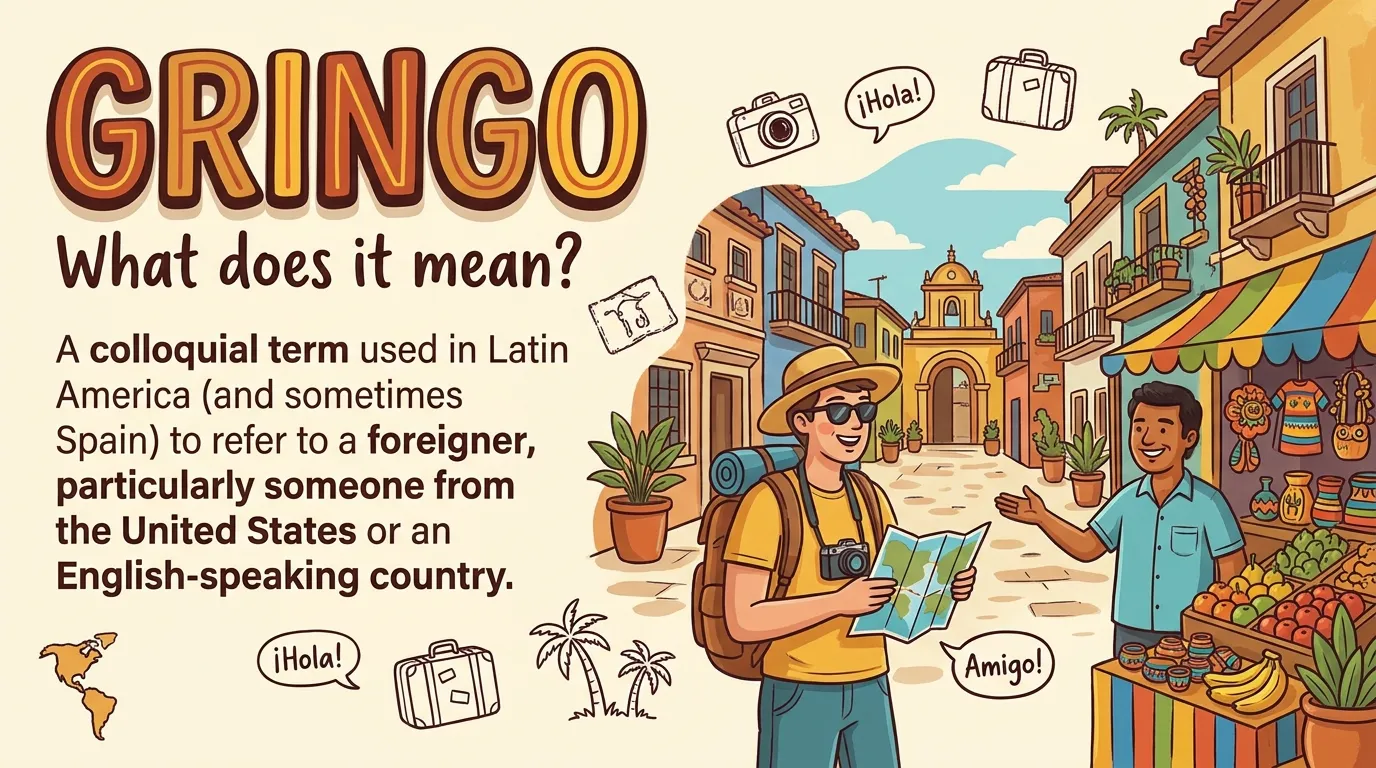
Have you ever heard someone say gringo in a Spanish movie, song, or real-life chat? You may have wondered what the word means. Is it a friendly name for an American? Is it an insult? Or does it simply describe someone from another country?
The word gringo has a few shades of meaning. In many Spanish-speaking places, people use it to describe a foreigner, often someone from the United States. However, its meaning can change with the country, speaker, and tone.
Understanding this word can help you follow Spanish conversations and avoid awkward moments when speaking with native speakers. It can also help you understand how people use it in movies, travel stories, music, and online chats.
In this guide, you will learn the gringo meaning in English, where the word comes from, who it describes, and when it may sound rude or friendly. You will also see simple examples and useful tips for using it with care.
Quick Answer
Gringo means a foreigner, especially a person from the United States, in many Spanish-speaking countries. People often use it for an American, but the exact meaning depends on the country and the situation. It can sound neutral, playful, or rude.
Definition & Meaning
The word gringo is a Spanish term for a foreign person. In common use, it often refers to someone from the United States or another English-speaking country.
For example, a person in Mexico may call an American visitor a gringo. In some places, the word may also describe people from other countries.
The term does not always carry a bad meaning. A speaker may use it in a casual talk or joke. But another speaker may use it to show anger, dislike, or a sense of distance.
So, you should not judge the word by itself. Pay attention to the speaker’s tone, the setting, and the way the person uses it.
How Is Gringo Used in Spanish-Speaking Countries?
The meaning of gringo can change from one place to another. It does not have one fixed meaning across all Spanish-speaking countries.
Here are some common ways people use it.
1. In Mexico
In Mexico, people often use gringo for someone from the United States. It may describe an American tourist, visitor, or person who lives in Mexico.
For example:
- “The gringos are visiting our town.”
- “My neighbor is a gringo from Texas.”
- “That restaurant is popular with gringos.”
The speaker may use the word in a simple way. However, it can also sound unfriendly in certain situations.
2. In Central America
In some Central American countries, people use gringo to describe Americans or other foreign visitors.
The word may appear in talks about travel, culture, money, or local life. Its tone depends on the speaker and the situation.
For example:
“Many gringos visit this beach during the summer.”
This sentence simply talks about foreign visitors. It does not clearly show anger or hate.
3. In South America
The word also appears in parts of South America. However, its meaning can be broader than just an American.
In some places, people may use it for a person who looks or sounds foreign. In Brazil, where people speak Portuguese, gringo also has a common meaning for a foreigner.
This is a useful point: the word is not limited to Spanish-speaking countries.
4. In Everyday Conversations
People may use gringo in jokes, casual talks, or comments about foreign visitors.
For example, someone may say:
“Look, the gringos are trying local food!”
The sentence may sound playful among friends. But the same word can sound disrespectful when a speaker uses it to mock or insult someone.
Important: Never assume that everyone feels the same way about this word. Local habits and personal views matter.
Is Gringo a Bad or Offensive Word?
The short answer is: it can be offensive, but it is not always an insult.
Some dictionaries label gringo as informal and disapproving. Cambridge also notes that the term can be offensive when used for people seen as outsiders.
The tone makes a big difference.
For example, consider these two situations:
- A local person calls a visiting American a gringo during a friendly joke.
- Someone shouts the word at a foreigner during an angry argument.
Both speakers use the same word, but their messages are very different.
You should also consider your relationship with the speaker. A close friend may use the term in a playful way. A stranger may use it to show that you do not belong.
When Can It Sound Friendly?
It may sound friendly or playful when:
- Friends use it while joking.
- Someone uses it in a relaxed conversation.
- The speaker does not show anger or disrespect.
- Both people understand the local meaning.
When Can It Sound Rude?
It may sound rude when:
- Someone uses it to mock a foreign accent.
- The speaker wants to make a person feel like an outsider.
- It appears in an angry or hostile comment.
- Someone uses it to judge a person based on nationality or background.
If you are unsure, choose a more respectful word, such as foreigner, visitor, or the person’s nationality.
Where Does the Word Gringo Come From?
The history of gringo is older than many people think.
The word comes from Spanish. Historical records show that it was used in Spain before the Mexican-American War of 1846–1848.
One early dictionary record dates to 1787. At that time, the word described foreigners who spoke Spanish with an unfamiliar accent. It could also refer to people whose speech was hard for locals to understand.
The Link Between Gringo and Griego
One common theory connects gringo with the Spanish word griego, which means “Greek.”
Think about the English phrase “It’s all Greek to me.” People use this phrase when they cannot understand something.
A similar idea may have shaped the older Spanish use of gringo. It could describe someone whose language sounded strange or hard to understand.
However, the exact word history is not fully settled. Some dictionaries present this link as a possible origin, not a proven fact.
Is Gringo From “Green Go”?
You may have heard a story that gringo came from the words “green go.”
According to this story, Mexican people used the phrase to tell American soldiers wearing green uniforms to leave during the Mexican-American War.
It is a popular story, but it is not supported by the historical record. The word existed before that war, so the story cannot explain its original creation.
Etymology, Origin & Meaning+2
This is why it is better to treat the “green go” story as a myth rather than a fact.
Gringo vs. Gringa: What Is the Difference?
Spanish uses different word endings for masculine and feminine forms.
- Gringo: The masculine form.
- Gringa: The feminine form.
Both words can describe a foreigner, often an American or English-speaking person, depending on local use.
Here are some simple examples:
- “He is a gringo.”
- “She is a gringa.”
- “They are gringos.”
The plural masculine form is gringos. The plural feminine form is gringas.
You may also hear gringos used for a mixed group of people of all genders in Spanish.
Remember that these forms do not change the basic meaning. The tone still depends on the person who says them.
How to Use Gringo in a Sentence
Understanding a word becomes easier when you see it in real sentences.
Here are some simple examples of gringo in everyday English and Spanish-related settings.
1. “The gringo asked for directions.”
- Meaning: A foreign visitor asked someone how to reach a place.
2. “A group of gringos arrived at the hotel.”
- Meaning: A group of foreign visitors came to the hotel.
3. “My friend is a gringo from New York.”
- Meaning: My friend is an American from New York.
4. “The locals call him a gringo.”
- Meaning: Local people describe him as a foreigner.
5. “That gringo speaks Spanish very well.”
- Meaning: That foreigner speaks Spanish well.
6. “The gringa ordered a cup of coffee.”
- Meaning: A foreign woman ordered coffee.
7. “Some gringos love Mexican food.”
- Meaning: Some American or foreign visitors enjoy Mexican food.
These examples explain common uses. They do not mean that every Spanish-speaking person would choose the word in the same situation.
Gringo vs. Foreigner vs. American
These three words may seem similar, but they do not mean exactly the same thing.
A foreigner is someone from another country. An American usually means a person from the United States in everyday US English. A gringo is an informal term used in some countries for a foreigner, often an American or English-speaking person.
| Word | Meaning | Common use |
| Gringo | A foreigner, often an American | Informal Spanish and Latin American use |
| Foreigner | Someone from another country | General and neutral English |
| American | A person from the United States, in common US usage | Nationality or identity |
| Tourist | Someone visiting a place | Travel and tourism |
| Expat | Someone living outside their home country | Work and long-term living |
Which Word Should You Use?
Use foreigner when you want a neutral and respectful word.
Use American when you know the person comes from the United States.
Common Mistakes People Make About Gringo
Many people learn the word from movies, social media, or stories about Mexico. This can lead to a few wrong ideas.
Here are some common mistakes and the correct facts.
| Common mistake | Correct explanation |
| Gringo always means American | It can describe other foreigners, too |
| Gringo always means an insult | It can be neutral, playful, or rude |
| Gringo came from “green go” | This popular story has no solid historical support |
| Only men can be gringos | The feminine form is gringa |
| Everyone in Latin America uses it the same way | Local meanings and habits can differ |
| Gringo means tourist | A foreigner may live in a country and still be called gringo |
The biggest mistake is thinking that the word has the same meaning everywhere. Always consider the local culture and the speaker’s tone.
How to Understand Gringo When You Hear It
If someone calls you a gringo, do not rush to think that the person is insulting you.
Use this simple checklist to understand the situation.
| What to check | What it can tell you |
| Speaker’s tone | A friendly tone may suggest a joke |
| Facial expression | A smile may show a relaxed mood |
| Place | Local meaning can change by country |
| Conversation | The topic may explain the word |
| Relationship | Friends may use it more casually |
| Situation | An argument may make it sound insulting |
For example, if someone smiles and says, “Hey, gringo!” while greeting a friend, it may be a casual nickname.
But if someone uses the same word while shouting during an argument, it may show disrespect.
If you feel unsure, you can calmly ask, “What do you mean by gringo?” This gives the other person a chance to explain.
How Do You Pronounce Gringo?
The word gringo has two syllables.
Its English pronunciation is:
GRING-go
The stress falls on the first syllable. The word sounds much like it looks when spoken in American English.
Cambridge lists the American pronunciation as /ˈɡrɪŋ.ɡoʊ/.
definition in the Cambridge English Dictionary
You can practice it slowly:
- First, say “gring.”
- Then say “go.”
- Join both parts into one smooth word.
The plural form, gringos, adds an “s” sound at the end.
Is Gringo Still Used Today?
Yes. People still use gringo in everyday speech, travel conversations, films, books, and online discussions.
You may hear it when people talk about:
- American visitors in Mexico.
- Foreign people living in Latin America.
- Language and cultural differences.
- Tourism and local communities.
- Foreign music, food, and habits.
The word also appears in English-language media. Writers sometimes use it to show a local point of view or make a story sound more natural.
However, its use does not mean that every local person likes the word. Some people may find it offensive, while others may use it without any negative intent.
The safest approach is to understand the word before using it.
Quick Reference: Gringo Meaning at a Glance
Use this table when you need a fast reminder.
| Feature | Quick answer |
| Word | Gringo |
| Language | Spanish |
| Part of speech | Noun; also used as an adjective in Spanish |
| Main meaning | Foreigner |
| Common reference | American or English-speaking person |
| Feminine form | Gringa |
| Masculine plural | Gringos |
| Feminine plural | Gringas |
| Tone | Neutral, playful, or offensive |
| Best neutral alternative | Foreigner |
FAQs:
1. What does gringo mean in English?
Gringo means a foreigner, especially someone from the United States or an English-speaking country. People use it in many Spanish-speaking countries. Its tone can be friendly, neutral, or rude, depending on the speaker and situation.
2. Is gringo a bad word in Spanish?
Not always. Some people use it as a casual name for an American or foreign visitor. Others may use it as an insult. The tone, local culture, and relationship between speakers help decide whether it sounds offensive.
3. Does gringo mean white person?
Not exactly. The main meaning is a foreigner, often an American or English-speaking person. Some local uses may connect the word with appearance, but race is not its basic dictionary meaning. It is not correct to treat every white person as a gringo.
4. What is the female version of gringo?
The female version is gringa. Spanish speakers may use it for a foreign woman, often an American woman. For example, “She is a gringa” means that she is a female foreigner in that local context.
5. Why do Mexicans call Americans gringos?
In Mexico, gringo is a common informal term for Americans. It may reflect nationality, language, or a person’s foreign background. However, the word existed in Spanish before the Mexican-American War, so the popular “green go” story is not its true origin.
6. What is the plural of gringo?
The usual masculine plural is gringos. The feminine plural is gringas. For example, “The gringos are visiting Mexico” refers to a group of foreign people. Spanish also uses the masculine plural for mixed groups in many cases.
7. Is gringo used only in Mexico?
No. People use the word in many parts of Latin America. It also appears in Brazil, where Portuguese is the main language. However, its exact meaning and tone can differ from one country to another.
Conclusion:
The word gringo means a foreigner, often an American or English-speaking person. It comes from Spanish and has a long history that goes back before the Mexican-American War. Its meaning can change with the country, speaker, and situation.
Remember that gringo is not always an insult, but it can sound offensive. The best way to understand it is to pay attention to the tone and local culture. If you want to speak politely, use words like foreigner, visitor, or American instead.
Now that you understand the gringo meaning, you can recognize it more easily in Spanish conversations, movies, and everyday life.

Hi, I’m Nathan Foster. I’m passionate about words, their meanings, and the different ways we use them in everyday communication. I enjoy explaining unfamiliar words in simple English so readers can understand them without confusion.
At SimiliezMeta.com, I focus on word meanings, definitions, synonyms, antonyms, and useful examples that show how words work in real sentences. I believe learning a new word should be simple, practical, and helpful for everyday life.


