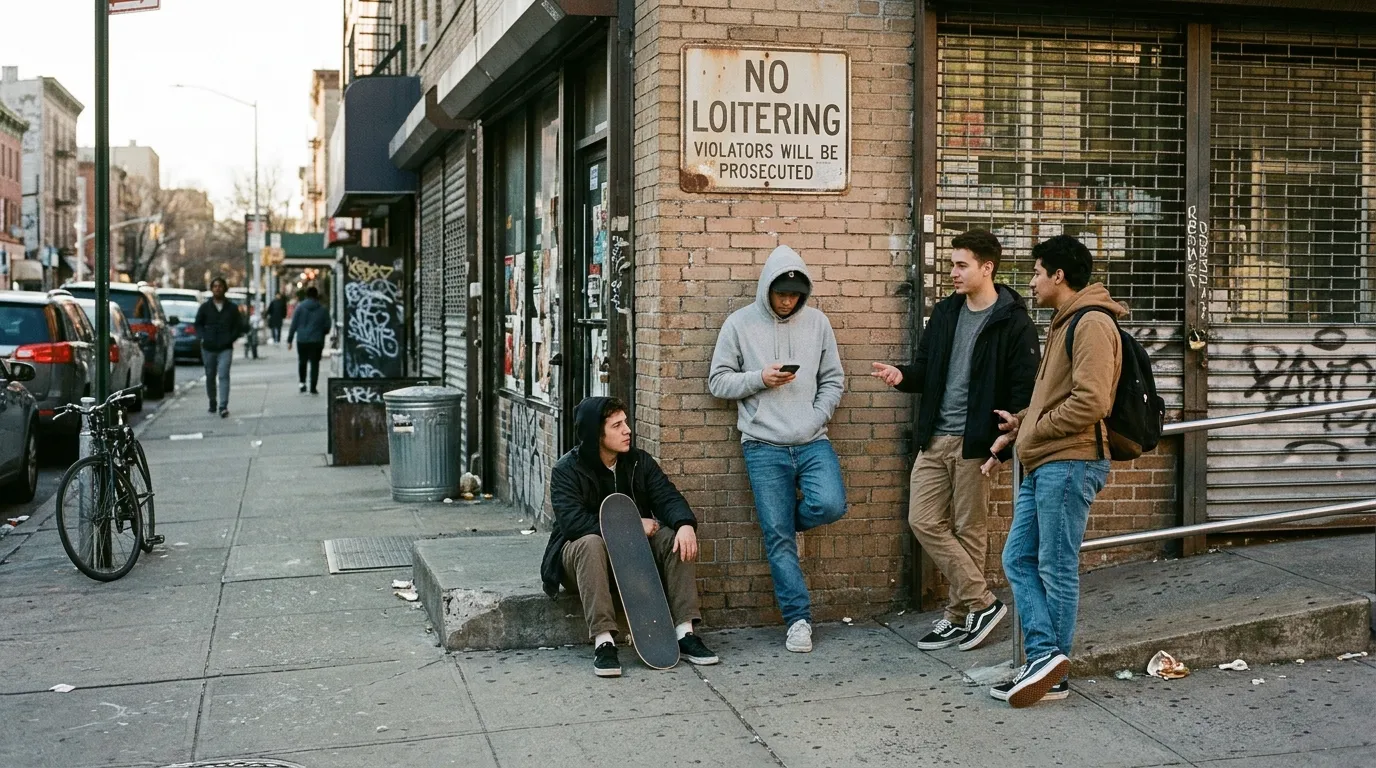
Have you ever heard someone say, “Stop loitering around the entrance”? You may have wondered what that person meant. The word loitering often comes up in daily talks, school rules, public places, and even legal cases.
The loitering meaning is staying in a place for a long time without a clear reason or purpose. For example, a person who stands outside a store for an hour without shopping may appear to be loitering.
However, the word does not always describe bad behavior. People can wait, talk, or spend time in public places without doing anything wrong. The meaning often depends on the place, the situation, and local rules.
In this guide, you will learn what loitering means, how to use it in a sentence, where people commonly use the word, and how it differs from trespassing and loitering laws. You will also find simple examples, synonyms, and answers to common questions.
Quick Answer
Loitering means staying or spending time in a place without a clear purpose, especially when you remain there longer than expected.
Example: A person standing outside a shopping mall for several hours without shopping may be described as loitering.
Loitering Meaning and Definition
Loitering is the act of staying in one place for longer than needed, often without a clear reason for being there.
It usually refers to someone who hangs around a public or private area without taking part in a clear activity.
For example:
- A person stands outside a store for hours.
- A group hangs around a school entrance after classes.
- Someone walks around a parking lot without a clear reason.
- A person stays near a building entrance without visiting anyone.
In simple words, loitering means hanging around a place without an obvious purpose.
The word can have a negative tone. People may use it when they feel someone is staying somewhere without permission or causing concern.
However, simply waiting or standing in a public place does not always mean someone is breaking a rule or law.
How Is Loitering Used in Everyday Life?
People use the word loitering in many daily situations. It often describes someone who stays somewhere without doing anything clear.
Here are some common situations.
1. Loitering Outside a Store
Imagine someone standing outside a grocery store for a long time. They do not enter the store or meet anyone.
A shop owner may ask why the person is loitering near the entrance.
2. Loitering Around a School
A person who stays near a school gate without a clear reason may attract attention.
Schools may have rules about visitors who remain on school grounds without permission.
3. Loitering in a Parking Lot
Someone who walks around a parking lot for a long time without parking or visiting a business may look like they are loitering.
However, waiting for a friend or looking for a car is not automatically wrong.
4. Loitering in a Public Park
A person may sit on a park bench for hours, read a book, or enjoy the fresh air.
Some people may call this loitering. But spending time in a public park for rest or fun is not automatically a problem.
5. Loitering Near a Building
Someone who stands near an office entrance without visiting anyone may be asked to move.
The building may have rules about visitors and public access.
These examples show that context matters. A person can stay in one place for a long time without doing anything illegal.
Loitering Meaning in Different Contexts
The word loitering can have different meanings based on how people use it.
In everyday English: It means hanging around without a clear purpose.
In public places: It can describe staying near a shop, school, park, or building for a long time.
At work: It can mean wasting time instead of doing a task.
In school: It may describe students who stay in hallways or near school entrances when they should be somewhere else.
In law: It can describe conduct that meets the exact rules of a local or state law.
The legal meaning is important because not every act of waiting or standing around is a crime. The law may look at the person’s actions, location, purpose, and other facts.
Is Loitering Illegal in the United States?
Loitering is not automatically illegal everywhere in the United States.
The rules depend on the state, city, and type of place. Some laws focus on certain actions or situations. Others deal with behavior near specific places, such as schools or transport areas.
For example, Florida has a law about loitering or prowling when a person’s time, place, or behavior creates reasonable concern for the safety of people or property. New York also has laws that cover certain forms of loitering linked to specific conduct.
LII / Legal Information Institute+1
There is also an important legal issue: a law must explain what behavior it bans. A rule that gives police too much freedom to decide who looks suspicious may face a constitutional challenge.
In City of Chicago v. Morales (1999), the U.S. Supreme Court struck down Chicago’s gang-loitering law because it did not clearly explain what conduct was forbidden.
So, keep these points in mind:
- Standing in a public place is not always illegal.
- Waiting for a friend is not automatically a crime.
- Local rules may restrict access to private property.
- Some laws target specific conduct, not simply the act of standing around.
- The exact law and facts matter.
If you face a legal warning or charge, check the law in your area or speak with a qualified lawyer. This article gives general information, not legal advice.
Loitering vs. Trespassing: What Is the Difference?
People sometimes confuse loitering with trespassing. Both words can describe problems involving a person’s presence in a place, but they do not mean the same thing.
Loitering usually means staying somewhere without a clear purpose. Trespassing means entering or remaining on property without legal permission.
For example, a person may stand on a public sidewalk without trespassing. But entering a private building after the owner tells them to leave may involve trespassing.
Here is a simple comparison:
| Loitering | Trespassing |
| Staying in a place without a clear purpose | Entering or remaining without permission |
| Can happen in public areas | Usually involves property rights |
| May be restricted by specific local laws | Depends on property access and applicable law |
| Does not always involve illegal behavior | Can involve unauthorized entry or remaining |
| Example: Hanging around a store entrance | Example: Entering a closed private building without permission |
Remember: Loitering and trespassing are different legal ideas. A person can loiter without trespassing, and a person can trespass without loitering.
Loitering vs. Lingering vs. Wandering
These three words have similar meanings, but people use them in different ways.
- Loitering: Staying somewhere without a clear purpose.
- Lingering: Staying longer than expected or taking extra time before leaving.
- Wandering: Moving around without a fixed direction or destination.
For example, a person who stays outside a shop for a long time may be loitering.
A guest who stays after a party ends may be lingering.
A tourist who walks through a city without a planned route may be wandering.
The main difference is that loitering often suggests idle behavior, while lingering focuses on staying longer and wandering focuses on movement.
15 Simple Sentences Using Loitering
Learning through examples can help you understand how to use a new word.
Here are 15 simple sentences with loitering:
- The security guard asked the man to stop loitering outside the store.
- The students were warned against loitering near the school gate.
- We saw a group of people loitering near the parking lot.
- The shop owner does not allow loitering near the entrance.
- The police officer asked why the group was loitering there.
- Stop loitering and come inside.
- The sign warned visitors against loitering in the hallway.
- Some people were loitering near the bus station.
- The manager noticed two workers loitering during office hours.
- The children were loitering around the playground after school.
- The guard told visitors that loitering was not allowed in the private area.
- The man was accused of loitering near the closed building.
- The group left after being asked to stop loitering.
- The store placed a sign to discourage loitering.
- The teacher asked students not to loiter in the corridor.
These sentences show that loitering often appears in situations involving public spaces, workplaces, schools, and private property.
Common Synonyms of Loitering
Synonyms are words that have the same or nearly the same meaning.
You can use these words to describe someone who stays somewhere without a clear purpose.
| Synonym | Simple Meaning | Example |
| Lingering | Staying longer | He was lingering near the door. |
| Hanging around | Staying in a place | They were hanging around outside. |
| Idling | Spending time without work | He was idling at the station. |
| Lurking | Staying hidden or nearby | Someone was lurking near the gate. |
| Dawdling | Moving or acting too slowly | Stop dawdling and get ready. |
| Loafing | Spending time doing little | He was loafing around all day. |
| Sauntering | Walking in a relaxed way | She was sauntering through the park. |
| Milling around | Moving or standing in a group | People were milling around the entrance. |
Not every synonym works in every sentence. For example, lurking can suggest secrecy or suspicious behavior, while lingering can sound neutral.
Opposite Words of Loitering
An opposite word has a different or reverse meaning.
Here are some useful opposites of loitering:
- Leaving: Moving away from a place.
- Departing: Going away from somewhere.
- Proceeding: Moving forward with an activity.
- Working: Doing a task or job.
- Hurrying: Moving quickly.
- Continuing: Moving ahead with an action.
For example:
- Loitering: He was loitering outside the office.
- Leaving: He was leaving the office.
- Loitering: The workers were hanging around.
- Working: The workers were completing their tasks.
These words can help you understand the meaning of loitering more clearly.
What Does No Loitering Mean?
You may have seen a sign that says “No Loitering” outside a shop, school, parking area, or private building.
It means people should not stay or hang around in that area without a permitted reason.
The property owner or manager may use this sign to keep entrances clear, manage visitors, or protect private areas.
For example, a sign outside a store may say:
“No Loitering. Please Keep the Entrance Clear.”
This message asks people not to stand around the entrance in a way that blocks access.
However, a sign does not mean every person who stops nearby has committed a crime. The property rules and local laws still matter.
Loitering Meaning in a Workplace
In a workplace, loitering often means spending time without doing your assigned work.
For example, an employee may stand near the break room for a long time instead of returning to work.
A manager may say:
“Please stop loitering and return to your duties.”
Here, the word does not always have a legal meaning. It simply describes wasting time or delaying work.
A person who takes an approved break is not automatically loitering in a negative sense. The workplace rules and reason for staying matter.
What Is the Difference Between Loitering and Hanging Around?
The phrases loitering and hanging around are close in meaning.
However, hanging around is more casual. People often use it when talking with friends or family.
Loitering can sound more formal or negative, especially when someone stays near a place without a clear reason.
For example:
- “We were hanging around at the mall.” This sounds like a normal social activity.
- “The men were loitering outside the closed store.” This may suggest that their presence raised concern.
Both phrases can describe staying in one place, but the tone changes how the listener understands the situation.
Quick Reference: How to Understand Loitering
Use this table to remember the main points about the word.
| What to Check | Meaning or Example |
| Main meaning | Staying somewhere without a clear purpose |
| Word type | Noun or verb form |
| Base verb | Loiter |
| Similar word | Lingering |
| Casual phrase | Hanging around |
| Common place | Store, school, park, or street |
| Legal meaning | Depends on the exact law |
| Common sign | No Loitering |
| Example | He was loitering near the entrance. |
| Important point | Waiting is not always illegal. |
FAQs:
1. What does loitering mean in simple words?
Loitering means staying in one place for a long time without a clear reason or purpose. For example, standing outside a shop for hours without shopping may be called loitering.
2. Does loitering mean trespassing?
No. Loitering and trespassing have different meanings. Loitering means hanging around without a clear purpose. Trespassing means entering or staying on property without permission. A person can loiter in a public place without trespassing.
3. Is loitering a crime?
Loitering is not always a crime. The rules depend on local and state laws. Some laws cover specific behavior, locations, or circumstances. Simply standing in a public place does not automatically mean someone has broken the law.
4. What does no loitering mean?
“No loitering” means people should not hang around in a particular area without a permitted reason. Shops and private buildings often use these signs to keep entrances clear and control access.
5. What is another word for loitering?
Some common synonyms include lingering, idling, hanging around, loafing, dawdling, and milling around. The best word depends on the situation and tone.
6. What is an example of loitering?
A person stands outside a closed store for several hours without shopping or meeting anyone. Someone may describe this behavior as loitering. However, the situation alone does not prove that the person has done anything illegal.
7. What is the difference between loitering and lingering?
Loitering usually means staying somewhere without a clear purpose. Lingering means staying longer than expected or taking extra time before leaving. Lingering often sounds more neutral than loitering.
Conclusion:
The loitering meaning is simple: it means staying or hanging around a place without a clear purpose. People often use this word when talking about stores, schools, streets, parking lots, and public spaces.
However, loitering does not always mean someone is doing something wrong. Its legal meaning depends on local laws and the facts of each situation.
Remember the difference between loitering, lingering, and trespassing. These words may seem similar, but they have different meanings.
If you see a “No Loitering” sign, check the area rules and respect the property owner’s instructions. Understanding these simple points will help you use the word correctly in everyday conversations.

Hi, I’m Nathan Foster. I’m passionate about words, their meanings, and the different ways we use them in everyday communication. I enjoy explaining unfamiliar words in simple English so readers can understand them without confusion.
At SimiliezMeta.com, I focus on word meanings, definitions, synonyms, antonyms, and useful examples that show how words work in real sentences. I believe learning a new word should be simple, practical, and helpful for everyday life.


