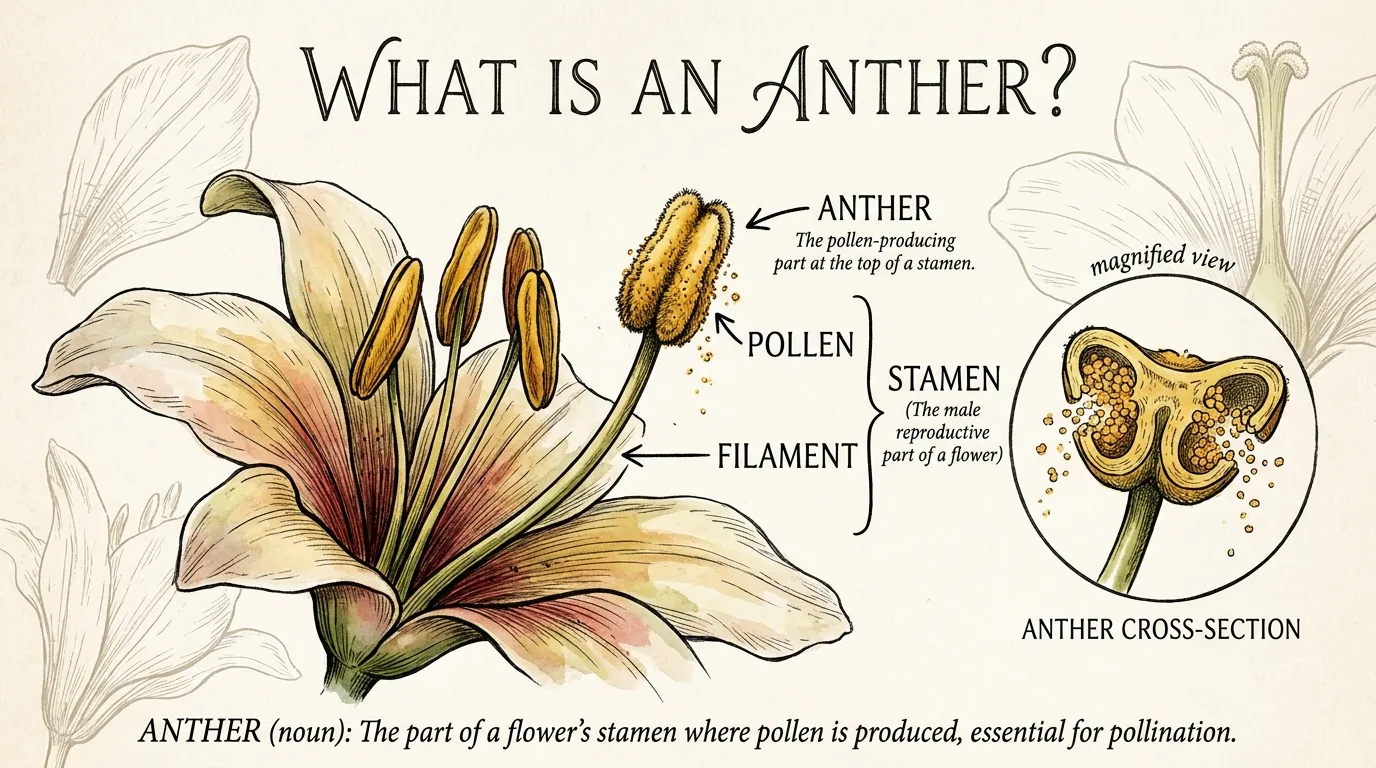
Have you ever looked closely at a flower and noticed tiny yellow grains on its center? Those grains play an important role in how many plants reproduce. The small part that produces and holds pollen is called the anther.
The word anther is a basic term in botany, the study of plants. You may see it in a science textbook, a biology lesson, or a guide to flower parts. Knowing what it means can help you understand how flowers make seeds and how pollen moves from one flower to another.
In simple terms, anther meaning refers to the pollen-bearing part of a flower’s stamen. It helps a plant reproduce by making pollen, which carries the male reproductive cells or their precursors, depending on the plant.
In this guide, you will learn what an anther is, where to find it, how it works, and how it differs from other flower parts. You will also see clear examples, a quick reference table, and answers to common questions.
Quick Answer: What Does Anther Mean?
An anther is the part of a flower’s stamen that produces and releases pollen. Pollen helps flowering plants reproduce. The anther usually sits at the tip of a thin stalk called the filament.
For example, if you look at a lily and see small structures covered with yellow or orange powder, you may be looking at its anthers.
Anther Definition and Meaning in Botany
The scientific definition of an anther is the pollen-bearing part of a stamen. A stamen is one of the main reproductive structures in a flower.
Anthers often look like small sacs or oval shapes. Their color can vary. Many appear yellow, but others may be white, brown, purple, or another color.
The main job of an anther is to develop pollen and release it when it is ready. Pollen can then reach the female reproductive part of a flower, called the stigma. This process helps lead to fertilization and seed formation.
The exact shape and structure of anthers vary among plant species. So, not every flower has an anther that looks the same.
Where Is the Anther Located in a Flower?
You can usually find the anther near the center of a flower. It sits at the top of the stamen, often on a narrow stalk.
To find it, look for these two parts:
- Filament: The thin stalk that supports the anther.
- Anther: The structure at the top that produces and releases pollen.
Together, the filament and anther form a stamen.
Some flowers have several stamens, so you may see several anthers in one flower. In other flowers, the structures may be arranged in a way that makes them harder to spot.
If you examine a fresh flower closely, use a magnifying glass to look for small pollen-bearing structures around the center. Avoid rubbing your eyes after handling pollen, especially if you have pollen allergies.
What Is the Function of an Anther?
The main function of an anther is to produce and release pollen. Pollen plays a key role in the reproduction of flowering plants.
Here is how the process works:
1. The Anther Develops Pollen
Inside the developing anther, special cells form pollen grains. As the anther matures, these grains develop and become ready for release.
2. The Anther Releases Pollen
When the pollen is mature, the anther opens or releases the grains through a structure in its wall. The exact method varies by plant species.
3. Pollen Moves to a Stigma
Wind, insects, birds, or other pollinators may carry pollen to a flower’s stigma. Some plants can also transfer pollen within the same flower or between flowers on the same plant.
4. Fertilization May Occur
If compatible pollen reaches the stigma, it can grow a pollen tube through the flower’s female tissue toward an ovule. A male reproductive cell then takes part in fertilization.
After fertilization, the ovule can develop into a seed. In flowering plants, the ovary often develops into a fruit.
An anther does not make seeds directly. It supplies pollen, which helps start the process that can lead to seed formation.
Anther and Stamen: What Is the Difference?
People sometimes use anther and stamen as if they mean the same thing. However, they refer to different parts of a flower.
A stamen is the complete male reproductive structure. It usually consists of an anther and a filament.
An anther is only the pollen-bearing part of that structure.
Think of the stamen as a unit with two main parts. The filament acts as the stalk, while the anther sits at the top and produces pollen.
For example, if a biology question asks you to name the part that holds pollen, the answer is usually anther. If it asks you to name the whole male reproductive structure, the answer is stamen.
Anther vs. Stigma: Key Differences
The anther and stigma have different roles in flower reproduction.
The anther belongs to the stamen and produces pollen. The stigma belongs to the female reproductive structure, called the pistil or carpel, and receives pollen.
Many stigmas have a sticky surface that helps capture pollen grains. After compatible pollen lands there, it may germinate and begin growing a pollen tube.
Remember this simple rule: the anther releases pollen, while the stigma receives it.
The two parts work together in the plant’s reproductive process, but they do not perform the same job.
What Does an Anther Look Like?
Anthers come in many shapes, sizes, and colors. Their appearance depends on the type of plant.
Common features include:
- A small, oval, or elongated shape.
- A position near the tip of a filament.
- Pollen inside or on the surface after release.
- A color that may be yellow, orange, purple, brown, white, or another shade.
A lily may have long anthers that stand out from the center of the flower. A grass flower may have small anthers that hang from delicate structures. Other flowers may hide their anthers inside the petals.
Do not rely on color alone to identify an anther. Look at its position and function instead.
Examples of Anthers in Common Flowers
You can learn about anthers by looking at familiar plants.
Lily
Lilies often have prominent stamens. Their anthers may be long and dark orange or brownish, with pollen that can leave visible stains on clothing.
Hibiscus
A hibiscus flower has a noticeable central structure with many stamens joined along part of a column. Its anthers produce pollen that can be transferred during pollination.
Sunflower
A sunflower head contains many small flowers grouped together. Each tiny flower has its own reproductive structures, so the flower head is more complex than it first appears.
Tulip
Tulips usually have six stamens. Each stamen carries an anther that produces pollen.
Grass
Grass flowers often have small, less showy reproductive structures. In many grasses, exposed anthers help release pollen into the air.
These examples show why anthers do not all look alike. Their form and placement often relate to how a plant transfers pollen.
What Is the Origin of the Word Anther?
The word anther has roots in older botanical and classical language. It entered English through French or New Latin forms connected to the Greek word anthos, meaning “flower.” The related Greek form carried the sense of something flowery or blooming.
The botanical meaning developed around the pollen-bearing part of a flower’s stamen.
This origin can help you remember the term: anther relates to flowers, while its scientific meaning points to the part that bears pollen.
Although the word has a long history, its modern botanical meaning is clear and specific.
Common Mistakes When Learning Anther Meaning
Flower anatomy can seem confusing at first. These are some mistakes worth avoiding.
| Common mistake | Correct understanding |
| Calling the whole stamen an anther | The anther is one part of the stamen. |
| Saying the anther receives pollen | The anther produces and releases pollen; the stigma receives it. |
| Saying the anther makes seeds | Pollen from the anther helps fertilization occur, which can lead to seed formation. |
| Assuming all anthers are yellow | Anthers vary in color, size, and shape. |
| Thinking every flower has the same arrangement | Flower structures differ across plant species. |
Use these differences to check your understanding when studying plant biology.
Anther Meaning: Quick Reference Table
Use this table to review the key facts at a glance.
| Feature | Quick answer |
| Word type | Noun |
| Main field | Botany |
| Definition | Pollen-bearing part of a stamen |
| Location | Usually at the tip of a filament |
| Main function | Produces and releases pollen |
| Related structure | Stamen |
| Female structure that receives pollen | Stigma |
| Role in reproduction | Supplies pollen for pollination |
| Plural form | Anthers |
| Example sentence | The anther released pollen as the flower matured. |
How to Identify an Anther: A Simple Checklist
If you need to identify an anther for homework, a lab, or a garden project, follow these steps.
- Find the flower’s center. Look among the petals for its reproductive structures.
- Look for thin stalks. These may be the filaments that support the anthers.
- Check the tips of the stalks. Look for small sacs or oval structures.
- Look for pollen. Mature anthers may carry visible grains or powder.
- Compare the parts. The anther sits on the filament, while the stigma belongs to the female reproductive structure.
- Use a plant guide if needed. Some flowers have unusual structures, so a clear species guide can help.
Do not pull apart a rare or protected flower just to identify its parts. A fallen flower or a common garden flower can be a better choice for close study.
Why Is the Anther Important to Plant Reproduction?
Without functional pollen-producing structures, many flowering plants cannot reproduce through their usual sexual process. The anther helps supply the pollen needed for fertilization.
This process also matters beyond the flower itself. Pollination supports the reproduction of many plants that form fruits and seeds. Those plants provide food and habitat for people, wildlife, and other living things.
However, anthers are only one part of a larger system. Successful reproduction also depends on factors such as pollen viability, the stigma, compatible plant structures, and suitable conditions.
The role of an anther is simple to state, but it forms an important step in the life cycle of flowering plants.
FAQs:
1. What does anther mean in simple words?
An anther is the part of a flower that produces and releases pollen. It usually sits at the tip of a thin stalk called the filament. Pollen helps flowering plants reproduce.
2. What is the main function of an anther?
Its main function is to develop and release pollen. When compatible pollen reaches a stigma, it may lead to fertilization and seed formation.
3. Is an anther the same as a stamen?
No. A stamen is the whole male reproductive structure, which usually includes an anther and a filament. The anther is the part that bears pollen.
4. What is the difference between anther and stigma?
The anther produces and releases pollen. The stigma receives pollen on the female reproductive structure of a flower. Both play different roles in reproduction.
5. What color is an anther?
Anthers can be yellow, orange, purple, brown, white, or other colors. Their color depends on the plant. Yellow is common, but it is not a rule for every flower.
6. Does an anther produce seeds?
No. An anther produces pollen, not seeds. After successful pollination and fertilization, an ovule can develop into a seed.
7. Where can I find an anther in a flower?
You can usually find an anther near the center of a flower, at the tip of a filament. Look for a small structure that bears pollen. A magnifying glass can help you see it clearly.
Conclusion:
The meaning of anther is simple: it is the pollen-bearing part of a flower’s stamen. It produces and releases pollen, which helps flowering plants reproduce. The anther usually sits at the tip of a filament, while the stigma receives pollen on the female reproductive structure.
To remember the difference, think of the anther as the pollen source and the stigma as the pollen receiver. Look closely at a common flower, such as a lily or tulip, to see these parts in action.
Understanding the anther makes flower anatomy easier to learn and helps explain how pollination can lead to seeds and new plants. Use the quick reference table and checklist to review the key facts whenever you need them.

Hi, I’m Nathan Foster. I’m passionate about words, their meanings, and the different ways we use them in everyday communication. I enjoy explaining unfamiliar words in simple English so readers can understand them without confusion.
At SimiliezMeta.com, I focus on word meanings, definitions, synonyms, antonyms, and useful examples that show how words work in real sentences. I believe learning a new word should be simple, practical, and helpful for everyday life.


