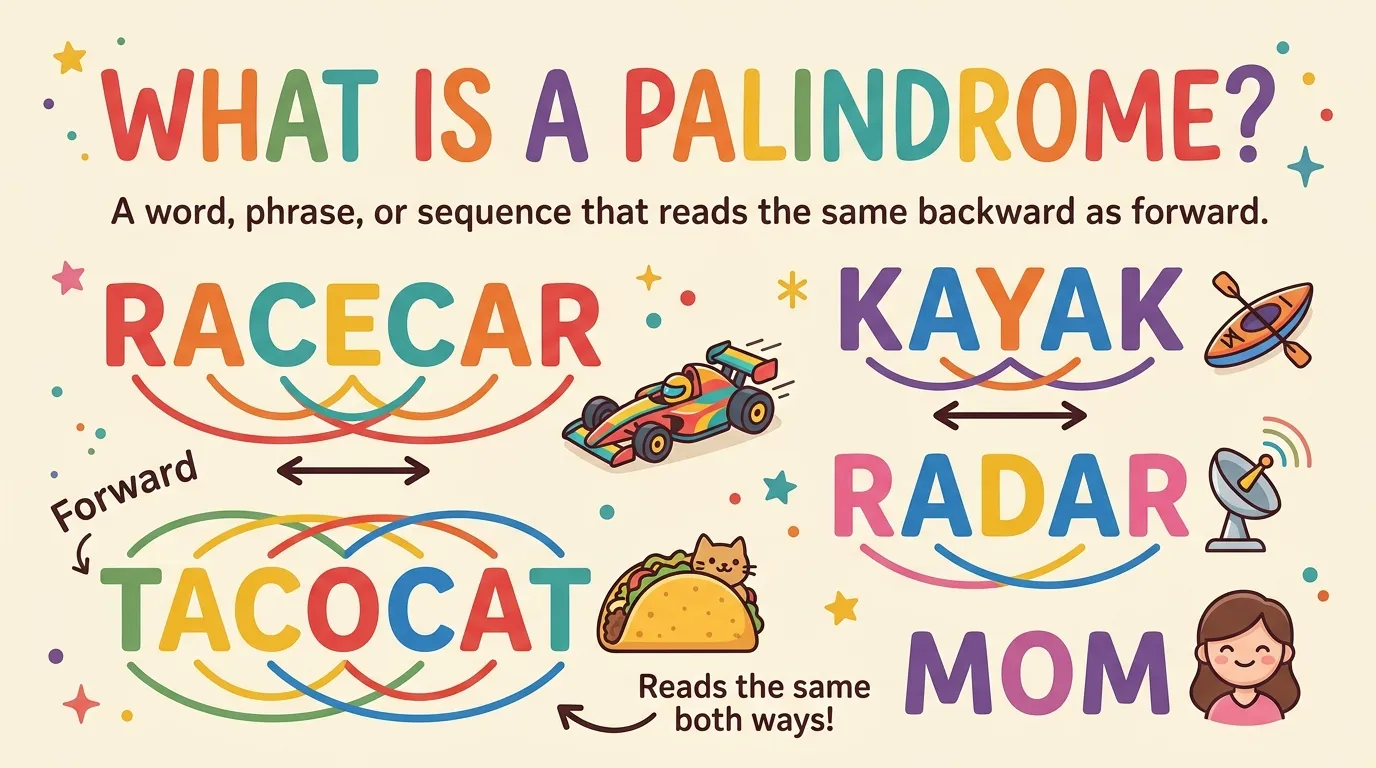
Have you ever seen a word that looks exactly the same when you read it from left to right or right to left? Words such as level, radar, and civic do this. They are called palindromes.
The palindrome meaning is simple: a palindrome is a word, phrase, number, or other sequence that stays the same when you reverse it, usually after ignoring spaces, punctuation, and letter case when dealing with phrases.
Palindromes can appear in English, math, names, dates, puzzles, and creative writing. They may look like a small language trick, but they also teach useful ideas about patterns, symmetry, and how we read text.
In this guide, you will learn what a palindrome means, how to identify one, see clear palindrome examples, understand palindrome numbers, avoid common mistakes, and learn where palindromes appear in real life.
Quick Answer
Palindrome meaning: A palindrome is a word, phrase, number, or sequence that reads the same forward and backward.
For example, level is a palindrome because reversing it gives level again. The same idea works with numbers such as 121 and phrases such as “Never odd or even,” when spaces and punctuation are ignored.
Definition & Meaning
A palindrome is a sequence that remains unchanged when its order is reversed.
The word can describe more than just a word. You can have a palindromic word, phrase, sentence, number, or sequence.
For a single word, the test is very easy. Take the word and reverse its letters.
- level → level
- radar → radar
- civic → civic
- refer → refer
Because the reversed forms match the original forms, these are palindromic words.
The same rule applies to numbers. For example:
- 121 → 121
- 1331 → 1331
- 1221 → 1221
Wolfram MathWorld defines a palindromic number as a number that stays the same when written forward and backward.
For longer phrases, people normally ignore spaces, punctuation, and capitalization when checking the pattern. That lets a phrase such as “Never odd or even” qualify as a palindrome.
The key idea is always the same: the sequence matches its reverse.
How to Identify a Palindrome
You do not need a special tool to find a palindrome. You can check one by hand in a few seconds.
Start with the first and last characters. If they match, move inward and compare the second character with the second-to-last character.
Continue until you reach the middle.
Take “radar” as an example:
- First letter: r
- Last letter: r
- Second letter: a
- Second-to-last letter: a
- Middle letter: d
Every matching pair confirms the pattern.
You can also reverse the whole word. If the reversed version matches the original, you have a palindrome.
This simple test works well for short words and numbers. For a long phrase, first remove spaces and punctuation and use the same comparison.
Palindrome Examples
Simple examples make the palindrome meaning much easier to understand.
Common Palindromic Words
Here are several familiar examples:
- level
- radar
- civic
- madam
- refer
- rotor
- kayak
- racecar
- tenet
- deified
Each word has the same sequence of letters in both directions.
Some palindromes are especially easy to notice because they have a clear center. For example, level has l-e-v-e-l. The letters on both sides mirror each other around v.
Palindromic Numbers
Numbers can also form palindromes.
Examples include:
- 11
- 22
- 101
- 121
- 131
- 1221
- 1331
- 12321
A number such as 12321 reads the same in either direction.
Palindromic numbers do not need to contain only repeated digits. 12321 shows why. The digits move toward the center and then mirror back out.
MathWorld lists numbers such as 11, 22, 99, 101, and 121 among the early palindromic numbers.
Palindrome Sentences and Phrases
Longer palindromes can use complete phrases.
One famous example is:
“Never odd or even.”
If you remove the spaces and punctuation and ignore capitalization, the remaining letters form the same sequence in reverse.
Phrase palindromes require more care than single words. You must decide which characters count before testing the phrase.
That is why different palindrome tools may use slightly different rules. A strict character-by-character test may treat spaces and punctuation as part of the sequence, while a normal language-based test usually ignores them.
Palindromic Words vs. Palindromic Phrases
The basic idea stays the same, but the checking method changes.
A palindromic word uses letters within one word. For example, civic works without changing anything.
A palindromic phrase uses several words. You usually ignore spaces, punctuation, and capitalization before checking it.
This difference matters when you test a phrase with a computer or online tool. You need to know whether the tool removes spaces and punctuation before it checks the characters.
Comparison Table
| Type | Example | How to Check | Common Mistake |
| Word | level | Reverse the letters | Checking only the first few letters |
| Number | 121 | Reverse the digits | Treating 12021 as a palindrome without checking |
| Phrase | Never odd or even | Ignore spaces and punctuation | Counting spaces as letters |
| Sentence | A full palindromic sentence | Normalize the text first | Ignoring punctuation rules |
| Sequence | A custom character sequence | Compare each position | Assuming visual symmetry is enough |
How Palindrome Numbers Work
A palindrome number stays the same when its digits are reversed.
Consider 1221.
Reverse the digits:
1221 → 1221
The result does not change, so 1221 is palindromic.
Now consider 1234:
1234 → 4321
The result changes, so 1234 is not a palindrome.
The same rule can work in number systems other than base 10. MathWorld describes palindromic numbers in terms of a number’s representation in a given base.
This point is useful because a number does not have to look palindromic in every possible number system. The property depends on how the number is written.
What Is the Difference Between a Palindrome and Symmetry?
Palindromes and symmetry share a similar idea, but they are not exactly the same.
A palindrome deals with the order of a sequence. If you reverse the sequence and it stays the same, it is palindromic.
Symmetry is a broader idea. It can describe shapes, images, designs, sounds, patterns, and other structures.
For example, a butterfly may have visual symmetry because its two sides look similar. A word such as radar has sequence symmetry because its letters match when reversed.
So, you can think of a palindrome as a special type of pattern based on reversal.
Palindromes in Language and Literature
Writers have used palindromes as wordplay for a long time. They can add humor, surprise, or a puzzle-like quality to writing.
A short palindrome can work as a memorable phrase. Longer palindromes can challenge a writer because every character must fit the reverse pattern.
Palindromes also appear in names, titles, poetry, puzzles, and experimental writing.
The challenge becomes much harder as the text grows. A writer must create a meaningful sentence while also maintaining the reverse sequence.
That makes a strong palindrome more than a random collection of matching letters. It must satisfy two goals:
- The text should make sense.
- The normalized text should read the same backward.
This is why good palindromes often feel clever.
Are Palindromes Always Exact?
Not always in the same practical sense.
For a single word such as level, the letters match exactly in reverse order.
For a phrase, readers usually apply a normalization rule. They may:
- Ignore capital letters.
- Remove spaces.
- Ignore punctuation.
- Compare letters only.
For example, the phrase “Never odd or even” becomes a continuous sequence of letters before the reverse test.
This distinction is important if you use a programming language or palindrome checker. The program needs clear rules about which characters to keep.
Common Palindrome Mistakes
Palindromes seem simple, but people often make small errors when checking them.
One common mistake is checking only the beginning and end. Matching the first and last letters is not enough. Every matching pair must pass the test.
Another mistake is confusing visual appearance with letter order. A word may look balanced but fail when you reverse its letters.
A third mistake happens with phrases. People may forget to remove spaces or punctuation before checking.
Numbers can cause similar confusion. A number such as 12021 is not a palindrome because its reverse is 12021 actually, this one is a palindrome. The important lesson is to reverse the full number instead of judging it by appearance.
Actionable Quick-Reference Table
| Step | What to Do | Example |
| 1 | Write the word, phrase, or number | 1221 |
| 2 | Decide what to ignore | Nothing for a number |
| 3 | Reverse the sequence | 1221 |
| 4 | Compare both forms | 1221 = 1221 |
| 5 | Confirm the result | It is a palindrome |
| 6 | For phrases, state your rules | Ignore spaces and punctuation |
How to Create Your Own Palindrome
Creating a short palindrome is easier than creating a full sentence.
Start with a short sequence that has a clear center.
For example:
level
The center is v, and the letters on each side mirror each other.
You can build another pattern by choosing letters on one side and reflecting them on the other.
For a five-letter structure:
A-B-C-B-A
For a seven-letter structure:
A-B-C-D-C-B-A
You can then replace the letters with real words or characters.
When you create a phrase palindrome, start with the reverse structure first. This helps you avoid writing a normal sentence and trying to force it into palindrome form later.
Keep the sentence short. Meaningful long palindromes are much harder to create.
Why Are Palindromes Interesting?
Palindromes are interesting because they combine language with pattern recognition.
They give readers a small puzzle. You can understand the words normally, then discover that the whole sequence also works backward.
They also help people notice how text is structured. Students can use simple palindromes to practice spelling, sequencing, and pattern recognition.
In mathematics and computer science, palindromes offer simple examples of reversal and string comparison.
For programmers, checking whether a string equals its reverse is also a basic exercise in handling text.
The concept stays simple, but it connects language, math, logic, and computing.
Palindromic Primes
A palindromic number can have another property too.
If a palindromic number is also a prime number, it is called a palindromic prime.
Examples include:
- 2
- 3
- 5
- 7
- 11
- 101
- 131
- 151
MathWorld identifies these as early examples of palindromic primes.
This shows how one mathematical property can overlap with another. A number can be both prime and palindromic.
It is also worth noting that not every palindrome has to be mathematically special. Most simple palindromes are simply interesting because of their structure.
Palindromes and the Number 196
One famous topic in recreational mathematics involves the number 196.
A common process called the reverse-then-add method takes a number, reverses its digits, adds the two numbers, and repeats the process.
For example, the sequence can eventually produce a palindrome for many starting numbers.
The case of 196 is famous because it has not been shown to produce a palindrome through the usual reverse-and-add process. The numbers associated with this problem are often called possible Lychrel numbers, although the exact status involves an open mathematical question rather than a simple proven fact.
This is a good example of how a simple palindrome idea can lead to deeper mathematical questions.
Quick Rules to Remember
If you only need the basic palindrome meaning, remember these rules:
- A palindrome matches its reverse.
- It can be a word, phrase, number, or sequence.
- Single-word palindromes usually need no special cleanup.
- Phrase tests often ignore spaces, punctuation, and capitalization.
- Every position must match its opposite position.
- A palindromic number reads the same backward and forward.
- A palindromic prime is both palindromic and prime.
The easiest test is still the best one: reverse it and compare it with the original.
FAQs:
What does palindrome mean in simple words?
Palindrome means something that reads the same forward and backward. The term can describe a word, phrase, number, or sequence. Examples include level, radar, and 121.
What is an example of a palindrome?
Level is a simple palindrome. When you reverse the letters, you still get level. Other examples include radar, civic, madam, and racecar.
What is a palindrome number?
A palindrome number is a number that remains the same when its digits are reversed. Examples include 11, 121, 1331, and 1221. The concept can also apply to numbers written in other bases.
Is every word that looks symmetrical a palindrome?
No. A word must have the same character sequence after reversal. Visual balance alone does not make a word a palindrome.
What is the longest palindrome?
There is no single useful answer to “the longest palindrome” because people can create palindromic sequences of many lengths. The answer also depends on whether you mean a word, phrase, sentence, number, or another type of sequence.
Can a phrase be a palindrome?
Yes. A phrase can be palindromic when its letters match in reverse after applying a stated rule, such as ignoring spaces, punctuation, and capitalization. “Never odd or even” is a well-known example.
Why are palindromes important?
Palindromes are useful for learning about patterns, language, numbers, and reversal. They also appear in puzzles, creative writing, mathematics, and programming. Their value comes from the simple rule that makes them easy to understand but sometimes difficult to create.
Conclusion:
The palindrome meaning is simple: a palindrome is a word, phrase, number, or sequence that stays the same when read backward.
Words such as level and radar make the idea easy to see. Numbers such as 121 and 1221 follow the same basic rule.
When checking a phrase, remember to decide which characters count. Most phrase palindromes ignore spaces, punctuation, and letter case.
If you want to find a palindrome yourself, reverse the sequence and compare it with the original. That simple test works for most everyday examples.
Once you understand this pattern, you can spot palindromic words, numbers, and phrases almost anywhere and even try creating one of your own.

Hello, I am Daniel Brooks a passionate writer and educator with a deep love for language and creative expression. My work on similiezmeta.com focuses on helping kids and students explore the beauty of words through playful examples and practical explanations.