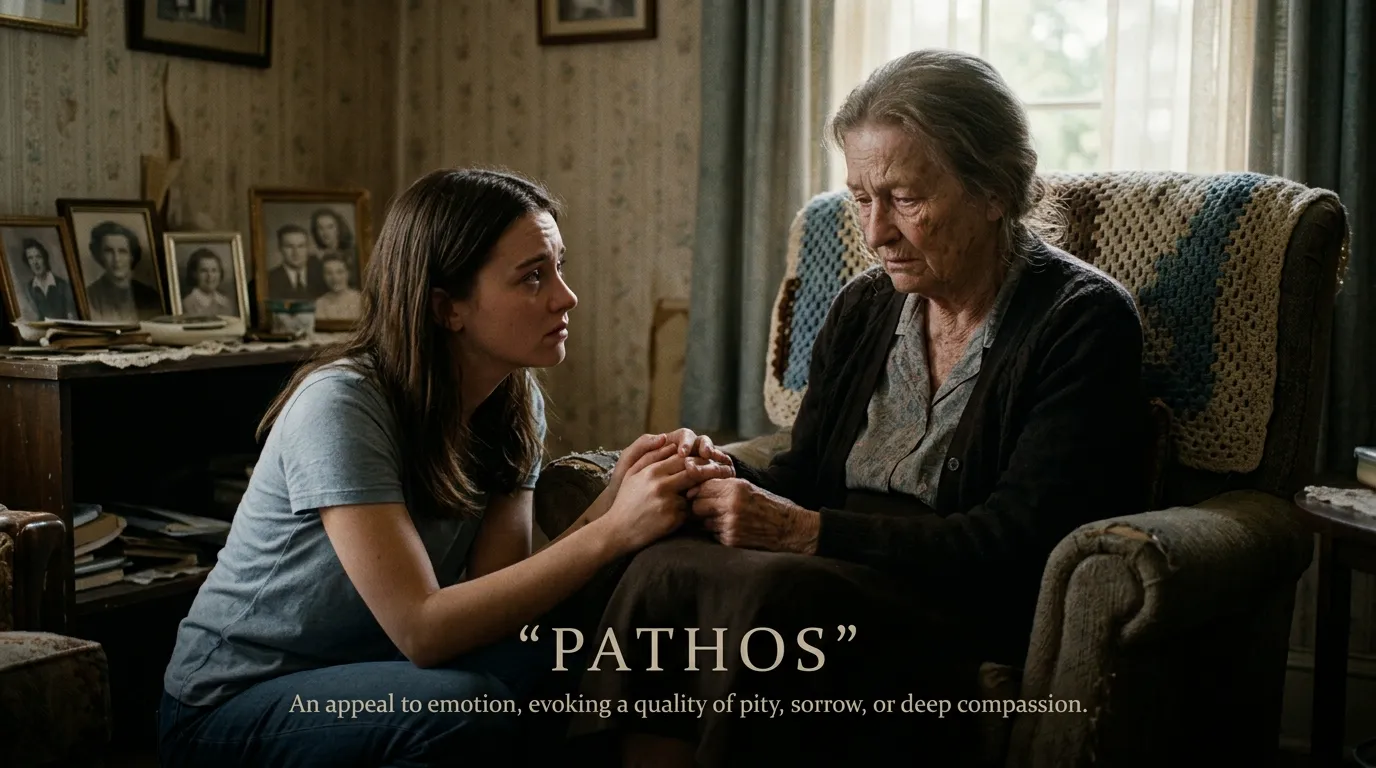
Have you ever watched an ad, read a story, or heard a speech that made you feel something right away? Maybe it made you happy, sad, angry, hopeful, or even afraid. That emotional reaction is often what pathos tries to create.
The simple pathos meaning is an appeal to emotion. It is a way of using words, stories, images, or ideas to connect with an audience’s feelings. Writers and speakers use pathos to make a message feel personal and important.
Pathos comes from the ancient study of rhetoric. It is one of the three famous rhetorical appeals linked to Aristotle: ethos, pathos, and logos. Ethos focuses on credibility, logos focuses on reasoning, and pathos focuses on the audience’s emotions.
In this guide, you will learn what pathos means, how it works, where you can find it, and how to use it without sounding fake or manipulative.
Quick Answer
Pathos means an appeal to emotion. It is a rhetorical method that tries to affect how an audience feels about a person, idea, problem, product, or argument.
For example, a charity ad that shows a struggling family may use pathos to make viewers feel sympathy. A campaign speech may use pathos to create hope or pride.
Pathos does not mean that an argument has no facts. A strong message can use emotion along with logic and credibility.
Definition & Meaning
Pathos is a rhetorical appeal that connects with an audience through feelings, values, needs, and emotional reactions.
In simple terms, pathos asks:
“How can I make my audience feel something that supports my message?”
The feeling can vary. It may include:
- Happiness
- Sadness
- Fear
- Hope
- Anger
- Love
- Pride
- Sympathy
- Guilt
- Compassion
- Excitement
Purdue OWL explains pathos as an appeal to an audience’s needs, values, and emotional sensibilities. It also notes that pathos can involve the audience’s broader perspective, not just a simple attempt to make someone cry.
That point matters.
Pathos is not simply “making people emotional.” Good pathos connects an emotion to the message and the audience.
For example:
“Every child deserves a safe place to sleep tonight.”
This sentence creates concern and compassion. It also connects those feelings to a clear idea: children need safe homes.
Pathos in Rhetoric
Pathos in rhetoric means using emotion as part of communication or persuasion.
Rhetoric is not limited to political speeches. People use rhetorical choices in essays, ads, social media posts, sales pages, speeches, videos, stories, and everyday conversations.
When you use pathos, you think about the audience before you choose your words.
Ask yourself:
- What does my audience care about?
- What problem affects them?
- What values do they share?
- What emotion fits my message?
- What story could make the idea easier to understand?
This makes pathos more useful than simply adding dramatic words.
A good emotional appeal supports the main point. It should not hide weak evidence or distract people from the real issue. Purdue OWL also warns that emotional appeals should not misrepresent a topic or frighten people simply to win an argument.
Ethos, Pathos, and Logos Explained
The three common rhetorical appeals work in different ways.
Ethos builds trust.
Pathos creates an emotional connection.
Logos uses reasoning and evidence.
You can remember them with three simple questions:
- Ethos: Why should I trust you?
- Pathos: Why should I care?
- Logos: Why should I believe this?
Purdue OWL notes that strong arguments often use a combination of these appeals rather than relying on only one.
Imagine a doctor explaining why a patient should follow a treatment plan.
The doctor’s experience can support ethos.
Research and medical evidence can support logos.
A discussion about the patient’s family, goals, or fear of losing important time with loved ones can create pathos.
Together, these appeals can make communication stronger.
Pathos Examples in Everyday Life
You do not need to study classical rhetoric to see pathos around you.
Advertising
Many advertisements use emotions to sell an idea or product.
A family laughing together in a car commercial may create feelings of happiness and belonging.
A pet food ad may show a lonely dog waiting for its owner. The scene can create sympathy and affection.
The product still matters, but the ad connects the product with a feeling.
Charity Campaigns
Charities often use personal stories to help people understand a problem.
A statistic may tell you how many people need help.
A personal story can help you imagine what one person’s experience feels like.
That emotional connection can make an issue feel more real.
Political Speeches
Political speakers often use words tied to shared values.
They may talk about:
- Freedom
- Family
- Safety
- Hope
- National pride
- Community
- Fairness
These ideas can create strong emotional reactions.
The use of pathos does not automatically make a speech dishonest. The key question is whether the emotional appeal supports a fair and truthful message.
Books and Movies
Stories use pathos all the time.
A character may lose someone they love. A family may overcome a serious problem. A hero may risk everything to protect another person.
These events make readers or viewers care about what happens next.
This is one reason stories can stay with us long after we finish reading them.
Social Media
Social posts can also use pathos.
A person sharing a difficult personal experience may create empathy.
A post about an unfair event may create anger.
The words, images, and personal details all shape the emotional response.
Common Pathos Examples in Writing
Writers can create pathos without using dramatic language.
Consider these two sentences:
Example 1:
“Many students feel nervous before their first exam.”
Example 2:
“His hands shook as he opened the exam paper. He had studied for weeks, but the first question still looked impossible.”
Both sentences describe nervousness.
The second example creates a stronger emotional picture. It gives the reader a small human moment.
That is often how effective pathos works.
Here are more examples:
Hope:
“After years of setbacks, she finally opened the doors to her own small business.”
Fear:
“One missed warning could put the entire team at risk.”
Compassion:
“An older people neighbor carried every grocery bag alone through the snow.”
Pride:
“After months of practice, the young team stepped onto the field wearing their school colors.”
The goal is not to force an emotion. The goal is to give the audience a reason to feel connected to the message.
How to Use Pathos in an Argument
You can use pathos in an essay or argument without making your writing overly dramatic.
Start with your main claim.
Then ask what human value connects to that claim.
For example, suppose your argument supports better school lunch programs.
A logical argument may discuss nutrition and cost.
A pathos-based part might describe a student who cannot focus in class because they have not had enough food.
The emotional example gives the issue a human face.
But do not stop there. Support the claim with reliable evidence too.
A useful pattern is:
Claim → Evidence → Human impact
This approach helps emotion support the argument instead of replacing it.
Purdue OWL recommends using credible evidence and explains that emotional appeals can help illuminate the human side of an issue when used properly.
How to Use Pathos Without Manipulating People
Pathos can become weak or unfair when a writer uses emotion to hide the truth.
For example, imagine a company says:
“If you really care about your family, you will buy our product.”
That statement tries to connect the product with love and family duty. But the emotional pressure does not prove that the product works.
A better approach would be:
- Explain what the product does.
- Give useful evidence.
- Show a real customer problem.
- Connect the solution to a genuine human need.
- Avoid fear or guilt that has no clear reason.
Strong pathos should make the message more human, not less truthful.
Pathos Mistakes to Avoid
Pathos can fail when writers push emotions too hard.
| Mistake | Better Approach |
| Using fear without a real reason | Explain the real risk clearly |
| Making every sentence dramatic | Use emotion only where it adds value |
| Using fake personal stories | Use honest examples |
| Replacing facts with emotion | Combine pathos with evidence |
| Guilt-tripping the audience | Respect the audience’s choice |
| Using emotional images with no context | Explain why the image matters |
| Trying to make everyone feel the same emotion | Consider different audience reactions |
The best emotional appeal feels natural.
If readers can see the writer trying too hard to make them cry, panic, or feel guilty, the message may lose trust.
How Pathos Works With Ethos and Logos
Pathos becomes more powerful when it works with the other rhetorical appeals.
Consider a public safety message.
Ethos: A trusted expert explains the issue.
Logos: The message gives clear facts and evidence.
Pathos: A real human story shows why the issue matters.
Each appeal does a different job.
A message that uses only logos may contain strong facts but fail to connect with the audience.
A message that uses only ethos may sound trustworthy but still lack enough evidence or emotional connection.
That is why balanced communication often works better.
Pathos in Speeches
Speeches provide many opportunities for emotional appeal.
A speaker may begin with a personal story. They may describe a shared challenge or talk about a future that the audience wants.
The closing section can also use pathos.
Purdue OWL’s discussion of classical argument notes that the conclusion can appeal to the audience’s emotions and values.
For example, a speaker discussing education might end with an idea like:
“Every student deserves the chance to discover what they can become.”
The sentence does not provide a statistic. Instead, it connects the topic to hope and fairness.
That emotional connection can help the main argument stay in the audience’s mind.
Pathos in Essays
Students often use pathos in persuasive and argumentative essays.
One simple method is to include a short example after presenting evidence.
For example:
Fact:
A large number of students struggle with sleep.
Pathos:
Imagine trying to learn a new lesson after spending most of the night awake.
The second sentence helps the reader picture the human experience behind the issue.
Still, keep the balance.
Academic writing should not become a dramatic story with no support. Use pathos as one tool inside a larger argument.
How to Identify Pathos in a Text
When you read an article, speech, ad, or essay, look for emotional signals.
Ask:
- What emotion does this passage create?
- Which words create that emotion?
- Does the writer use a personal story?
- Does the writer describe a human struggle?
- Does the writer appeal to shared values?
- Does the emotion support the main message?
- Is the writer using emotion to distract from weak evidence?
Look closely at word choice.
Words such as “family,” “loss,” “freedom,” “danger,” “hope,” and “love” can carry strong emotional meaning. But a word does not automatically create pathos. Context matters.
An emotional word may be part of a neutral statement.
That is why you should look at the whole passage rather than search for one emotional word.
Quick Reference: How to Use Pathos
| Goal | What to Do | Simple Example |
| Create sympathy | Show a human struggle | “She faced the winter alone.” |
| Create hope | Show a possible positive future | “A better path is still possible.” |
| Create concern | Explain a real human risk | “One mistake can affect the whole team.” |
| Create pride | Connect with shared values | “They worked together for their community.” |
| Create empathy | Help readers see another view | “Imagine facing the problem yourself.” |
| Build connection | Tell a relevant true story | Share a real experience tied to the topic |
Use this table as a quick guide, not as a formula.
The best pathos depends on the audience, topic, and purpose.
Is Pathos Always Emotional?
Yes, but “emotional” does not always mean sad or dramatic.
Pathos can create positive emotions too.
A story about success can use pathos.
A message about community can use pathos.
Even a calm message can appeal to values and feelings.
The important part is the connection between the message and the audience’s emotional response.
Purdue OWL also points out that pathos can relate to an audience’s needs, values, and disposition toward a topic.
What Is the Difference Between Pathos and Logos?
Pathos and logos appeal to different parts of communication.
Pathos focuses on emotion, values, and human response.
Logos focuses on reasoning, evidence, and logical support.
For example:
Logos:
“Regular exercise can improve several aspects of physical health.”
Pathos:
“Imagine having more energy to play with your children after work.”
The first statement focuses on a claim.
The second connects the topic with a personal benefit.
Good writing can use both.
What Is the Difference Between Pathos and Ethos?
Pathos creates an emotional connection.
Ethos builds credibility and trust.
For example, a doctor may use ethos by explaining their professional experience.
The same doctor may use pathos by discussing a patient’s hope of returning to normal daily life.
One focuses on trust.
The other focuses on emotion.
A strong speaker or writer can use both without confusing their roles.
Why Pathos Still Matters Today
Pathos may come from an ancient rhetorical tradition, but people still respond to stories, values, hopes, fears, and personal experiences.
Modern communication gives writers even more ways to create emotional connections.
A short video can combine music, images, words, and storytelling.
A social post can use a personal story.
A website can use customer stories.
A speech can use a powerful personal example.
The format changes, but the basic communication goal remains familiar: help the audience connect with the message.
At the same time, modern readers often face a large amount of emotional content. That makes honest use of pathos even more important.
Emotion can attract attention, but trust comes from the full message.
FAQs:
What is the simple meaning of pathos?
Pathos means an appeal to emotion. It is a rhetorical method that tries to affect an audience’s feelings, values, needs, or emotional response. Writers and speakers can use pathos to make a message feel more personal and meaningful.
What is an example of pathos?
A charity advertisement showing a family struggling after a natural disaster can use pathos. The image and story may create sympathy and concern. The emotional response can encourage viewers to think about the problem and consider helping.
What are ethos, pathos, and logos?
Ethos, pathos, and logos are three common rhetorical appeals. Ethos focuses on credibility, pathos focuses on emotion, and logos focuses on reasoning. Writers and speakers often combine all three to make an argument stronger.
Is pathos the same as emotional appeal?
Yes, in common rhetorical use, pathos refers to emotional appeal. However, the idea can go beyond simply making people feel an emotion. It can also involve an audience’s values, needs, and overall response to a message.
How do you identify pathos in an essay?
Look for stories, emotional language, personal experiences, vivid descriptions, and appeals to shared values. Then ask what feeling the writer wants the audience to experience and whether that feeling supports the main argument.
Can pathos be used in academic writing?
Yes. Academic writers can use pathos when it helps readers understand the human side of an issue. But emotional examples should support reliable evidence. Pathos should not replace facts or be used to mislead the reader.
Can pathos be negative?
Yes. Pathos can create negative emotions such as fear, sadness, anger, or guilt. It can also create positive emotions such as hope, joy, pride, and compassion. The ethical issue depends on how the writer uses those emotions and whether the message remains truthful.
Conclusion:
The simplest pathos meaning is an appeal to emotion. It helps writers and speakers connect a message with an audience’s feelings, values, needs, and human experiences.
Pathos can make an argument easier to understand and remember. But emotion works best when it supports facts and credibility. Do not use fear, guilt, or dramatic language just to control a reader.
When you write, ask one simple question: “Why should my audience care?” Then use a real story, clear example, or shared value to answer it.
Combine pathos with ethos and logos when the situation calls for a stronger, more complete argument.

Hello, I am Ethan Carter a dedicated content creator and storyteller with expertise in literary techniques and language learning. At similiezmeta.com, my crafts engaging articles on similes, idioms, and figurative language designed specifically for children and beginners.