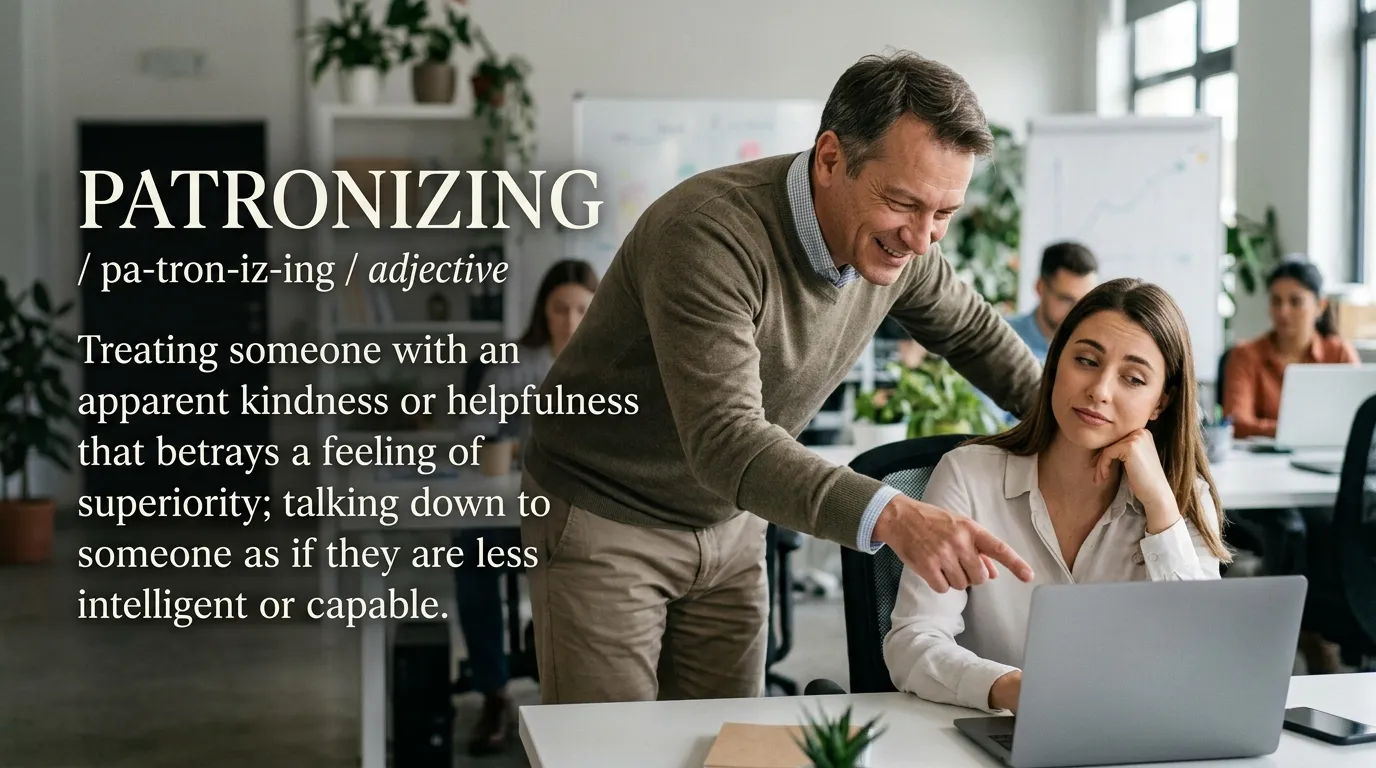
Have you ever asked someone a simple question and received an answer that made you feel foolish? Perhaps they spoke slowly, used a fake smile, or explained something you already knew. Even if their words sounded polite, their attitude felt insulting. This is often called being patronizing.
The patronizing meaning describes words, actions, or behavior that make someone feel less important, less intelligent, or less capable than the person speaking to them. A patronizing person may act as if they know everything and others know very little.
This word often comes up in daily conversations, friendships, relationships, schools, and workplaces. However, it can be hard to tell the difference between someone who is trying to help and someone who is talking down to you.
In this guide, you will learn what patronizing means, how to recognize a patronizing tone, see real-life examples, and understand how to respond without making a small disagreement worse.
Quick Answer
Patronizing means speaking or behaving toward someone as if you are smarter, more important, or better than they are. It often makes the other person feel small, foolish, or unimportant.
For example, if someone says, “Good job! You finally understood it,” they may sound supportive, but their words suggest that they expected you to fail.
A person who acts this way may seem friendly on the surface, but their attitude shows a sense of superiority.
Definition & Meaning of Patronizing
Patronizing is an adjective that describes a person, comment, action, or tone that shows an unfair sense of superiority.
In simple words, it means treating someone like they are less intelligent or capable than you.
A patronizing person may think they are being helpful. However, their words or actions can make others feel embarrassed or disrespected.
For example:
- “Don’t worry, this might be too hard for you.”
- “Let me explain it in words you can understand.”
- “That’s actually a good idea for someone like you.”
These statements may sound helpful or kind at first. However, they can carry an insulting message.
According to the Cambridge Dictionary, patronizing describes speaking or behaving toward someone as if they are ignorant or unimportant. Oxford also connects the word with the idea of acting as if you are better or more intelligent than another person.
definition in the Cambridge English Dictionary+1
What Does Patronizing Mean in Simple Words?
In simple English, patronizing means talking down to someone.
Imagine that you know how to use a computer. A friend asks you a question about a basic setting.
Instead of giving a normal answer, you say:
“Wow, you don’t even know that? Let me show you how to do it.”
You answer the question, but you also make your friend feel less intelligent.
That is a patronizing response.
The main idea is not about how much someone knows. It is about how they treat another person.
A teacher can know more than a student without being patronizing. A manager can correct an employee without making them feel small.
The problem starts when someone uses their knowledge, age, money, job title, or experience to make another person feel inferior.
What Is a Patronizing Tone?
A patronizing tone is a way of speaking that makes someone feel as if the speaker is above them.
It is not always about the words. The voice, facial expression, and situation can also change how a message feels.
For example, consider these two statements:
- Respectful: “Would you like me to explain how this works?”
- Patronizing: “Let me explain this slowly so you can understand.”
Both people offer help. However, the second person suggests that the listener cannot understand a simple idea.
A patronizing tone may include:
- Speaking in an overly slow or childish way.
- Using a fake or forced smile.
- Laughing at someone’s simple question.
- Giving praise that sounds like an insult.
- Acting surprised when someone does something well.
- Interrupting others to show superior knowledge.
Not every slow explanation or friendly smile is patronizing. Some people speak slowly to help others understand. Context, word choice, and the way someone treats others matter.
Common Examples of Patronizing Behavior
Patronizing behavior can appear in many parts of life. It can happen between friends, family members, couples, teachers, students, and coworkers.
Here are some common situations that make the meaning easier to understand.
1. At Work
Imagine an employee shares an idea during a meeting.
Their manager replies:
“That’s cute, but let the experienced people handle this.”
This is patronizing because the manager dismisses the employee instead of discussing the idea.
A respectful manager would listen and explain any concerns without insulting the employee.
2. Between Friends
Your friend asks how you learned to cook a new meal.
You reply:
“Well, it’s not that hard. Even a beginner can do it.”
This response can sound patronizing because it makes your friend’s lack of experience seem foolish.
3. In a Relationship
One partner asks for help with a problem.
The other says:
“Don’t worry your little head about it. I’ll take care of everything.”
Although the words may sound caring, they can suggest that the other person cannot think or make decisions.
4. In a Classroom
A student gives an incorrect answer.
The teacher responds:
“That’s a very interesting guess. Maybe next time you’ll get it right.”
This comment may embarrass the student instead of helping them learn.
A better response would explain the mistake and give the student another chance.
5. In Daily Conversations
Someone tells you that they have never visited another country.
You reply:
“Oh, you’ve never traveled? You really need to experience the world.”
This may sound patronizing if you say it as though your life experiences make you better than theirs.
Patronizing vs. Condescending: What’s the Difference?
Patronizing and condescending have very similar meanings. Both describe behavior that makes another person feel less important or less intelligent.
However, patronizing can sometimes carry a false appearance of kindness or helpfulness.
For example, someone may offer help while speaking as if the other person cannot do anything alone.
Condescending behavior often shows a direct sense of superiority. A person may openly act as if they are smarter, more important, or better than others.
| Patronizing | Condescending |
| May sound friendly or helpful on the surface | Often shows a clear sense of superiority |
| Can include fake praise | Can include direct insults or dismissive comments |
| May treat someone like a child | May treat someone as less intelligent |
| Often hides disrespect behind kindness | Often shows disrespect through attitude |
| “Aww, you tried your best!” | “You clearly don’t understand this.” |
Both words can describe the same situation. The difference often depends on the way someone expresses their attitude.
Cambridge lists patronizing as a synonym of condescending, which shows how closely these words relate.
definition in the Cambridge English Dictionary+1
Patronizing vs. Polite: How Can You Tell?
It is easy to confuse politeness with patronizing behavior because both can involve friendly words.
However, there is an important difference.
A polite person respects your ability to think, learn, and make choices. A patronizing person may act as if you need their approval or guidance for everything.
Consider these examples:
- Polite: “Would you like some help with that?”
- Patronizing: “You probably can’t manage that on your own.”
- Polite: “You made a good point.”
- Patronizing: “That’s a surprisingly smart idea.”
- Polite: “Let me know if you have any questions.”
- Patronizing: “I’ll explain it again because you seem confused.”
The difference is respect.
You can be kind without treating someone like a child. You can also offer help without making another person feel weak.
Why Do People Act Patronizing?
People may act patronizing for different reasons. Sometimes they want to feel important. In other cases, they may not realize how their words affect others.
Here are some common reasons:
1. They Want to Feel Superior
Some people use their knowledge, job position, or experience to feel more important than others.
They may put other people down to make themselves look better.
2. They Lack Social Awareness
A person may not notice that their words sound rude.
They may believe they are being friendly or helpful. However, they fail to think about how the other person feels.
3. They Want to Control Others
Some people use patronizing language to control a conversation.
They may dismiss other people’s ideas or make them doubt their own abilities.
4. They Have Poor Communication Skills
Not everyone knows how to explain an idea in a respectful way.
A person may use childish words, unnecessary praise, or an unfriendly tone without understanding the effect.
5. They Feel Insecure
Sometimes, people put others down because they feel unsure about themselves.
Acting superior may give them a short feeling of control or importance. However, this does not excuse disrespectful behavior.
It is also important not to assume someone’s motive from one comment. Look at the person’s words, actions, and repeated behavior before making a judgment.
How to Recognize a Patronizing Person
One rude comment does not always mean someone has a patronizing personality.
People make mistakes. They may use the wrong words or speak poorly during a stressful moment.
However, repeated behavior can help you recognize a pattern.
Look for these signs:
- They often interrupt you while you speak.
- They treat your questions as silly.
- They give unwanted advice without listening.
- They use fake praise to make you feel small.
- They act surprised when you succeed.
- They explain simple things as if you know nothing.
- They dismiss your ideas without considering them.
- They often remind you that they have more experience.
A person may show one or more of these signs without always intending harm.
The best way to understand their behavior is to look at the full situation. Notice whether they treat other people with the same lack of respect and whether they listen when someone raises a concern.
How to Respond to Patronizing Behavior
You do not need to respond with anger every time someone speaks to you in a patronizing way.
A calm and clear response can help protect your confidence and set a healthy boundary.
Here are some useful ways to respond.
1. Ask Them to Explain
Sometimes, a simple question can make someone think about their words.
You can say:
“Could you explain what you mean by that?”
This gives the person a chance to clarify their statement.
2. Point Out Their Tone
If someone repeatedly talks down to you, address the behavior directly.
For example:
“I understand your point, but I would appreciate it if you spoke to me with more respect.”
This response makes your feelings clear without starting an argument.
3. Show Confidence
Do not let someone’s attitude make you doubt your abilities.
You can say:
“I understand the topic. Please let me finish explaining my point.”
You do not need to prove your intelligence to someone who refuses to listen.
4. Set Clear Boundaries
If a person keeps making insulting comments, tell them what you will not accept.
For example:
“I’m happy to discuss this, but I don’t want to be spoken to like a child.”
A clear boundary helps both people understand what respectful communication should look like.
5. Walk Away When Needed
Not every conversation deserves a long response.
If someone continues to insult you or refuses to listen, ending the conversation may be the best choice.
You can say:
“I don’t think this conversation is going anywhere. Let’s talk later.”
Your goal should be to protect your peace, not win every argument.
Common Mistakes: Patronizing vs. Respectful Communication
People sometimes use patronizing words without realizing it. Small changes in language can make a big difference.
The following table shows how to replace common patronizing statements with more respectful ones.
| Patronizing statement | Better statement |
| “You finally got it!” | “Great, you’ve got it.” |
| “Let me explain this in simple words.” | “Would you like a quick explanation?” |
| “That’s cute.” | “That’s an interesting idea.” |
| “You don’t understand, do you?” | “Which part should we go over?” |
| “Good job for a beginner.” | “You did a good job.” |
| “Don’t worry your little head.” | “Let’s work through it together.” |
| “Even you can do this.” | “I think you can handle this.” |
The goal is not to avoid giving feedback or advice. It is to share your thoughts without making others feel less valuable.
Quick Reference: How to Identify Patronizing Behavior
Use this table to understand the word in different situations.
| Situation | What it looks like |
| Conversation | Talking to someone like they are unintelligent |
| Workplace | Dismissing a coworker’s ideas |
| Friendship | Making fun of someone’s lack of knowledge |
| Relationship | Treating a partner like a child |
| Education | Making a student feel foolish for asking |
| Body language | Using a smug smile or exaggerated gestures |
| Praise | Giving compliments that include hidden insults |
| Advice | Offering help while questioning someone’s ability |
What Is the Difference Between Patronizing and Patronage?
This is an important point because the word patronize has more than one meaning.
When someone patronizes another person in a conversation, they treat that person as if they are less intelligent or important.
However, when someone patronizes a business, it means they shop at or support that business.
For example:
- “Stop patronizing me.” This means stop talking down to me.
- “We regularly patronize this local restaurant.” This means we regularly visit or support the restaurant.
The second meaning is not insulting.
The verb can also describe supporting an artist, group, or organization with money. These meanings depend on the context.
Is Patronizing Always Negative?
Yes, when you use patronizing to describe someone’s way of treating another person, it usually carries a negative meaning.
It suggests that someone acts as if they are better, smarter, or more important than the person they are speaking to.
However, the word patronize does not always have a negative meaning.
For example, when you say, “I patronize local shops,” you mean that you regularly support those businesses.
So, the meaning depends on how you use the word.
When describing a person’s attitude or tone, patronizing usually points to disrespect. When describing support for a business or artist, patronize can have a positive or neutral meaning.
FAQs:
1. What does patronizing mean in simple words?
Patronizing means treating someone as if they are less intelligent, less important, or less capable than you. It often involves talking down to someone while acting as if you are helping them.
2. Is patronizing the same as condescending?
Yes, the two words have very similar meanings. Both describe behavior that shows a sense of superiority. Patronizing behavior may appear friendly or helpful on the surface, while condescending behavior often shows a more direct sense of superiority.
3. What is an example of a patronizing comment?
An example is, “Wow, you finally understood it!” This sounds like praise, but it suggests that the other person is slow or not very intelligent. It can make someone feel embarrassed rather than appreciated.
4. What does a patronizing tone sound like?
A patronizing tone may sound overly sweet, childish, sarcastic, or dismissive. A person may speak slowly, use fake praise, or explain simple things as if the listener cannot understand them.
5. Is being patronizing rude?
Yes, patronizing behavior is generally considered rude because it can make another person feel small or disrespected. Even when someone intends to help, their tone or choice of words may send the wrong message.
6. What is the opposite of patronizing?
Words such as respectful, humble, considerate, supportive, and understanding can express the opposite of patronizing. These words describe people who treat others as equals and value their thoughts and abilities.
7. What does it mean when someone says, “Don’t patronize me”?
It means the person feels that you are talking down to them or treating them as if they are less intelligent. They want you to speak to them with respect instead of acting superior.
Conclusion:
Understanding the patronizing meaning helps you recognize when someone’s words or actions show a sense of superiority. It describes behavior that makes another person feel less intelligent, important, or capable.
A patronizing tone may hide behind friendly words, fake praise, or unwanted advice. However, respectful communication should make people feel valued rather than small.
Remember that helping someone does not mean talking down to them. If someone treats you this way, stay calm, speak clearly, and set healthy boundaries.
Use this guide to understand the word, recognize it in daily conversations, and communicate with more respect.

Hello, I am Daniel Brooks a passionate writer and educator with a deep love for language and creative expression. My work on similiezmeta.com focuses on helping kids and students explore the beauty of words through playful examples and practical explanations.


