Buying a used car can feel like a great deal, especially when the price is much lower than normal. But what if the car has a salvage title? You may see this term in a car listing, auction, or vehicle history report. Before you buy, you need to know what it means.
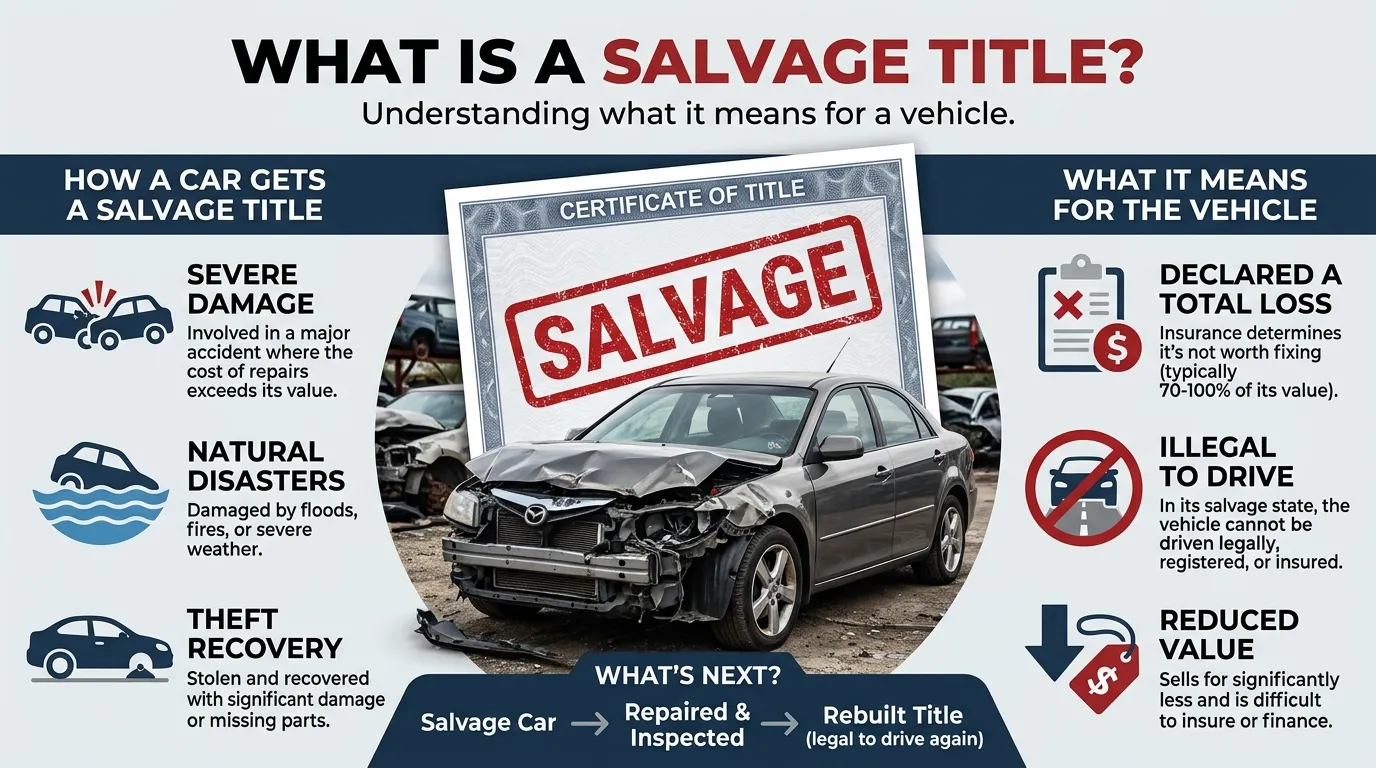
Salvage title meaning refers to a special vehicle title that shows an insurance company or state has classified a car as a total loss under the rules that apply. This often happens after a major crash, flood, fire, theft, or other serious damage. However, a salvage title does not always mean that a car can never run again.
In this guide, you will learn why cars get salvage titles, how they affect value, whether you can drive or insure one, and what to check before buying. You will also learn the difference between salvage, rebuilt, and clean titles.
The goal is simple: help you understand the risks so you can make a smart choice and avoid an expensive mistake.
Quick Answer
A salvage title means a state has marked a vehicle as a total loss under its title rules. The car may have serious damage from a crash, flood, fire, or theft. It may still be repairable, but you usually cannot drive it on public roads until it meets the required repair and inspection rules.
Definition & Meaning of a Salvage Title
A salvage title is a legal vehicle document that warns buyers that a car has suffered major damage or has been declared a total loss.
In many cases, an insurance company makes this decision when the cost to repair a car is too high compared with its value. The exact rules differ by state.
For example, imagine a car worth $15,000 before an accident. After a serious crash, the repair estimate reaches $12,000. The insurer may decide that repairing the car does not make financial sense.
The insurer may then declare it a total loss. The state may issue a salvage title after the required paperwork.
This title gives future buyers an important warning. It tells them that the car has a serious damage history. It does not, by itself, tell them every part that was damaged or whether repairs were done well.
Why Does a Car Get a Salvage Title?
A car can receive a salvage title for several reasons. The most common reason is serious damage that leads an insurance company to declare it a total loss.
Here are the main causes.
1. Major Accident Damage
A serious car crash can damage the frame, engine, airbags, suspension, or other key parts.
Sometimes, the repair cost comes close to or exceeds the car’s market value. The insurance company may then declare it a total loss.
2. Flood or Water Damage
Floodwater can damage a car’s engine, wiring, brakes, and other electrical parts.
Even if the car looks clean after repairs, hidden water damage may cause problems later. Rust and electrical faults can also appear over time. The National Highway Traffic Safety Administration warns buyers to check for signs of past flooding.
3. Fire Damage
A vehicle may get a salvage title after a fire.
Fire can harm the engine, wiring, paint, seats, and safety systems. Smoke and heat can also damage parts that may look fine from outside.
4. Theft and Recovery
A stolen car may receive a salvage brand after an insurance company pays a theft claim.
For example, an insurer may pay the owner for a stolen vehicle. If the police later find the car, the vehicle may have a salvage history. The exact title result depends on state rules and the damage involved.
5. Other Serious Damage
Hail, vandalism, and other events can also lead to a salvage title.
For example, heavy hail may damage nearly every body panel. The car may still run, but the repair cost may be too high compared with its value.
How Does a Salvage Title Work?
The process can vary by state, but it often follows these steps:
- The car suffers damage: An accident, flood, fire, or another event harms the vehicle.
- The insurance company reviews it: The insurer checks the damage and estimates repair costs.
- The insurer declares a total loss: This may happen when repairs do not make financial sense under the insurer’s rules.
- The title status changes: The state may issue a salvage certificate or add a salvage brand to the vehicle record.
- The vehicle enters the salvage market: A buyer, repair shop, or licensed rebuilder may purchase it.
- The car gets repaired: If state rules allow it, the new owner can repair the vehicle.
- The car goes through required checks: The owner must meet the state’s inspection and paperwork rules.
- A rebuilt title may be issued: If the vehicle qualifies, the state may approve it for road use.
For example, Virginia uses a 75% repair-cost threshold for certain late-model vehicles. Other states use different rules, so never assume one state’s limit applies everywhere.
Salvage Title vs. Rebuilt Title vs. Clean Title
These three terms are important when you shop for a used car. They describe different stages or histories of a vehicle.
What Is a Salvage Title?
A salvage title shows that the state has branded the vehicle because of serious damage or another qualifying event.
The car may need repairs before it can qualify for road use. In many states, you cannot register or drive it while it has an active salvage status.
What Is a Rebuilt Title?
A rebuilt title usually means a car once had a salvage title but has since been repaired and passed the checks required by the state.
However, rebuilt does not mean the car has returned to its original factory condition. You should still inspect it before buying.
What Is a Clean Title?
A clean title means the title record does not show a salvage or similar brand.
But a clean title does not prove that a car has never been in an accident. Some damage may never lead to a title brand. You should still check the vehicle history and arrange an inspection.
| Title type | What it means | What buyers should know |
| Salvage title | The state has marked the car as salvage | Repairs and approval may be needed |
| Rebuilt title | A former salvage car has met the state’s rebuilding rules | Past damage still matters |
| Clean title | No salvage brand appears on the title | It does not guarantee a damage-free history |
| Junk or nonrepairable title | The car is not approved for normal rebuilding or road use | It may be limited to parts or scrap |
Remember: Title terms and rules differ by state. Always check the exact brand on the vehicle record before making a deal.
Can You Drive a Car With a Salvage Title?
In many states, you cannot legally drive a vehicle on public roads while it has an active salvage title or certificate.
The reason is simple: the vehicle may not have passed the checks needed for road use.
You may need to:
- Repair all required damage.
- Provide repair receipts and ownership papers.
- Complete a state inspection.
- Pass any required safety or anti-theft checks.
- Apply for a rebuilt title.
- Register the vehicle and obtain valid plates.
For example, Virginia does not allow a vehicle with an active salvage certificate to operate on public roads. Maryland also requires a salvage vehicle to be rebuilt and inspected before it can be registered.
Before you move or transport a salvage car, check your local DMV rules. You may need a trailer or another legal transport method.
Is It Worth Buying a Salvage Title Car?
A salvage title car can look like a great deal. The asking price may be much lower than the price of a similar clean-title car.
But a low price does not always mean good value.
The real question is how much the car will cost after repairs, inspections, insurance, and future maintenance.
A salvage car may make sense for an experienced buyer who understands the damage and has a clear repair plan. It may be a poor choice for someone who needs a reliable daily driver and cannot afford unexpected repairs.
Before you buy, compare the total cost with the price of a similar car that has a clean title.
Pros and Cons of Buying a Salvage Title Car
There are a few possible benefits, but the risks deserve close attention.
| Pros | Cons |
| Lower purchase price | Hidden damage may remain |
| Can suit skilled repair buyers | Insurance options may be limited |
| May offer value after proper repairs | Resale value is often lower |
| Useful as a parts vehicle | Registration may require extra steps |
| Some cars can qualify for rebuilt titles | Repair costs can rise quickly |
Possible Benefits
1. Lower Buying Price
Salvage cars often sell for less than similar clean-title vehicles. This may help buyers with repair skills and a clear budget.
2. Good for Parts
A damaged car may still have useful parts. Buyers who need an engine, doors, seats, or other components may find value in it.
3. A Chance to Rebuild
Some salvage vehicles can be repaired and approved for road use. A skilled mechanic may be able to restore one at a reasonable cost.
Main Risks
1. Hidden Damage
A car may look fine but still have problems with its frame, wiring, airbags, or engine.
2. Insurance Problems
Some insurers may offer limited coverage or refuse certain types of coverage. Rules and options vary by company and state.
3. Lower Resale Value
Many buyers prefer clean-title cars. As a result, selling a rebuilt vehicle may take more time and bring a lower price.
4. Unexpected Repair Costs
A small repair can lead to a much larger bill if a mechanic finds hidden damage.
How Does a Salvage Title Affect Car Value?
A salvage title can reduce a car’s market value because it tells buyers that the vehicle has a serious history.
For example, imagine two cars of the same make, model, year, and similar mileage.
- Car A has a clean title and costs $15,000.
- Car B has a salvage history and costs $8,000.
Car B looks cheaper. But you must also consider repair costs, inspection fees, insurance, and future maintenance.
There is no single discount that applies to every salvage vehicle. The amount depends on several factors:
- The type of damage.
- The quality of repairs.
- The car’s make and model.
- Its age and mileage.
- Local demand.
- The title brand.
- The availability of parts.
A rebuilt car with proper repair records may attract more buyers than an unrepaired salvage car. Still, its history can affect its value.
Can You Get Insurance for a Salvage Title Car?
Insurance for a salvage vehicle can be difficult.
Many insurers do not offer normal coverage for a car that still has an active salvage title. Some may only consider it after the car has been repaired and approved for road use.
A rebuilt vehicle may qualify for insurance, but the available coverage depends on the insurer.
Here are the main types of coverage to understand:
Liability coverage: This helps pay for injuries or property damage you cause to others, subject to your policy limits.
Collision coverage: This helps pay for damage to your own car after a covered collision.
Comprehensive coverage: This may cover events such as theft, fire, or certain weather damage.
An insurer may offer liability coverage but refuse collision or comprehensive coverage. Another insurer may have different rules.
Before buying a salvage car, contact insurance companies and ask about the exact vehicle identification number (VIN). Get clear answers about coverage before you pay.
How to Check a Salvage Title Before Buying
Never buy a salvage or rebuilt car just because it looks good in photos.
A proper check can help you find problems before you spend your money.
1. Check the Vehicle Identification Number (VIN)
The VIN is a unique number assigned to a vehicle. You can use it to check the car’s history.
Ask the seller for the VIN before you visit. Use it to look for:
- Previous title brands.
- Reported accidents.
- Theft records.
- Flood damage records.
- Odometer readings.
- Total-loss reports.
You can also use the official National Motor Vehicle Title Information System (NMVTIS) to find approved vehicle history report providers.
However, no report contains every detail. NMVTIS is useful for title history, but it does not provide a complete repair history.
2. Look at the Damage History
Ask the seller why the car received a salvage title.
Was it damaged in a crash? Did it suffer flood damage? Was it stolen and later recovered?
Ask for photos from before and after the repairs. Also request repair bills, parts receipts, and inspection papers.
A seller who cannot explain the car’s history may be hiding important details.
3. Hire an Independent Mechanic
This is one of the most important steps.
Take the car to a trusted mechanic who has experience with damaged vehicles. Do not depend only on the seller’s mechanic.
Ask the mechanic to check:
- Frame and body alignment.
- Engine and transmission.
- Airbags and seat belts.
- Brakes and suspension.
- Electrical systems.
- Signs of water damage.
- Rust and corrosion.
- Warning lights and computer codes.
A mechanic may find problems that are hard to see during a normal test drive.
4. Check for Flood Damage
Flood damage can be hard to spot because sellers may clean the car before putting it up for sale.
Look for these warning signs:
- A musty or moldy smell.
- Mud under the seats or dashboard.
- Rust around metal parts.
- Water marks inside the trunk.
- Loose or mismatched carpets.
- Corrosion around electrical connections.
- New interior parts in an older car.
Pay close attention to the wiring and areas under the seats. These spots may show signs of water exposure.
The Federal Trade Commission recommends checking for these signs and getting an independent mechanic to inspect the car.
5. Check Your State’s DMV Rules
Every state has its own rules for salvage and rebuilt vehicles.
Visit your state’s official DMV website. Check whether the car can be rebuilt, inspected, registered, and driven.
Ask about the documents you need before buying it.
6. Compare the Total Cost
Do not compare only the seller’s asking price.
Add the expected repair costs, inspection fees, registration costs, insurance, and possible future repairs.
If the final cost comes close to the price of a clean-title car, buying the salvage vehicle may not make sense.
Salvage Title Buying Checklist
Use this quick reference before making a purchase.
| What to check | What you should do |
| VIN | Check the vehicle’s title history |
| Damage history | Ask why the car received a salvage title |
| Repair records | Request bills, receipts, and photos |
| Frame | Ask a mechanic to inspect its structure |
| Airbags | Check that safety systems work correctly |
| Flood damage | Look for rust, mold, and water marks |
| Insurance | Confirm available coverage |
| DMV rules | Check inspection and registration needs |
| Total cost | Add repairs and other expenses |
| Seller details | Confirm the title matches the vehicle |
What Is the Difference Between a Salvage Title and a Total Loss?
These terms often appear together, but they do not mean exactly the same thing.
A total loss is an insurance decision. It means the insurer has decided that the vehicle meets its rules for a total-loss claim.
A salvage title is a vehicle title status recorded under state law.
For example, an insurance company may decide that repairing a damaged car does not make financial sense. The insurer may then report the vehicle for salvage processing under the rules of that state.
The two terms are closely related, but they are not always interchangeable. State title laws and insurance rules can differ.
Can a Salvage Title Become a Clean Title?
In most cases, a salvage title does not simply disappear after repairs.
A vehicle may qualify for a rebuilt title after it meets the state’s repair, inspection, and paperwork requirements.
However, the original salvage history usually remains part of the vehicle’s record.
Be careful if a seller claims that a rebuilt car now has a completely clean history. Ask for the official title and check the vehicle’s record.
Some states also use different title brands or terms. Always confirm the status with the relevant DMV.
What Is Title Washing, and Why Should Buyers Care?
Title washing happens when someone tries to hide a vehicle’s damage history by moving it between states or using misleading paperwork.
This can make a damaged vehicle appear to have a clean title.
For example, a car may receive a salvage brand in one state. Someone may then move it to another state and try to obtain a title that does not clearly show its past damage.
This is why checking only the paper title is not enough.
Use an NMVTIS report, check the VIN, and ask an independent mechanic to inspect the car. State title rules differ, and a history report may not show every event.
When Should You Avoid a Salvage Title Car?
Not every salvage car is a bad purchase. But some vehicles carry risks that are too high for an average buyer.
Avoid the deal when:
- The seller refuses to share the VIN.
- The seller cannot explain the damage.
- There are no repair records.
- The frame has serious structural damage.
- The airbags or safety systems do not work.
- The car has signs of serious flood damage.
- The seller refuses an independent inspection.
- The title details do not match the vehicle.
- The seller pressures you to pay quickly.
A low price should never make you ignore safety concerns.
If you cannot confirm that the car is safe, legal to register, and worth the full cost, walk away.
FAQs:
1. What does salvage title mean on a used car?
A salvage title means a state has marked a vehicle because of serious damage or another qualifying event. The car may have been involved in an accident, flood, fire, or theft. It may need repairs and inspection before it can qualify for road use.
2. Is a salvage title bad?
Not always, but it does mean you need to be careful. Some salvage cars can be repaired and used again. Others may have hidden damage that makes them unsafe or expensive to maintain. Always check the vehicle history and get an expert inspection.
3. Can you register a car with a salvage title?
In many states, you cannot register a car with an active salvage title for normal road use. You may first need to repair it, pass the required inspection, and obtain a rebuilt title. Check your local DMV rules because requirements vary.
4. Does a salvage title affect resale value?
Yes. A salvage or rebuilt history can lower a car’s resale value. Many buyers prefer clean-title vehicles because they have fewer known title concerns. The amount of the price difference depends on the damage, repair quality, vehicle type, and local market.
5. Can you get full coverage insurance on a rebuilt title car?
Sometimes. Some insurance companies offer comprehensive and collision coverage for rebuilt vehicles, while others may offer liability coverage only. Each company has its own rules. Contact the insurer with the VIN before buying the car.
6. How can I tell if a salvage title car was in a major accident?
Start with the VIN and check its vehicle history report. Ask for old damage photos and repair records. Then hire an independent mechanic to inspect the frame, airbags, suspension, engine, and other important parts. A history report alone cannot prove that every repair was done correctly.
7. Is a rebuilt title better than a salvage title?
A rebuilt title is usually a better option for someone who wants a road-ready vehicle. It means the car has been repaired and has met the required state checks. A salvage vehicle may still need major repairs and approval. However, a rebuilt title does not guarantee perfect repairs or factory-level safety.
Conclusion:
Understanding salvage title meaning can help you avoid costly mistakes when buying a used car. A salvage title shows that a vehicle has a serious history, but it does not mean every car is beyond repair.
Before buying one, check its VIN, review its damage history, and hire an independent mechanic. Also, check your state’s DMV rules and speak with an insurance company.
Remember, a low price does not always mean a good deal. Compare the full cost with a similar clean-title car before making your choice. Take your time, ask questions, and put safety first.

Hello, I am Daniel Brooks a passionate writer and educator with a deep love for language and creative expression. My work on similiezmeta.com focuses on helping kids and students explore the beauty of words through playful examples and practical explanations.


