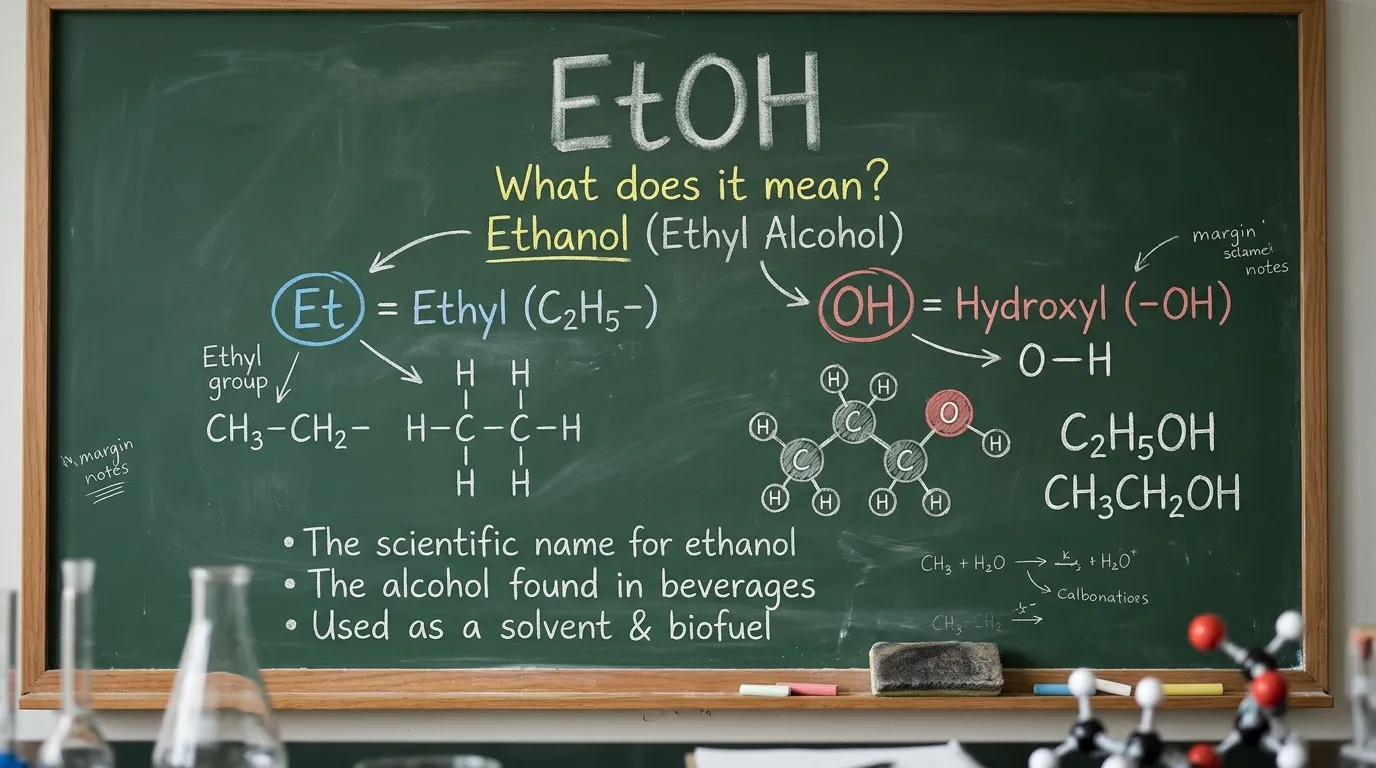
Have you ever seen the word EtOH on a medical report, lab test, hospital note, or health form? You may have wondered what it means. It looks like a strange word, but its meaning is quite simple.
EtOH means ethanol, which is the type of alcohol found in beer, wine, and liquor. Doctors, nurses, and lab workers often use this short term when they talk about alcohol use, blood tests, or a patient’s medical history.
The term may appear in a hospital chart, a blood alcohol test, or a note about a patient’s health. However, its meaning can change a little based on where you see it.
In this guide, you will learn the full EtOH meaning, how doctors use it, what an EtOH test checks, and how to read common medical terms linked to it. You will also learn the difference between EtOH, ethanol, and alcohol so you can better understand your medical records.
Quick Answer: What Does EtOH Mean?
EtOH stands for ethanol, also known as ethyl alcohol. It is the kind of alcohol found in alcoholic drinks, such as beer, wine, vodka, and whiskey.
Doctors and health workers use EtOH as a short form in medical records and lab reports.
Here is what it means in common settings:
- Medical records: A note about alcohol use or drinking history.
- Blood tests: A test that checks the amount of alcohol in the blood.
- Hospital reports: A reference to alcohol use or possible alcohol poisoning.
- Lab results: A measured level of ethanol in a blood sample.
- Drug and alcohol screening: A test that checks for recent alcohol use.
The exact meaning depends on the words around it.
EtOH Meaning and Definition
EtOH is a short chemical form used for ethanol. The letters come from the chemical formula of ethyl alcohol.
Its chemical formula is C₂H₅OH. The formula shows the atoms that make up ethanol.
Ethanol is a clear liquid. It is the main type of alcohol in drinks made for people to consume. It can affect the brain, mood, balance, memory, and body control.
You may see EtOH in medical notes because it saves space and gives health workers a quick way to refer to alcohol.
For example:
- EtOH use means alcohol use.
- EtOH level means the amount of ethanol in a sample.
- EtOH positive means a test found ethanol.
- EtOH negative means the test did not find ethanol at its detection level.
Important: EtOH does not mean every type of alcohol. It refers to ethanol. Other alcohols, such as methanol and isopropyl alcohol, are different chemicals and can be very dangerous if swallowed.
What Does EtOH Mean in Medical Terms?
In medical terms, EtOH refers to ethanol or drinking alcohol. Doctors may use this term when they ask about a patient’s drinking habits or check for alcohol in the body.
You may find it in different parts of a medical record.
For example, a doctor may write:
- History of EtOH use.
- No EtOH reported.
- EtOH intoxication.
- EtOH blood level ordered.
- EtOH abuse history.
Each phrase gives a different piece of information.
A history of EtOH use may mean that a patient has used alcohol in the past. It does not prove that the person drank on the day of the visit.
EtOH intoxication means that alcohol has affected the person’s body or brain. A doctor may check speech, balance, alertness, and other signs.
If you see this term in your medical record, read the full sentence. A single abbreviation does not tell the whole story.
What Does EtOH Mean on a Blood Test?
An EtOH blood test checks for ethanol in a blood sample. It can help doctors find out whether someone has alcohol in their body and measure how much is present.
A doctor may order this test after an accident, a suspected alcohol overdose, or signs of intoxication.
The test may also help in some legal or workplace cases.
A lab may report the result in milligrams per deciliter (mg/dL) or as a blood alcohol concentration (BAC).
For example, a report may show:
- EtOH: 0 mg/dL
- EtOH: 40 mg/dL
- EtOH: 80 mg/dL
- EtOH: 150 mg/dL
These numbers show the measured amount of ethanol. A higher number means more alcohol was present in the sample.
However, the number alone cannot show exactly how a person feels or functions. Age, body size, drinking history, food, medicines, and other factors can affect the effects of alcohol.
MedlinePlus explains that a blood alcohol test can help check for intoxication and alcohol poisoning.
What Does EtOH Positive and Negative Mean?
You may see the words positive and negative beside an EtOH test result.
These words describe whether the test found ethanol.
EtOH positive: The test detected ethanol in the sample. This may suggest recent alcohol exposure.
EtOH negative: The test did not detect ethanol at the test’s reporting level.
A negative result does not always prove that a person has never consumed alcohol. It only describes what the test found in that sample at that time.
The type of test also matters. A blood ethanol test looks for ethanol itself. Other alcohol-related tests may look for different markers that remain in the body for longer.
Always check the test name, result, unit, and lab reference range before drawing a conclusion.
What Is an EtOH Test Used For?
Doctors may use an EtOH test for several reasons. The main goal is to check for alcohol and understand whether it may be linked to a health problem.
Common reasons include:
1. Checking for alcohol intoxication
A doctor may order the test when someone has slurred speech, poor balance, confusion, or unusual behavior.
2. Checking for alcohol poisoning
Too much alcohol can affect breathing, heart rate, and brain function. A blood test may help doctors assess the situation.
3. After a road accident
Medical staff may check alcohol levels when they need more information about a person’s condition after an accident.
4. Reviewing possible alcohol exposure
A test can help confirm whether ethanol is present when a doctor suspects recent drinking.
5. Monitoring treatment
Some treatment programs use alcohol-related tests to check progress and support recovery.
The test result is only one part of a medical review. Doctors also consider symptoms, medical history, and other test results.
How Is an EtOH Blood Test Performed?
An EtOH blood test is usually simple. A health worker collects a small blood sample from a vein in your arm.
Here is what normally happens:
- A health worker cleans the area on your arm.
- They place a small needle into a vein.
- They collect blood in a test tube.
- They remove the needle and cover the area.
- A laboratory checks the sample for ethanol.
- Your doctor reviews the result.
The blood collection usually takes only a few minutes.
Most people do not need special preparation for a basic blood alcohol test. However, follow the instructions from your doctor or testing center.
You may feel a small pinch when the needle enters your skin. Some people also notice mild bruising after the test.
MedlinePlus notes that blood alcohol testing usually takes less than five minutes and has a low risk of side effects.
How Long Does EtOH Stay in Your Blood?
Ethanol does not stay in your blood forever. Your body breaks it down over time, mainly through the liver.
The time it takes depends on several factors, such as:
- How much alcohol you drank.
- How quickly you drank it.
- Your body size.
- Your age.
- Your liver function.
- Your food intake.
- Your medicines and health.
A blood alcohol test may detect alcohol for up to about 12 hours after the last drink. However, this is not a fixed time for every person or every test.
Do not use a time estimate to decide whether you are safe to drive. You may still have poor judgment or slow reactions even when you feel normal.
Also, drinking coffee, taking a cold shower, or exercising does not quickly remove ethanol from your blood. Your body needs time to process it.
EtOH vs. Ethanol vs. Alcohol: What Is the Difference?
These three terms are closely related, but people use them in different ways.
- EtOH: A short chemical form for ethanol.
- Ethanol: The scientific name for ethyl alcohol.
- Alcohol: A broad term that can refer to ethanol in everyday speech or to a wider group of chemicals in science.
In daily conversation, people often use alcohol to mean the drinkable kind. In chemistry, however, alcohol refers to a larger group of compounds.
For example, methanol and isopropyl alcohol are also alcohols. But they are not the same as ethanol.
Comparison table: EtOH, ethanol, and alcohol
| Term | Meaning | Common use |
| EtOH | Short form for ethanol | Medical notes and lab reports |
| Ethanol | Ethyl alcohol | Science and medicine |
| Alcohol | A broad chemical group or drinking alcohol | Everyday speech and science |
| Methanol | A different, toxic alcohol | Industrial products |
| Isopropyl alcohol | A different type of alcohol | Rubbing alcohol and cleaning |
The key point is simple: EtOH and ethanol refer to the same chemical. The word alcohol can have a wider meaning.
What Are the Common EtOH Abbreviations in Medical Records?
Medical workers often use short terms to save time when writing reports. You may see several EtOH-related phrases in a hospital chart.
Here are some common examples:
- EtOH use: A reference to alcohol use.
- EtOH abuse: A term used in some records for harmful or problematic alcohol use.
- EtOH intoxication: A condition in which alcohol affects the brain and body.
- EtOH level: The amount of ethanol found in a sample.
- EtOH screen: A test that checks for ethanol.
- EtOH negative: No ethanol detected at the test’s reporting level.
- EtOH positive: Ethanol detected in the sample.
- EtOH withdrawal: Symptoms that may occur when a person who has been drinking heavily for a long time stops or reduces alcohol use.
Medical language can vary between hospitals and health systems. Some facilities use different codes or terms for the same type of test.
If an abbreviation appears in your record, ask your doctor what it means in your case.
What Is the Difference Between EtOH and Alcohol Poisoning?
EtOH is the name of a chemical. Alcohol poisoning is a serious medical condition that can happen when someone drinks too much ethanol.
A person with alcohol poisoning may have dangerous changes in brain function. Their breathing, heart rate, and body temperature may also become unsafe.
Common warning signs include:
- Confusion or severe disorientation.
- Repeated vomiting.
- Trouble staying awake.
- Inability to wake up.
- Seizures.
- Slow or irregular breathing.
- Pale, bluish, or cold skin.
Medical emergency
If someone has these signs after drinking, call 911 in the United States. Do not leave the person alone or assume they can sleep it off.
Do not try to make them vomit. If they are unconscious but breathing, place them on their side while waiting for help. Follow the emergency operator’s instructions.
Alcohol poisoning can cause brain damage or death. Quick medical care matters.
EtOH Meaning in Different Situations
The meaning of EtOH stays linked to ethanol, but the reason for using it can change.
Here are some examples that show how the term works in real situations.
In a hospital: A doctor may write EtOH intoxication when alcohol appears to be affecting a patient’s behavior or body.
On a lab report: EtOH may appear as the name or code of a blood alcohol test.
In an emergency room: A medical team may check EtOH levels after an accident or when a person shows signs of alcohol poisoning.
In a treatment center: Staff may use EtOH-related terms when discussing alcohol use and recovery.
The surrounding words help you understand the exact meaning. Do not assume that every EtOH reference means a person was drunk or has an alcohol problem.
Common Mistakes People Make When Reading EtOH Results
EtOH looks simple, but people can misunderstand it when they read a medical report without context.
| Common mistake | Correct understanding |
| Thinking EtOH means all types of alcohol | EtOH refers to ethanol |
| Assuming EtOH positive means addiction | A positive test shows ethanol was detected |
| Thinking EtOH negative means no past drinking | It only describes the tested sample |
| Treating every EtOH level as the same | Results depend on the value, unit, and test |
| Assuming a blood result tells the full story | Doctors also review symptoms and medical history |
| Thinking coffee removes alcohol quickly | The body needs time to process ethanol |
A medical report should never be read from one word or number alone. Check the full report and discuss unclear results with a health professional.
EtOH Quick Reference: What Should You Know?
Use this table when you see EtOH on a medical report or test result.
| What you see | What it means | What to do |
| EtOH | Ethanol or drinking alcohol | Read the full note |
| EtOH positive | Ethanol detected | Check the test value |
| EtOH negative | Ethanol not detected at the test level | Check the test details |
| EtOH level | Amount of ethanol in a sample | Review the unit |
| EtOH intoxication | Alcohol is affecting the person | Follow medical advice |
| EtOH withdrawal | Symptoms after reducing or stopping heavy alcohol use | Seek medical advice |
| EtOH test | A test for ethanol | Ask why it was ordered |
Remember these points:
- Do not confuse EtOH with methanol.
- Do not assume a positive result means alcohol addiction.
- Do not judge a medical result without its unit.
- Do not use a test result alone to judge someone’s health.
- Ask a health professional if you do not understand a report.
FAQs:
1. What does EtOH stand for?
EtOH stands for ethanol, also called ethyl alcohol. It is the type of alcohol found in beer, wine, and liquor. Doctors and lab workers often use this short form in medical notes, blood tests, and hospital reports.
2. Does EtOH mean alcohol?
Yes. EtOH refers to ethanol, which is the alcohol found in alcoholic drinks. However, the word alcohol has a wider meaning in chemistry because it also includes other chemicals, such as methanol and isopropyl alcohol.
3. What does EtOH positive mean on a blood test?
EtOH positive means the test found ethanol in the blood sample. It can suggest recent alcohol exposure. The result does not prove alcohol addiction or show the full health condition of the person. Your doctor can explain the result.
4. What does EtOH negative mean?
EtOH negative means the test did not detect ethanol at the test’s reporting level. It does not prove that a person has never consumed alcohol. The result only describes the sample tested at that time.
5. What does EtOH mean in a hospital?
In a hospital, EtOH usually refers to ethanol or drinking alcohol. Doctors may use it when recording a patient’s drinking history, checking for intoxication, or ordering a blood alcohol test.
6. How long does EtOH stay in your blood?
A blood alcohol test may detect ethanol for up to about 12 hours after the last drink. The actual time can vary based on the amount consumed, body factors, and the test used. No single detection time applies to everyone.
7. Is EtOH the same as ethanol?
Yes. EtOH is a short chemical form for ethanol. Both terms refer to ethyl alcohol. You may see EtOH in medical records and ethanol in scientific reports or laboratory descriptions. They refer to the same substance.
Conclusion:
Understanding the EtOH meaning is simple once you know that it refers to ethanol, the alcohol found in beer, wine, and liquor. Doctors use this term in medical notes, blood tests, and hospital reports to discuss alcohol use or check alcohol levels.
Remember that EtOH positive does not automatically mean addiction, and EtOH negative does not prove a person has never consumed alcohol. Always read the full test result and check its units.
If you find EtOH on your medical report, ask your doctor to explain what it means for your health. A clear explanation is always better than guessing.

Hello, I am Ethan Carter a dedicated content creator and storyteller with expertise in literary techniques and language learning. At similiezmeta.com, my crafts engaging articles on similes, idioms, and figurative language designed specifically for children and beginners.


