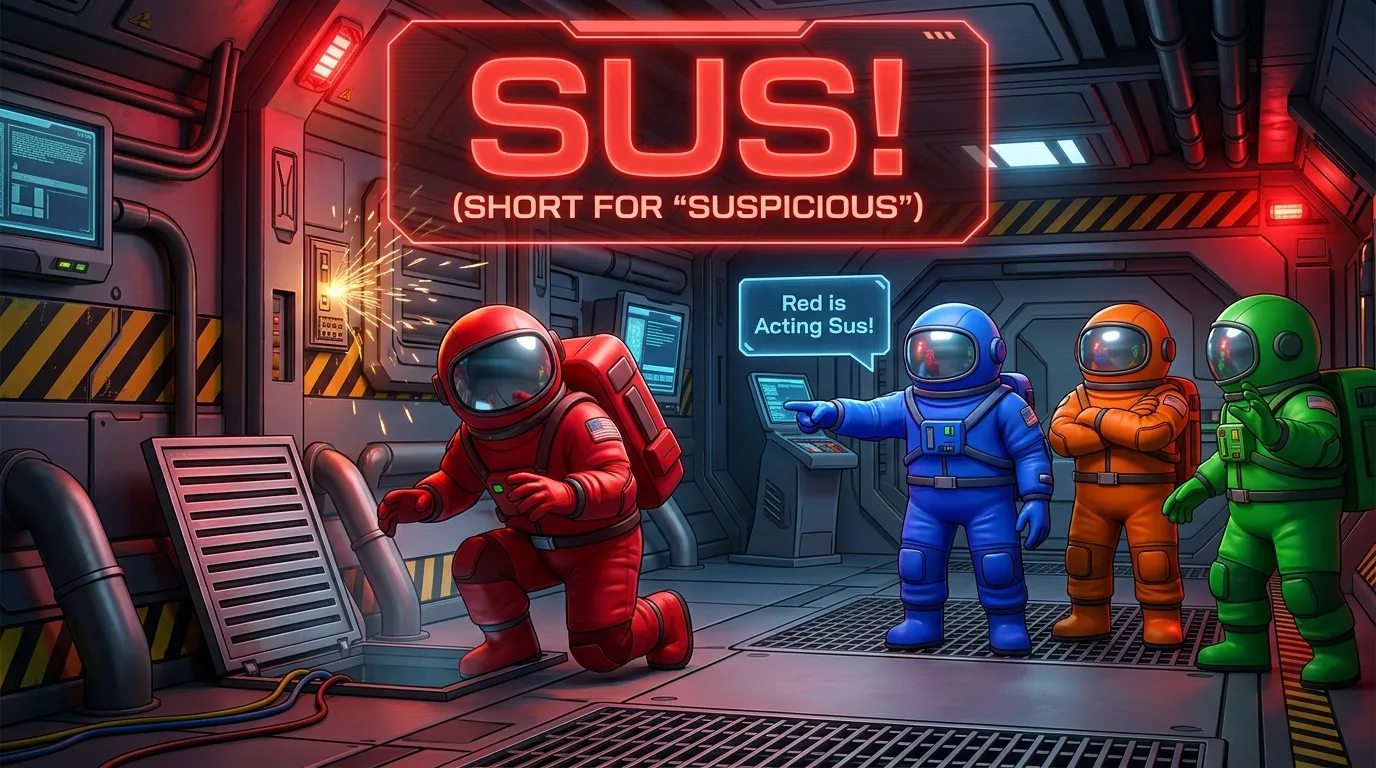
Have you ever seen someone reply, “That’s sus,” and wondered what they meant? You are not alone. The word sus shows up in texts, TikTok comments, group chats, memes, gaming chats, and everyday online talk.
The simple sus meaning is suspicious, questionable, or not quite right. People use it when a person, message, action, excuse, or situation makes them doubt something.
For example, if your friend gives a strange excuse, you might say, “That sounds sus.” You are saying that the story feels suspicious.
The word became much more famous through the game Among Us, where players called someone “sus” when they thought that person might be the Impostor. However, sus did not start with the game. It was already used as a shortened form related to “suspicious” or “suspect.”
This guide explains sus meaning in text, chat, slang, social media, and gaming, with simple examples you can use right away.
Quick Answer
Sus means “suspicious” or “suspect.” It describes someone or something that seems strange, shady, questionable, or hard to trust. In texting, “That’s sus” means “That seems suspicious.” In Among Us, it often means a player seems suspicious and may be the Impostor.
Definition & Meaning
The main sus meaning is suspicious.
It is informal slang. People use it to point out something that does not seem right.
For example:
- “That excuse is sus.”
- “Why are you acting sus?”
- “This website looks sus.”
- “His story sounds sus.”
- “That price is kinda sus.”
In each case, sus shows doubt.
It does not always mean that someone has done something wrong. It can simply mean that something feels unusual or does not make sense.
Dictionary.com lists sus as slang meaning “suspicious” and notes that it comes from a shortening of “suspicious.”
That small point matters. If someone says, “Your story is sus,” they are not always saying, “Your story is false.” They may only mean, “I am not sure I believe this.”
What Does Sus Mean in Text?
The sus meaning in text is usually suspicious, questionable, or shady.
People often use it because it is short and easy to type.
Imagine this text conversation:
Alex: “He said he never saw the message.”
Sam: “But he replied to it five minutes later.”
Alex: “That’s sus.”
Here, “sus” means the situation seems suspicious.
It can also describe online activity.
For example:
“That account keeps asking for my password. Very sus.”
The word can be playful or serious. Context tells you how strong the meaning is.
If a friend hides your birthday gift, you might jokingly call them sus. If a stranger sends you a strange payment link, calling the link sus may show a real concern.
What Does Sus Mean in Chat?
In chat, sus is a quick way to say that something seems off.
It can describe:
- A person
- A message
- A story
- An excuse
- A website
- A link
- A deal
- A decision
- A strange action
- A gaming move
Here are some natural chat examples:
“Why did you leave the group right after I asked you? Sus.”
This means the person’s action seems suspicious.
“That deal is $5 when every other site charges $50. Seems sus.”
This means the deal seems questionable.
“You said you ate one cookie. There are six missing. Sus.”
This is a playful accusation.
The word does not need a long explanation. One short word can show doubt.
What Does Sus Mean in Slang?
In slang, sus is a casual shortened form linked to suspicious and suspect. Dictionary.com describes it as slang for suspicious, while other current slang references also describe it as a short form used for something questionable or untrustworthy.
It is most common in informal settings.
You may see it in:
- Text messages
- Social media comments
- Discord chats
- Gaming chats
- Memes
- Group chats
- Casual conversations
Slang can change quickly, so a word may gain new uses over time. Cambridge notes that slang is very informal and can change quickly.
That is why sus works well with friends but is usually not the best choice in a formal email, school paper, or business report.
Instead of:
“This report looks sus.”
A formal version would be:
“This report contains some questionable information.”
The second sentence fits a professional setting better.
Is Sus Short for Suspicious?
Yes, in modern slang, sus is generally understood as a shortened form of suspicious or suspect. It is not normally an acronym in which each letter represents a different word.
So you can think of it like this:
suspicious → sus
The shortened form is faster and more casual.
This also explains why people can use it in many different situations. The basic idea stays the same: something raises doubt.
You may also see suss in English. But be careful. “Suss out” has a different job in a sentence. It means to figure something out or investigate something.
For example:
“That website looks sus.”
This means the website looks suspicious.
But:
“I need to suss out what happened.”
This means you need to figure out what happened.
What Does Sus Mean in Among Us?
If you have played Among Us, you have probably seen sus many times.
In the game, players try to identify hidden Impostors. When a player acts in a way that makes others suspicious, another player may say:
“Red is sus.”
This means Red seems suspicious and may be the Impostor.
For example, a player might seem sus because they were near an important event, gave a strange explanation, or behaved in a way that made other players doubt them.
The important point is that sus does not mean proven guilty.
A player can be called sus and still be innocent.
The game helped make the word extremely visible online. Among Us was released before its major popularity surge, and its 2020 rise helped push “sus” into wider internet culture. However, the word existed before the game.
So, if someone asks, “Is sus from Among Us?” the best answer is:
Among Us popularized sus, but it did not invent the word.
Sus Meaning Before Among Us
Many people first learned sus from Among Us, so it is easy to think the game created it.
That is not accurate.
Dictionary.com records sus as an older shortening connected to “suspicious” and gives historical evidence for the word before the modern gaming era.
The game gave the word a new and very visible setting. Players needed a fast way to say that another player looked suspicious. “Sus” fit perfectly.
Then the word moved beyond gaming.
People started using it for strange texts, weird behavior, bad excuses, unusual prices, questionable websites, and funny situations.
This is a common way slang spreads. A word can have an older use, gain attention in one community, and then move into wider everyday speech.
How to Use Sus in a Sentence
Using sus is easy when you remember its main idea.
Use it when something seems suspicious or questionable.
Here are natural examples:
For a person:
“Why is he being so sus today?”
For an excuse:
“Her excuse sounds sus.”
For a website:
“That website looks sus.”
For a message:
“This message is kinda sus.”
For a deal:
“A new phone for $20? That’s sus.”
For gaming:
“Blue is sus. I saw him near the body.”
For a joke:
“You ate the last slice and blamed the dog? Sus.”
The word often works best with is, looks, sounds, or acting.
Examples:
- “That is sus.”
- “It looks sus.”
- “That sounds sus.”
- “You’re acting sus.”
Sus vs Suspicious: What Is the Difference?
The meaning is close, but the tone is different.
Suspicious is a normal English word. It can work in casual, professional, and formal writing.
Sus is slang. It feels shorter, lighter, and more casual.
If you are talking to a friend, “That sounds sus” feels natural.
If you are writing a work email, “That seems suspicious” is usually better.
The difference is mainly about register, not the basic idea.
Comparison Table
| Sus | Suspicious |
| Casual slang | Standard English |
| Common in texts and chats | Works in formal and casual writing |
| Short and playful | Clear and more professional |
| Popular in gaming and social media | Used across many settings |
| “That seems sus.” | “That seems suspicious.” |
Using the right form depends on who you are talking to.
Is Sus Positive, Negative, or Rude?
Sus is usually negative or doubtful, because it suggests that something may not be right.
But it does not have to be harsh.
Friends often use it as a joke.
For example:
“You said you were going to eat healthy, then ordered three pizzas. Sus.”
That may be playful.
But if you tell a stranger:
“You are sus. I don’t trust you.”
It can sound like a real accusation.
This is why tone matters.
The word itself is not normally a swear word. Still, calling someone suspicious can make them feel accused or judged.
A useful rule is simple:
Use sus lightly with friends. Use clear, careful language when the situation is serious.
Does Sus Mean Guilty?
No.
This is one of the most important points about the word.
Sus means suspicious, not guilty.
If someone says:
“That account looks sus.”
They do not have proof that the account is bad.
The same idea works in Among Us. A player can look sus but still be innocent.
This distinction matters even more when you talk about real people or serious issues. A feeling of suspicion is not proof.
If something truly concerns you, explain what caused the concern.
For example:
“The link asks for your password, and the address looks wrong. I would avoid it.”
That gives useful information.
Simply saying:
“That link is sus.”
may not explain why.
Common Mistakes When Using Sus
Some mistakes happen because people learn the word through memes or games.
Mistake 1: Thinking sus only belongs to Among Us
It does not. The word is now used more broadly in casual online language.
Mistake 2: Thinking sus means guilty
It does not. It shows suspicion or doubt.
Mistake 3: Using sus in formal writing
It is slang. Use “suspicious,” “questionable,” or another clear word in formal situations.
Mistake 4: Thinking sus is an acronym
It is generally treated as a shortened slang form, not an acronym with a separate meaning for each letter.
Mistake 5: Confusing sus with suss out
“Sus” means suspicious.
“Suss out” means figure out or investigate.
Quick Reference Table
| Situation | Meaning of “sus” | Better example |
| Texting a friend | Something seems strange | “That excuse is sus.” |
| Gaming | A player seems suspicious | “Blue is sus.” |
| Social media | A post or claim seems questionable | “This post looks sus.” |
| Online safety | Something may not be trustworthy | “That link looks sus.” |
| Formal writing | Use standard English instead | “The link appears suspicious.” |
| A joke | Playful doubt | “You ate all the cookies? Sus.” |
| Serious accusation | Avoid relying on slang alone | Explain the actual concern |
When Should You Use Sus?
Use sus when the setting is relaxed.
Good places include:
- Group chats
- Text messages
- Gaming
- Social media
- Casual conversations
- Memes
- Friendly jokes
Avoid it when you need a formal or precise tone.
For example, these settings usually call for standard English:
- Job applications
- Business emails
- School assignments
- Legal documents
- Academic writing
- Official reports
Instead of saying:
“The information looks sus.”
You could say:
“The information appears questionable.”
That sounds more professional and gives the same basic idea.
What Are Some Synonyms for Sus?
The best synonym depends on the situation.
Common alternatives include:
- Suspicious
- Questionable
- Shady
- Sketchy
- Fishy
- Doubtful
- Untrustworthy
- Strange
- Unusual
- Not right
Some are more casual than others.
For example, sketchy and fishy are also informal. Suspicious and questionable are safer choices when you need a neutral tone.
Merriam-Webster lists words such as “questionable,” “dubious,” “suspect,” “shady,” and “fishy” among related terms for suspicious.
Sus Meaning on Social Media
On social media, sus often works as a quick reaction.
Someone may post a strange claim, edited image, unusual offer, or confusing story. A reply might simply say:
“Sus.”
The short reply tells the poster that the commenter has doubts.
You may also see phrases such as:
“Very sus.”
“Kinda sus.”
“That’s sus.”
“Why are you being sus?”
These forms change the tone slightly.
Very sus sounds stronger.
Kinda sus sounds softer.
That’s sus points to a specific thing.
You’re being sus points to a person’s behavior.
This flexibility helps explain why the word works so well in short online conversations.
Sus Meaning in Everyday Conversation
Although the word grew strongly through internet culture, people can also use it in casual speech.
For example:
“You left the room when the surprise started. That’s sus.”
Or:
“He suddenly changed his story. Pretty sus.”
Or:
“That restaurant deal seems sus.”
The meaning stays the same.
The speaker thinks something does not add up.
Still, usage can vary by age, community, and context. Slang is informal and changes over time, so not everyone will use every slang word in the same way.
How Do You Pronounce Sus?
Sus is pronounced like “suss.”
It rhymes with words such as bus and plus in common American pronunciation.
The pronunciation is simple, which may also help explain why the word works well in fast chat and gaming talk.
If you have only seen the word online, there is no special pronunciation you need to learn. Say it like the word “suss.”
Is Sus a Bad Word?
No. Sus is not normally considered a swear word.
It is slang.
However, the situation can change how it feels.
Calling your friend “sus” can be funny.
Calling a coworker “sus” in a serious meeting may sound childish or insulting.
So the issue is not that the word is offensive by itself. The main issue is context.
If you need to sound respectful and professional, use a standard word such as:
- Suspicious
- Questionable
- Unclear
- Concerning
- Untrustworthy
What Does “You’re Sus” Mean?
When someone says “You’re sus,” they mean:
“Your behavior seems suspicious.”
The exact reason depends on the situation.
Maybe you changed your story.
Maybe you are hiding something.
Or maybe your friend is simply joking.
For example:
Friend 1: “Who ate the last cookie?”
Friend 2: “Not me.”
This does not have to be a serious accusation. It can simply be playful teasing.
What Does “That’s Sus” Mean?
“That’s sus” means “That seems suspicious or questionable.”
The phrase usually focuses on a thing rather than a person.
For example:
“The seller wants payment before showing the product. That’s sus.”
Or:
“He said the meeting was canceled, but everyone else got a reminder. That’s sus.”
It can also be used for humor:
“You said you hate cake, but you ate half of mine. That’s sus.”
The phrase is flexible because it can describe almost anything that seems unusual.
FAQs:
What does sus mean in texting?
In texting, sus means suspicious, questionable, or strange. If someone says, “That sounds sus,” they mean they have doubts about what they heard or saw.
Is sus short for suspicious?
Yes. In modern slang, sus is commonly understood as a shortened form of “suspicious” or “suspect.” It is not normally an acronym.
What does sus mean in Among Us?
In Among Us, sus means that a player seems suspicious and may be the hidden Impostor. Being called sus does not prove that the player is the Impostor.
Is sus a bad word?
No. Sus is slang, not a swear word. However, calling someone sus can sound rude or accusing in some situations, so tone and context matter.
Did Among Us invent the word sus?
No. The word existed before Among Us. The game helped make it much more popular with online gamers and social media users.
What is the difference between sus and suspicious?
They have a similar meaning, but sus is casual slang while suspicious is standard English. Use suspicious when writing formally or speaking in a professional setting.
What does “suss out” mean?
Suss out means to figure out, understand, or investigate something. It is different from sus, which usually means suspicious. For example, “I need to suss out what happened” means “I need to figure out what happened.”
Conclusion:
The simplest sus meaning is suspicious, suspect, or questionable. People use it when someone or something seems strange, shady, or not quite right.
You will often see sus in text, chat, social media, memes, and gaming. Among Us helped make the word widely popular, but the slang existed before the game.
Remember one key point: sus shows suspicion, not proof. A person, message, or situation can seem sus without actually being wrong.
Use sus with friends and in other casual settings. For formal writing, choose words such as suspicious or questionable instead. Once you understand the context, the word is simple to spot and easy to use.

Hello, I am Daniel Brooks a passionate writer and educator with a deep love for language and creative expression. My work on similiezmeta.com focuses on helping kids and students explore the beauty of words through playful examples and practical explanations.