Have you ever read a sentence like “That was an apt response” and wondered what apt means? It is a short word, but it can express a clear and useful idea.
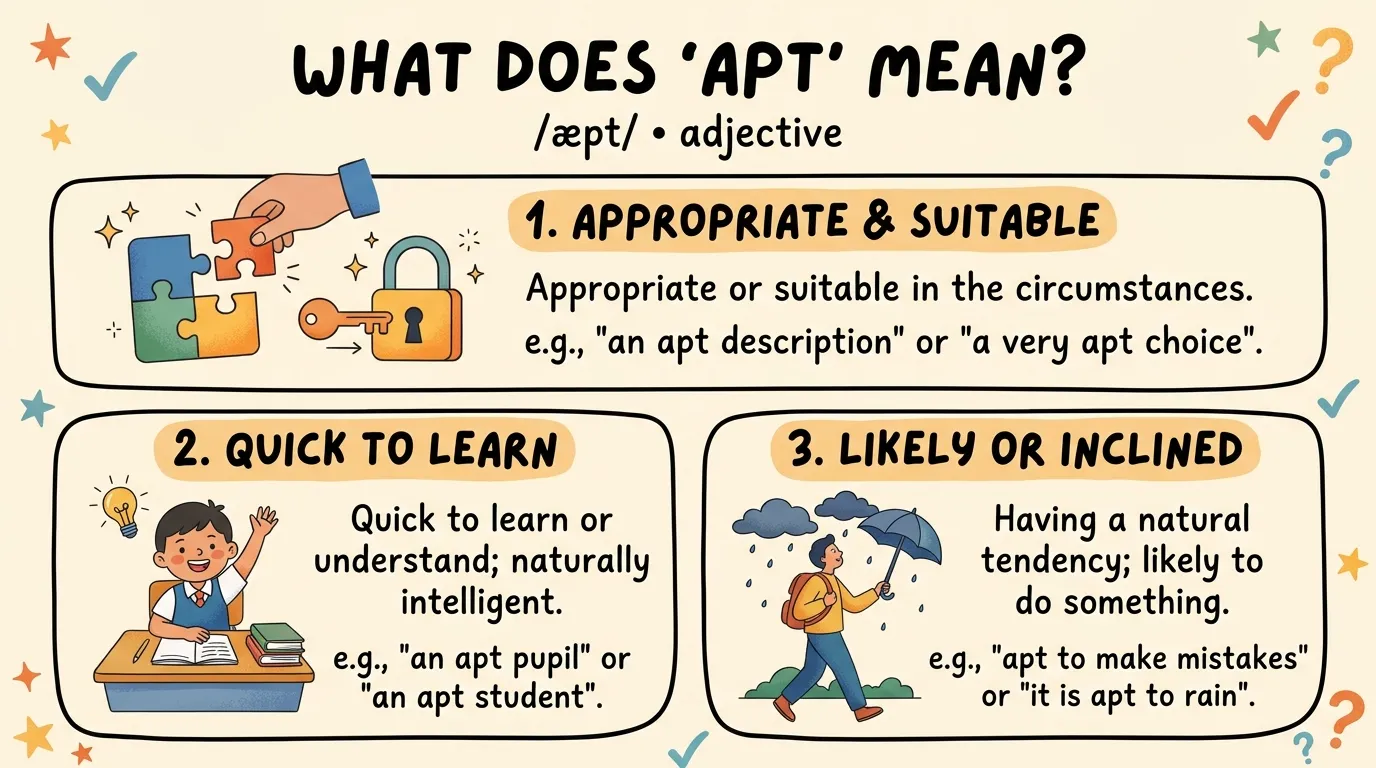
The word apt means suitable, appropriate, or right for a particular person, purpose, or situation. It can also mean likely to do something or quick to learn a skill. The exact meaning depends on how you use it.
For example, an apt reply is a reply that fits the situation well. An apt student may be someone who learns quickly. And if someone is apt to forget, they are likely to forget.
In this guide, you will learn the definition of apt, how to use it in everyday speech and writing, and which synonyms fit different situations. You will also see common phrases, easy examples, and mistakes to avoid.
Quick Answer: What Does Apt Mean?
Apt means suitable, fitting, or appropriate for a situation. It can also mean likely to do something or quick to learn.
Here are three simple examples:
- Suitable: Her apt choice made the task easier.
- Likely: He is apt to arrive late.
- Quick to learn: She is an apt learner.
The word apt often appears in books, news stories, schoolwork, and formal conversations. You can use it in daily speech, too.
Apt Definition and Meaning
The adjective apt has three main meanings.
1. Suitable or Appropriate
This is the most common meaning of apt. It describes something that fits a need, moment, or purpose.
For example, “That is an apt name for the puppy” means the name suits the puppy well.
You can use this meaning when talking about a choice, word, reply, example, or action.
- Her comment was apt for the moment.
- Blue was an apt color for the design.
- The teacher gave an apt example.
In each sentence, apt shows that something fits the situation.
2. Likely or Prone to Do Something
The word apt can also describe a person or thing that is likely to behave in a certain way.
This meaning often appears in the phrase “apt to.”
For example, “I am apt to lose track of time when I read” means I am likely to lose track of time while reading.
More examples include:
- He is apt to worry about small things.
- This road is apt to flood after heavy rain.
- Young children are apt to ask many questions.
Here, apt does not mean suitable. It means likely or prone.
3. Quick to Learn or Understand
Apt can describe someone who learns or understands something with ease.
For example, “She is an apt student” means she learns well or shows a natural ability to understand lessons.
You may see this meaning in phrases such as an apt pupil or an apt learner.
Examples:
- He is an apt student of mathematics.
- Maria proved to be an apt learner.
- The young musician was apt at picking up new tunes.
This meaning is less common in everyday American English than the meaning of suitable or appropriate.
How to Use Apt in a Sentence
You can use apt before a noun or in the phrase apt to + verb. The sentence structure helps show which meaning you intend.
Use Apt Before a Noun
Place apt before a noun when you mean suitable or appropriate.
Examples:
- That was an apt answer.
- The writer chose an apt title.
- Her story offers an apt example of kindness.
- It was an apt way to end the speech.
In these sentences, apt describes the noun that follows it.
Use Apt To Before a Verb
Use apt to when you mean likely or prone to do something.
Examples:
- I am apt to forget names.
- He is apt to speak before he thinks.
- The old machine is apt to stop without warning.
- She is apt to notice small details.
The word after to should be the base form of a verb, such as forget, speak, or notice.
Use Apt At or Apt for a Skill
You may also see apt at when describing someone’s ability, though good at or skilled at often sounds more natural in everyday American English.
Examples:
- He is apt at solving puzzles.
- She is apt at learning new languages.
For a more natural daily expression, you could say, “He is good at solving puzzles” or “She learns new languages quickly.”
Apt Meaning in Everyday English
The meaning of apt changes with the context. The examples below show how the word works in common situations.
At School
“The teacher gave an apt example.”
This means the example fit the lesson and helped explain the topic.
At Work
“Her response was apt.”
This means her response suited the question or situation.
In Daily Life
“I am apt to forget where I put my keys.”
This means I often forget where I put my keys or am likely to do so.
In Writing
“The author used an apt phrase.”
This means the phrase expressed the idea well.
When Talking About Talent
“He is an apt learner.”
This means he can learn new things quickly or shows a natural ability to learn.
These examples show why it helps to read the full sentence before choosing a meaning.
Common Phrases With Apt
Some phrases can help you understand and use the word with confidence.
Apt Example
An apt example clearly fits the point being discussed.
Example: “The broken bridge is an apt example of poor planning.”
Apt Response
An apt response suits a question or situation.
Example: “Her calm reply was an apt response to the complaint.”
Apt Description
An apt description captures the main features of a person, place, or thing.
Example: “Quiet and thoughtful is an apt description of Sam.”
Apt to Do Something
This phrase means likely or prone to do something.
Example: “He is apt to get nervous before a big test.”
Apt Pupil
An apt pupil is a learner who shows a natural ability to understand or learn.
Example: “The coach saw that the new player was an apt pupil.”
Apt Comparison
An apt comparison draws a useful link between two things.
Example: “Comparing the brain to a computer can be an apt comparison in some contexts.”
Remember that an apt comparison does not mean the two things are exactly the same. It means the comparison fits the point being made.
Apt Synonyms and Their Differences
Several words have meanings close to apt, but you cannot always swap them without changing the sentence.
- Suitable: Right for a purpose or need.
- Appropriate: Acceptable or fitting for a situation.
- Fitting: Well matched to a person, event, or purpose.
- Relevant: Directly related to the topic.
- Likely: Expected or probable to happen.
- Prone: Often likely to act in a certain way, sometimes with a negative sense.
- Quick-witted: Able to think and respond quickly.
- Capable: Having the ability to do something.
For example, “an apt reply” can often mean “a suitable reply” or “an appropriate reply.” But “he is apt to forget” means “he is likely to forget,” not “he is suitable to forget.”
Choose a synonym based on the meaning you want to express.
Apt vs. Suitable vs. Appropriate
These three words overlap, but each has its own tone and use.
| Word | Main meaning | Example |
| Apt | Fitting, suitable, or likely | That was an apt reply. |
| Suitable | Right for a need or purpose | These shoes are suitable for walking. |
| Appropriate | Right or acceptable in a given setting | Wear appropriate clothes for the event. |
| Fitting | Well matched to a person or moment | It was a fitting end to the story. |
| Likely | Expected to happen | Rain is likely this evening. |
Use apt when you want to show that something fits a point or situation well. Use suitable when you focus on a purpose or need.
For example, “an apt quote” suggests a quote that expresses the point well. “Suitable shoes” means shoes that work for the task. “Appropriate behavior” means behavior that fits the setting.
Apt vs. Likely: What Is the Difference?
Apt and likely can mean much the same thing when you describe something that may happen.
For example:
- “He is apt to forget” means he is likely to forget.
- “The road is apt to flood” means the road is likely to flood.
However, likely is more common in everyday American English when you talk about future events.
Apt can sound more formal or literary. It can also mean suitable or appropriate, while likely does not have that meaning.
Compare these sentences:
- “That was an apt answer.” This means the answer fit the question well.
- “That answer is likely to be correct.” This means the answer probably is correct.
The first sentence focuses on how well the answer fits. The second focuses on the chance that it is correct.
Common Mistakes When Using Apt
The word is easy to learn, but a few mistakes can cause confusion.
Mistake 1: Thinking Apt Only Means Suitable
Apt can mean suitable, likely, or quick to learn.
Incorrect assumption: “Apt to forget” means suitable for forgetting.
Correct meaning: “Apt to forget” means likely to forget.
Mistake 2: Using Apt When Likely Sounds Better
In casual speech, “I am apt to be late” is correct, but “I am likely to be late” often sounds more natural.
Choose the phrase that suits your tone and audience.
Mistake 3: Confusing Apt With Adept
These words look alike, but they have different meanings.
- Apt: Suitable, fitting, or likely.
- Adept: Skilled or very good at something.
Example: “She gave an apt answer” means her answer fit the question. “She is adept at coding” means she is skilled at coding.
Mistake 4: Using Apt Without Clear Context
A sentence such as “That is apt” may be correct, but readers may not know what makes it apt.
A clearer sentence is “That is an apt example of teamwork.”
Adding context helps the reader understand your point.
Quick Reference: How to Use Apt Correctly
Use this table to choose the right meaning and sentence pattern.
| Your goal | Best pattern | Example |
| Show a good fit | Apt + noun | That is an apt title. |
| Describe a likely action | Apt to + verb | He is apt to worry. |
| Describe learning ability | Apt learner or apt pupil | She is an apt pupil. |
| Use a more common daily phrase | Likely to + verb | He is likely to worry. |
| Describe skill | Adept at + noun or verb ending in -ing | She is adept at drawing. |
| Describe a good match for a need | Suitable for + noun | This tool is suitable for the job. |
Before you use apt, ask yourself one question: Do I mean suitable, likely, or quick to learn? This simple check can help you choose the right word.
Is Apt Formal or Informal?
Apt is correct in both formal and informal English, but it appears more often in writing or careful speech than in casual conversation.
You may see it in essays, reports, reviews, books, and news articles. Phrases such as an apt example, an apt description, and an apt response are common ways to express that something fits well.
In everyday conversation, people may use right, suitable, good, or likely instead.
For example:
- Formal: “That is an apt description of the problem.”
- Casual: “That is a good way to describe the problem.”
Both sentences express a similar idea. The best choice depends on your audience and tone.
What Is the Origin of the Word Apt?
The English word apt comes from Latin aptus, meaning fitted or suited. English has used the word for centuries to describe things that fit a purpose or situation.
Its meanings later came to include being inclined or likely to do something, as well as being quick to learn.
You do not need to know the word’s history to use it correctly. Still, the original idea of being fitted or suited can help you remember its main meaning.
FAQs:
1. What does apt mean in simple words?
Apt means suitable, fitting, or right for a situation. It can also mean likely to do something or quick to learn. For example, an apt answer fits the question well.
2. What does apt mean in a text message?
In a text message, apt usually means suitable or fitting. If someone says, “That is an apt name,” they mean the name suits the person or thing. It is not a common texting abbreviation.
3. What does apt to mean?
Apt to means likely or prone to do something. For example, “She is apt to worry” means she is likely to worry. The phrase usually comes before a verb.
4. Is apt a positive word?
Apt is usually neutral or positive when it means suitable or fitting. An apt answer is a good fit for a question. When it means likely, the tone depends on the action, as in “apt to succeed” or “apt to make mistakes.”
5. What is a synonym for apt?
Common synonyms include suitable, appropriate, fitting, and relevant when apt means right for a situation. When it means likely, use likely or prone. The best synonym depends on the sentence.
6. What is the difference between apt and adept?
Apt means suitable, likely, or quick to learn. Adept means skilled at doing something. For example, an apt answer fits the question, while an adept artist has strong artistic skills.
7. What is the opposite of apt?
The opposite depends on the meaning. When apt means suitable, possible opposites include unsuitable, inappropriate, or unfitting. When it means likely, unlikely may be the best opposite.
Conclusion:
The word apt means suitable, fitting, or appropriate. It can also mean likely to do something or quick to learn. The sentence tells you which meaning the writer intends.
Use apt for a fitting answer, a clear example, or a description that captures the point well. Use apt to when you mean likely or prone to do something. And remember that apt and adept are not the same: adept means skilled.
If you are unsure which word to choose, try replacing apt with suitable or likely. If the sentence keeps its meaning, you have probably found the right use.

Hi, I’m Nathan Foster. I’m passionate about words, their meanings, and the different ways we use them in everyday communication. I enjoy explaining unfamiliar words in simple English so readers can understand them without confusion.
At SimiliezMeta.com, I focus on word meanings, definitions, synonyms, antonyms, and useful examples that show how words work in real sentences. I believe learning a new word should be simple, practical, and helpful for everyday life.


