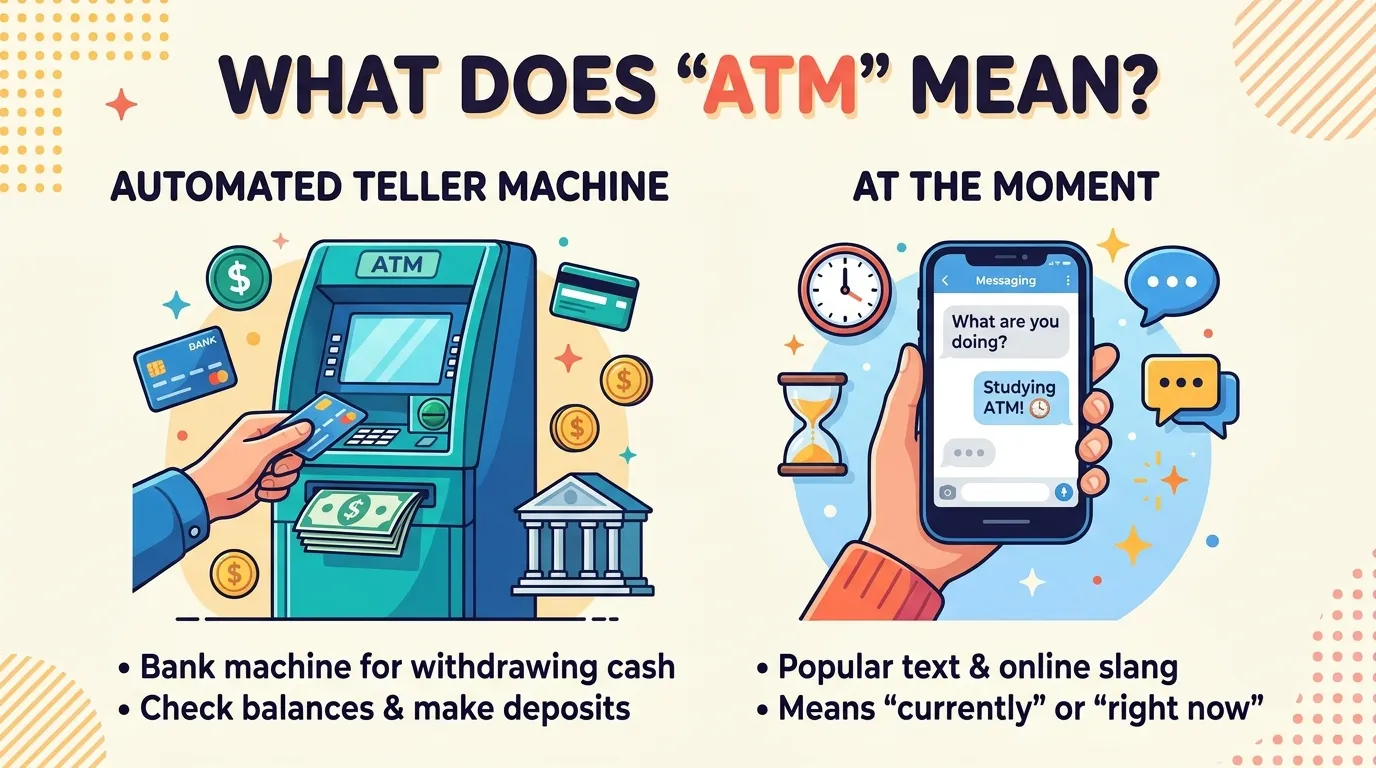
You may see the letters ATM on a bank sign, outside a shopping mall, or in a text message. But do they always mean the same thing? Not quite. The meaning can change based on where you see them.
In banking, ATM stands for Automated Teller Machine. It is a machine that lets people do basic banking tasks without speaking to a bank worker. You can use it to take out cash, check your balance, and sometimes deposit money.
However, ATM can also mean “at the moment” in text messages and online chats. This short form helps people save time when they type.
Understanding the ATM meaning can help you avoid confusion. In this guide, you will learn what ATM stands for, how the machine works, what you can do with it, and how to use one safely. You will also learn what ATM means in texting and other common settings.
Quick Answer: What Does ATM Stand For?
ATM stands for Automated Teller Machine. It is an electronic banking machine that lets you withdraw cash, check your account balance, and perform other banking tasks without visiting a bank teller.
In text messages, ATM can also stand for At The Moment, which means right now or currently.
The correct meaning depends on the situation:
- Banking: Automated Teller Machine.
- Texting: At The Moment.
- Everyday conversation: Usually refers to a cash machine.
ATM Definition and Meaning
The full form of ATM is Automated Teller Machine. It is a self-service machine that connects to a bank’s computer system and gives customers access to certain banking services.
The word automated means that a machine can perform a task with little or no help from a person. A teller is a bank worker who helps customers with money and other banking needs.
Together, these words describe a machine that handles some of the tasks a bank teller normally performs.
For example, imagine that you need cash on a Sunday. Your bank branch may be closed, but you can visit an ATM and withdraw money with your debit card and PIN.
You do not need to speak to a bank employee. The machine checks your details and processes your request.
According to the State Bank of Pakistan, ATMs connect customers to banking services such as cash withdrawals, deposits, fund transfers, and bill payments.
What Is the Full Form of ATM?
ATM stands for Automated Teller Machine.
Here is a simple breakdown of each word:
- Automated: A process that a machine performs automatically.
- Teller: A bank employee who handles customer transactions.
- Machine: An electronic device that performs a specific task.
An ATM works like a self-service bank counter. It helps customers complete common transactions without waiting for a bank employee.
You may also hear people call it a cash machine, cashpoint, or cash dispenser. These names usually refer to the same type of banking machine.
In the United States, ATM is the common term. In the United Kingdom, people often use the term cash machine or cashpoint.
What Is an ATM Used For?
An ATM does more than give people cash. It can offer several banking services, depending on the bank, machine, and card.
Here are some common uses.
1. Withdraw Cash
Taking out money is one of the main reasons people use ATMs.
You insert your card, enter your PIN, choose a withdrawal amount, and collect your cash.
For example, if you need $100 for shopping, you may withdraw that amount from your available account balance.
Some ATMs also let you withdraw cash without a physical card. This feature may use a mobile banking app or a one-time code.
2. Check Your Account Balance
You can use an ATM to see how much money you have in your bank account.
After inserting your card and entering your PIN, choose the balance inquiry option.
The machine displays your available balance on the screen.
This service helps you check your money before making a purchase or withdrawing cash.
3. Transfer Money
Some ATMs let customers send money between bank accounts.
For example, you may transfer money from your savings account to your current account.
Some machines also support transfers to other accounts. The available options depend on your bank.
4. Deposit Money
Certain ATMs allow you to deposit cash or checks into your account.
You place the money in the correct slot or follow the machine’s instructions. The ATM then processes the deposit.
Some deposits appear quickly, while others may need extra time for the bank to verify them.
Always check your account after making a deposit.
5. Pay Bills
Some banks offer bill payment services through their ATMs.
You may be able to pay electricity bills, phone bills, or other approved payments.
For example, a customer may use an ATM to pay a utility bill without visiting a bank branch.
6. Get a Mini Statement
A mini statement shows a short list of recent account transactions.
It may include money you received, cash you withdrew, and other payments.
This can help you track your spending without requesting a full bank statement.
Not every ATM offers all these services. Check your bank’s website to see which options are available.
How Does an ATM Work?
An ATM works by connecting to your bank through an electronic network. It checks your card details, confirms your identity, and processes the transaction.
Here is how a normal cash withdrawal works.
- Insert your card: Place your debit or ATM card into the card reader.
- Choose your language: Select the language you understand.
- Enter your PIN: Type your personal identification number.
- Select a service: Choose the cash withdrawal option.
- Enter the amount: Type how much money you want.
- Wait for approval: The machine checks your account and available funds.
- Collect your cash: Take the money from the cash slot.
- Take your card: Remove your card and any receipt.
The bank checks whether your card is valid and whether your account has enough available money.
If everything is correct, the ATM completes the request. If something is wrong, it may show an error message.
For example, you may see a message saying that your balance is too low or your PIN is incorrect.
What Do You Need to Use an ATM?
Most traditional ATMs require a bank card and a PIN.
Here are the main things you may need:
- ATM or debit card: This identifies your bank account.
- PIN: This is your secret number used to confirm your identity.
- Available balance: You need enough money for a withdrawal.
- Bank account: Your card must be linked to an active account.
Some modern ATMs also support cardless transactions. These may let you use a banking app, QR code, or temporary withdrawal code.
Your bank decides which methods you can use.
ATM vs. Bank Teller: What Is the Difference?
An ATM and a bank teller both help customers with banking tasks. However, they work in different ways.
A bank teller is a real person who works at a bank branch. An ATM is an electronic machine that handles certain tasks on its own.
| ATM (Automated Teller Machine) | Bank Teller |
| Works through an electronic system | Helps customers in person |
| Allows self-service transactions | Handles transactions for customers |
| Can offer access outside branch hours | Usually works during branch hours |
| Handles common banking tasks | Can help with more complex requests |
| Requires a card, PIN, or supported access method | May require account details and identification |
Which one should you use?
Use an ATM when you need a simple service, such as cash withdrawal or a balance check.
Visit a bank teller when you need personal help, want to discuss an account problem, or need a service that the ATM cannot provide.
ATM: Pros, Cons, and Common Mistakes
ATMs make banking easier, but they also have some limits. Understanding these points can help you use them with care.
| Pros of ATMs | Cons of ATMs |
| Offer quick cash withdrawals | May charge withdrawal fees |
| Reduce the need to visit a bank | Can run out of cash |
| Offer some services outside bank hours | May stop working during technical issues |
| Help customers check balances | Have daily withdrawal limits |
| Support self-service banking | Can be a target for card theft and fraud |
Here are some common mistakes to avoid:
- Entering the wrong PIN several times.
- Forgetting to take your card.
- Leaving your cash in the machine.
- Ignoring extra fees before confirming a transaction.
- Sharing your PIN with another person.
- Walking away without ending your session.
A little care can prevent many common problems.
How to Use an ATM Safely
ATMs are useful, but you should protect your card and personal details whenever you use one.
Follow these simple safety tips.
1. Keep Your PIN Secret
Your PIN is a private number that helps protect your bank account.
Never share it with strangers. Your bank should not ask you to reveal your full PIN over the phone.
2. Cover the Keypad
Use your free hand to cover the keypad while entering your PIN.
This makes it harder for someone nearby to see your number.
3. Check the Machine
Look at the card slot and keypad before using an ATM.
If you notice a loose part, strange device, or anything that looks unusual, do not use the machine.
Some criminals use hidden devices to steal card information. This type of fraud is known as card skimming.
American Bankers Association+1
4. Do Not Accept Help From Strangers
If someone offers to help you use an ATM, be careful.
Do not hand over your card or tell anyone your PIN. If you have a problem, contact your bank.
5. Take Your Card and Cash
Before leaving, check that you have your card, cash, and receipt.
Also, make sure the machine has ended your transaction.
6. Report Suspicious Activity
Check your account after using an ATM.
If you see a payment or withdrawal you did not make, contact your bank as soon as possible.
What Does ATM Mean in Text and Chat?
In texting, ATM means At The Moment.
People use it in messages, social media posts, and online chats to describe something happening right now.
It is a casual abbreviation that saves time when typing.
For example:
- “I’m busy atm.” means “I’m busy at the moment.”
- “Can’t talk atm.” means “I can’t talk right now.”
- “I’m studying atm.” means “I’m studying currently.”
- “Are you free atm?” means “Are you free right now?”
- “I don’t need anything atm.” means “I don’t need anything at the moment.”
The lowercase form, atm, is common in casual messages. People also write it in capital letters.
ATM Meaning in WhatsApp
On WhatsApp, ATM usually means “at the moment.”
For example:
Friend: Are you coming to the party?
You: I am working atm. I will let you know later.
Here, ATM tells your friend that you are working right now.
ATM Meaning on Instagram and Snapchat
On Instagram and Snapchat, people use ATM to share their current activities or feelings.
For example:
- “Missing my friends atm.”
- “Watching a movie atm.”
- “Not feeling well atm.”
- “Just relaxing atm.”
In each example, ATM means “at the moment.”
Is ATM Formal or Informal?
ATM is mostly informal when it means “at the moment.”
You can use it in:
- Text messages
- WhatsApp chats
- Instagram DMs
- Snapchat messages
- Online gaming chats
- Casual conversations
However, it is better to write the full phrase in formal emails, business reports, and professional documents.
For example:
- Informal: “I am busy atm.”
- Formal: “I am currently busy.”
ATM vs. ATM: How to Know the Correct Meaning
The same three letters can have two different meanings. The words around ATM usually tell you which one the writer intends.
| Example | Correct Meaning | Why? |
| “I need to find an ATM.” | Automated Teller Machine | The person needs cash. |
| “I am busy atm.” | At The Moment | The person describes their current situation. |
| “Where is the nearest ATM?” | Automated Teller Machine | The person asks about a banking machine. |
| “I cannot reply atm.” | At The Moment | The person cannot respond right now. |
| “The ATM is not working.” | Automated Teller Machine | The sentence describes a machine. |
| “I am studying atm.” | At The Moment | The person is talking about a current activity. |
Easy tip: If the sentence talks about money, cards, cash, or banking, ATM means Automated Teller Machine. If it talks about time, feelings, or activities, it usually means At The Moment.
Other Meanings of ATM
Although the two meanings above are the most useful in everyday life, ATM can have other meanings in special fields.
Here are a few examples:
- Asynchronous Transfer Mode: A type of networking technology used to transfer data.
- Atmosphere (atm): A unit of pressure used in science.
- At The Moment: A common abbreviation in digital communication.
- Automated Teller Machine: An electronic banking machine.
The meaning of ATM depends on the topic.
For example, a science book may use atm to describe pressure, while a banking guide uses ATM to describe a cash machine.
Do not assume that every use of ATM refers to banking. Read the full sentence to understand its meaning.
ATM Quick Reference Checklist
Use this table when you need to understand ATM quickly.
| What You See | What It Means |
| ATM full form | Automated Teller Machine |
| ATM in banking | A self-service banking machine |
| ATM in texting | At The Moment |
| ATM on WhatsApp | At The Moment |
| ATM on Instagram | At The Moment |
| ATM card | A card used for ATM transactions |
| ATM PIN | Personal Identification Number |
| ATM withdrawal | Taking cash from an account |
| ATM balance inquiry | Checking your account balance |
| atm in science | Atmosphere, a pressure unit |
This quick reference makes it easy to identify the correct meaning in different situations.
FAQs:
1. What does ATM stand for?
ATM stands for Automated Teller Machine. It is an electronic machine that allows bank customers to withdraw cash, check balances, and perform other banking tasks without visiting a bank teller.
2. What does ATM mean in texting?
In texting, ATM means “At The Moment.” People use it to describe what they are doing or feeling right now.
For example, “I am busy atm” means “I am busy at the moment.”
3. What is the full form of an ATM card?
An ATM card is a bank-issued card that lets customers access supported ATM services. ATM itself stands for Automated Teller Machine. The card can be used for cash withdrawals and other services supported by the bank.
4. Is ATM the same as a debit card?
No. An ATM is a machine, while a debit card is a payment card linked to a bank account. You can use a debit card at an ATM to withdraw money. You may also use it to pay for purchases.
5. Can I use an ATM without a card?
Yes, some banks offer cardless ATM services. These services may use a mobile banking app, QR code, or temporary withdrawal code. However, not every bank or ATM supports this feature.
6. Does using an ATM cost money?
It depends on your bank, card, and the ATM operator. Some withdrawals are free, while others may include a service fee. Always check the displayed charges before confirming your transaction.
7. What is the difference between ATM and ATM machine?
ATM already stands for Automated Teller Machine. Therefore, saying “ATM machine” repeats the word machine. However, many people still use this phrase in everyday conversation.
Conclusion:
The ATM meaning depends on where you see it. In banking, ATM stands for Automated Teller Machine, a device that helps people withdraw cash, check balances, and complete other banking tasks. In text messages, ATM means “At The Moment” and describes something happening right now.
The easiest way to understand ATM is to look at the words around it. Money and banking usually point to the machine, while casual conversations point to the texting meaning.
Now that you know both meanings, you can understand ATM in messages, banking, and everyday conversations with confidence. Share this guide with someone who wants to learn common abbreviations.

Hi, I’m Nathan Foster. I’m passionate about words, their meanings, and the different ways we use them in everyday communication. I enjoy explaining unfamiliar words in simple English so readers can understand them without confusion.
At SimiliezMeta.com, I focus on word meanings, definitions, synonyms, antonyms, and useful examples that show how words work in real sentences. I believe learning a new word should be simple, practical, and helpful for everyday life.


