Have you ever visited a doctor’s office and noticed the letters PA-C after a healthcare worker’s name? You may have wondered what these letters mean and whether that person is a doctor.
The term PA-C is common in hospitals, clinics, and other medical settings across the United States. It tells you something important about a healthcare professional’s training and certification.
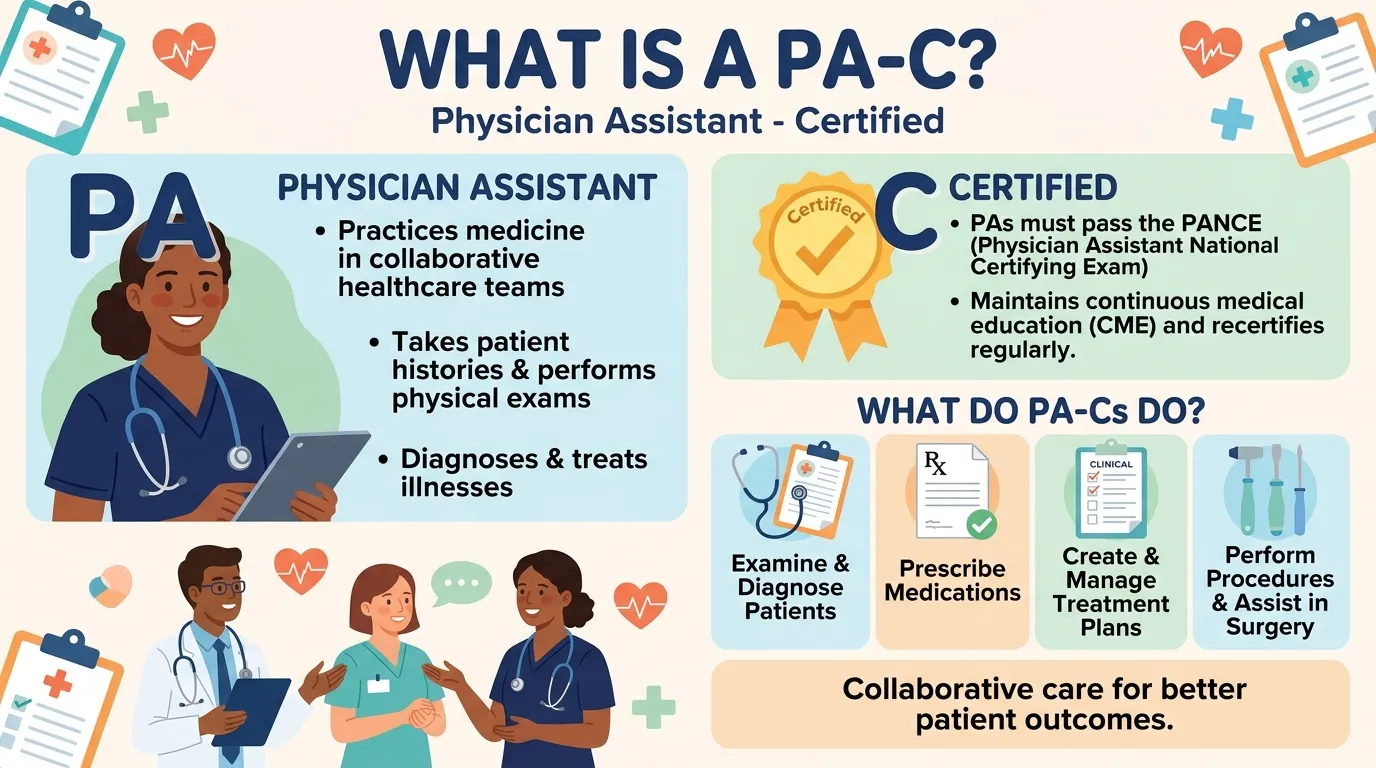
PA-C means Physician Assistant-Certified. It is a professional title for a physician assistant who has met the required education and certification standards. A PA-C can examine patients, diagnose health problems, order tests, and provide treatment. Their exact duties depend on state law and their workplace.
In this guide, you will learn what PA-C means, what these professionals do, how they earn the title, and how they differ from doctors and nurse practitioners. You will also learn what to expect when you visit a PA-C.
Quick Answer
PA-C stands for Physician Assistant-Certified. It is a professional credential for a physician assistant who has passed the national certification exam and met the required certification standards.
PA-Cs provide medical care, diagnose illnesses, treat patients, and may prescribe medicine under state law.
PA-C Definition and Meaning
The letters PA-C have two parts:
- PA: Physician Assistant.
- C: Certified.
Together, they mean Physician Assistant-Certified.
A PA-C is a trained medical professional who works as part of a healthcare team. They may work with doctors, nurses, and other medical staff to care for patients.
The title shows that the person has earned national certification. It is not simply a job title or a degree.
A PA-C has completed an approved physician assistant education program and passed the Physician Assistant National Certifying Examination (PANCE).
The National Commission on Certification of Physician Assistants (NCCPA) awards the PA-C credential to people who meet its certification requirements.
What Does a PA-C Do?
A PA-C provides many types of medical care. Their daily work depends on their medical specialty, training, workplace, and state rules.
For example, a PA-C in a family clinic may treat common illnesses. A PA-C in a hospital may care for patients with serious health problems.
Here are some common duties:
1. Examine Patients
A PA-C asks about your symptoms, health history, and current concerns. They may check your heart rate, blood pressure, breathing, and other signs.
2. Diagnose Health Problems
They can assess your symptoms and identify possible health problems. They may diagnose conditions such as infections, allergies, and minor injuries.
3. Order Medical Tests
A PA-C may order blood tests, urine tests, X-rays, and other exams. They can also review the results and explain what they mean.
4. Prescribe Medicine
In many states, PA-Cs can prescribe medicine. State laws set the rules for prescribing, including any limits on certain drugs.
5. Create Treatment Plans
They may suggest medicine, lifestyle changes, follow-up visits, or other care. They can also track your progress and adjust your treatment when needed.
6. Provide Preventive Care
A PA-C may offer health advice, check for early signs of illness, and help patients manage long-term health problems.
7. Assist With Surgery
Some PA-Cs work with surgeons. They may help prepare patients, assist during operations, and provide care after surgery.
The American Academy of Physician Associates (AAPA) lists these and other duties as part of PA practice.
How Does Someone Become a PA-C?
Becoming a PA-C takes years of study, practical training, and testing. A person cannot earn this title through a short course or a basic medical certificate.
Here are the main steps.
Step 1: Complete a Bachelor’s Degree
Many people first earn a bachelor’s degree. They often study biology, chemistry, health science, or another related subject.
PA schools also have entry requirements. These may include science courses and hands-on patient care experience.
Step 2: Graduate From an Accredited PA Program
The next step is to complete an entry-level physician assistant program accredited by the Accreditation Review Commission on Education for the Physician Assistant (ARC-PA).
These programs usually take about two to three years. Students study medical science and gain practical experience in clinical settings.
Their training may cover:
- Family medicine
- Emergency medicine
- Internal medicine
- Pediatrics
- Surgery
- Women’s health
- Mental health
Step 3: Pass the PANCE Exam
After graduation, eligible students can take the Physician Assistant National Certifying Examination (PANCE).
The NCCPA manages this national certification process. The exam tests medical knowledge, clinical reasoning, and skills needed for entry-level PA practice.
Passing the exam is a key step toward earning the PA-C credential.
NCCPA
Step 4: Meet State Licensing Rules
National certification and state licensure are not the same thing.
A person may earn PA-C certification, but they must also meet the licensing rules of the state where they plan to work.
These rules can cover applications, background checks, and other requirements.
Step 5: Maintain Certification
PA-Cs must meet NCCPA requirements to keep their certification current.
These requirements include continuing medical education and periodic recertification. A PA must keep up with the latest NCCPA rules to continue using the credential.
Important: The PA-C title is legally protected. A person cannot use it just because they graduated from a PA program. They must hold current NCCPA certification.
PA-C vs. MD: What Is the Difference?
PA-C and MD are different medical credentials.
An MD is a Doctor of Medicine. This person completes medical school and the required postgraduate training for their field.
A PA-C completes an accredited PA program and earns national certification. Both professionals can provide medical care, but their education, training paths, and legal roles differ.
| Feature | PA-C | MD |
| Full title | Physician Assistant-Certified | Doctor of Medicine |
| Education | Accredited PA program | Medical school |
| National exam | PANCE | USMLE |
| Residency | Not generally required | Required for standard medical practice |
| Main role | Provides care as part of a medical team | Physician who can lead and provide medical care |
| Prescribing | Allowed under applicable state rules | Allowed under medical licensing rules |
| Specialty training | May gain experience in a chosen field | May complete residency and fellowship |
A PA-C is not an MD and should not present themselves as one. However, PA-Cs can provide a wide range of medical services within their legal scope of practice.
A physician may also have a longer and more specialized training path, especially after residency and fellowship.
American Medical Association+1
PA-C vs. NP: Are They the Same?
No. A PA-C and a nurse practitioner (NP) are two different types of healthcare professionals.
A PA-C follows the physician assistant education path. An NP first becomes a registered nurse and then completes advanced nursing education.
Both may diagnose illnesses, order tests, treat patients, and prescribe medicine where state law allows.
However, their training models and practice rules differ.
| Feature | PA-C | NP |
| Training path | Physician assistant education | Nursing education |
| Starting background | Usually a bachelor’s degree and required prerequisites | Registered nursing background |
| Medical approach | General medical model | Advanced nursing model |
| Certification | NCCPA | Relevant nursing certification body |
| Scope of practice | Depends on state law | Depends on state law |
| Workplaces | Hospitals, clinics, and other medical settings | Hospitals, clinics, and other medical settings |
Neither title means that the professional is an MD. Both roles are important parts of modern healthcare.
Where Do PA-Cs Work?
PA-Cs work in many areas of healthcare. You may meet one in a small medical office or a large hospital.
Their workplace often depends on their interests and training.
Some common work settings include:
- Family medicine: They treat common illnesses and provide routine health checks.
- Emergency medicine: They help care for people with sudden injuries and health problems.
- Hospitals: They examine patients, manage treatment, and work with medical teams.
- Surgery: They assist surgeons and support patients before and after operations.
- Pediatrics: They provide care for babies, children, and teenagers.
- Dermatology: They assess skin problems and help treat skin conditions.
- Orthopedics: They care for patients with bone, joint, and muscle problems.
- Mental health: Some work with teams that treat mental health conditions.
A PA-C may also work in community health centers, nursing homes, and other care settings.
Is a PA-C a Real Doctor?
A PA-C is a qualified medical professional, but they are not a physician with an MD or DO degree.
This difference matters when you visit a clinic.
A PA-C can examine you, diagnose many health conditions, order tests, and create treatment plans. They may also prescribe medicine if state law allows it.
However, they do not complete the same medical school and residency path as physicians.
You should not assume that every person who provides medical care is an MD. Healthcare teams include many trained professionals with different roles.
If you want to know who is treating you, you can ask about their degree, certification, and role in your care.
Can a PA-C Prescribe Medication?
Yes. PA-Cs can prescribe medication in many parts of the United States.
However, prescribing rules depend on state law and the type of medicine.
Some states set extra rules for controlled substances. Workplaces may also have their own policies.
A PA-C may prescribe medicine for:
- Bacterial infections
- Pain
- Allergies
- High blood pressure
- Skin conditions
- Other health problems
The PA must follow the laws and rules that apply to their practice.
If you have questions about a prescription, ask the PA-C to explain the medicine, dose, possible side effects, and how to take it.
What Does PA-C Mean After a Name?
When you see PA-C after someone’s name, it shows that the person holds current NCCPA certification.
For example:
Sarah Johnson, PA-C
This means Sarah Johnson is a physician assistant with national certification.
You may see this title on:
- Hospital websites
- Medical staff badges
- Prescription records
- Clinic websites
- Patient medical records
- Appointment letters
The letters help patients and employers understand the professional’s certification.
Keep in mind that PA-C does not tell you the person’s exact specialty. A PA-C may work in family medicine, surgery, emergency care, or another field.
Does PA-C Mean Board Certified?
Yes. The NCCPA uses the term board certification for its national PA certification process.
The PA-C credential is the general certification earned by eligible physician assistants after they pass the PANCE and meet the required standards.
However, there is an important difference between general certification and specialty certification.
A PA-C does not automatically hold a separate specialty board certification. Some PAs may earn an additional Certificate of Added Qualifications (CAQ) in a specific area of practice.
For example, a PA may hold a CAQ in emergency medicine.
The NCCPA explains that its general board certification does not itself represent a specialty certification.
PA-C Quick Reference Checklist
Use this table when you see PA-C on a medical document or after a healthcare worker’s name.
| What to check | What it means |
| PA | Physician Assistant |
| C | Certified |
| Full meaning | Physician Assistant-Certified |
| Certifying body | NCCPA |
| Main exam | PANCE |
| Medical role | Examines, diagnoses, and treats patients |
| Prescribing rights | Depend on state law |
| Specialty | Depends on the PA’s training and experience |
| Current certification | Must be maintained to use PA-C |
This quick guide can help you understand the title without confusing it with MD, DO, or NP.
Is PA-C the Same in Every Country?
No. The meaning and use of PA-C can vary by country.
In the United States, PA-C refers to the Physician Assistant-Certified credential issued by the NCCPA.
Other countries may have different healthcare roles, education systems, and professional titles. A physician assistant in one country may not have the same legal duties as a PA in the United States.
There is also a change in professional language worth knowing. The American Academy of Physician Associates adopted the name physician associate for the profession in 2021. However, the PA-C credential remains in use, and state laws govern professional practice and titles.
So, if you see PA-C in an American medical setting, the safest interpretation is Physician Assistant-Certified.
FAQs:
1. What does PA-C stand for in medical terms?
PA-C stands for Physician Assistant-Certified. It is a national professional credential awarded by the NCCPA to physician assistants who pass the required certification exam and meet certification standards.
2. Is a PA-C higher than an RN?
A PA-C and a registered nurse (RN) have different roles and training paths. A PA-C receives advanced medical training to examine, diagnose, and treat patients. An RN focuses on nursing care, patient support, and treatment plans. Neither title alone makes one professional higher than the other.
3. Can a PA-C write prescriptions?
Yes. A PA-C can prescribe medicine in many states. However, state laws set the rules for prescribing. Some medicines may have extra restrictions.
4. How many years does it take to become a PA-C?
It often takes about six to seven years after high school. This includes a bachelor’s degree, required patient care experience, and a two- to three-year PA program. The exact time depends on the person’s education path and program.
5. Can a PA-C work without a doctor?
It depends on state law. Some states allow PAs more practice independence, while others require specific physician relationships or collaboration. A PA-C must follow the laws of the state where they work.
6. Is PA-C a medical degree?
No. PA-C is a professional certification, not a medical degree. It shows that a physician assistant has met national certification requirements. It is different from an MD or DO degree.
7. What is the difference between PA and PA-C?
PA means Physician Assistant, while PA-C means Physician Assistant-Certified. PA describes the profession. PA-C shows that the professional holds current NCCPA certification. A PA who has not yet earned or maintained certification cannot use the PA-C title.
Conclusion:
Understanding PA-C meaning helps you know who is providing your medical care. PA-C stands for Physician Assistant-Certified.
It shows that a physician assistant has passed the national certification exam and met the required standards.
PA-Cs can examine patients, diagnose illnesses, order tests, and provide treatment. They also work in many medical fields, from family care to surgery.
Remember, a PA-C is not an MD or DO, but they are a trained and certified healthcare professional. If you see PA-C after a name, you now know what those letters mean. You can also ask about their specialty and role whenever you visit a clinic.

Hi, I’m Nathan Foster. I’m passionate about words, their meanings, and the different ways we use them in everyday communication. I enjoy explaining unfamiliar words in simple English so readers can understand them without confusion.
At SimiliezMeta.com, I focus on word meanings, definitions, synonyms, antonyms, and useful examples that show how words work in real sentences. I believe learning a new word should be simple, practical, and helpful for everyday life.


