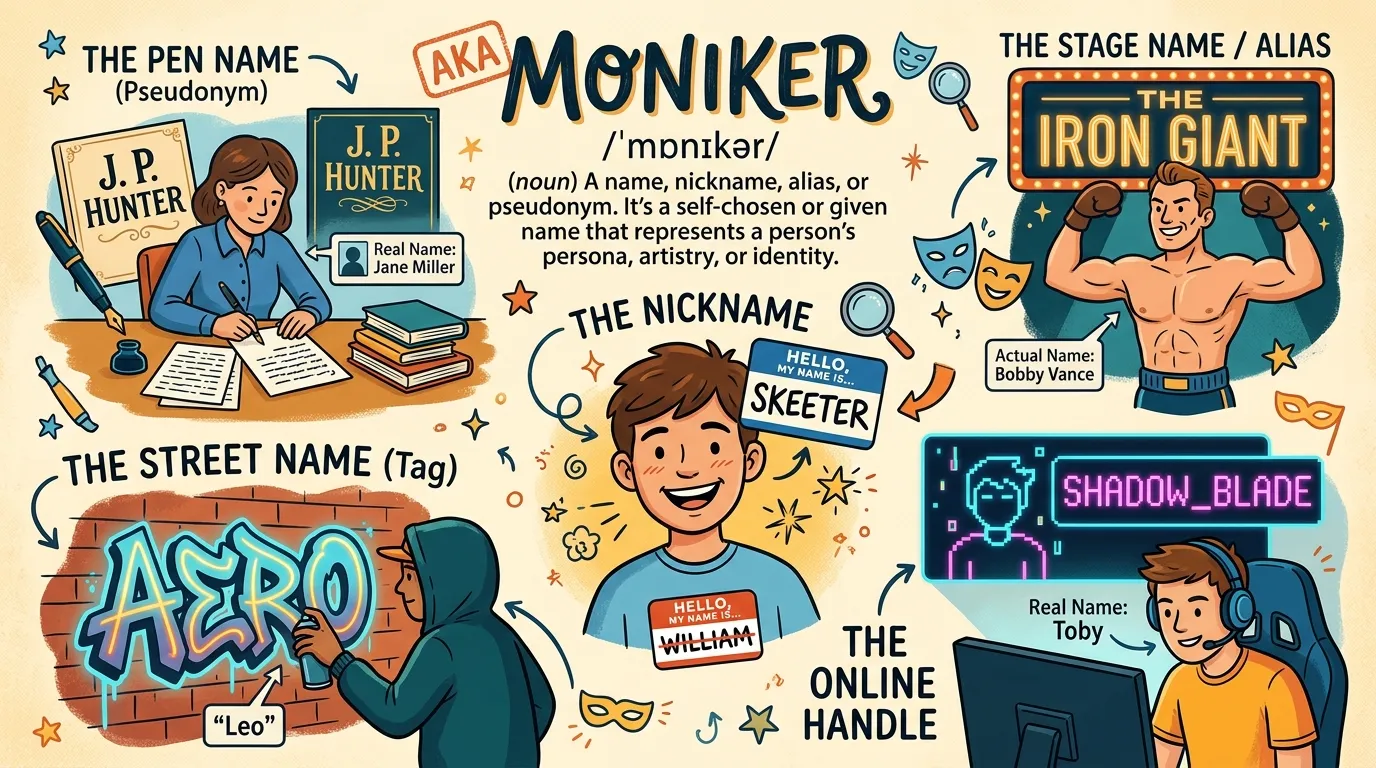
Have you ever heard someone call a person by a name that is not their real name? Maybe a friend uses a funny name for you. Or a singer performs under a name that fans know well. That name may be called a moniker.
The word moniker is often used in daily talk, news stories, music, and online posts. It may sound formal, but its meaning is simple. A moniker is a name or label that someone uses or that other people give them.
For example, a person named Robert may go by the moniker “Bob.” A famous artist may use a different name on stage. A gamer may choose a unique name for an online profile.
In this guide, you will learn the full moniker meaning, how people use the word, and how it differs from terms like nickname, alias, and pseudonym. You will also see clear examples, common phrases, and simple tips to help you use the word with ease.
Quick Answer
Moniker means a name, nickname, or label used to identify a person or, in some cases, a thing. People often use it when someone is known by a name other than their full or official name. For example, “The singer performs under the moniker Starboy.”
Definition & Meaning of Moniker
A moniker is a name that people use to refer to someone or something. It can be a casual nickname, a public name, or a name linked to a certain role or identity.
The word often appears when a person has a known name that differs from their legal name. It can also refer to a label that helps people recognize a person, group, or thing.
Here are a few simple examples:
- Nickname: His friends use the moniker “Red.”
- Stage name: The singer performs under a new moniker.
- Online name: She uses the moniker MoonFox in the game.
- Public label: The writer earned the moniker “The Storyteller.”
In each example, the moniker gives people another way to identify someone.
The word does not always mean that the name is funny or informal. A moniker can sound playful, serious, creative, or even bold. Its tone depends on the name and the way people use it.
Where Does the Word Moniker Come From?
The exact history of moniker is not fully clear. English speakers began using it in the 19th century, and it later became common in informal speech and writing.
Some sources link the word to British slang. Its early history has been discussed by word experts, but its precise origin remains uncertain. It is best to avoid treating one proposed origin as a proven fact.
Today, people use moniker in many settings. You may see it in a news story about a public figure, a review of a music artist, or a post about an online creator.
For example:
“Known by the moniker The Boss, the musician has a name that fans remember.”
Here, moniker refers to a name that people know and use. It does not tell us whether that name is official, legal, or chosen by the person.
How to Use Moniker in a Sentence
You can use moniker in place of words such as name, nickname, or alias when the sentence calls for it. It is common in both casual and formal writing, though it can sound a little more polished than nickname.
Here are some examples:
- “He earned the moniker ‘The Eagle’ after a big win.”
- “The artist uses a new moniker for her solo work.”
- “My brother gave me the moniker ‘Professor’ because I ask so many questions.”
- “The gamer chose a short moniker for his profile.”
- “The writer published the book under a different moniker.”
- “The town is known by the moniker ‘The City of Roses.’”
- “She kept the moniker that her fans gave her.”
- “The boxer became famous under his ring moniker.”
Each sentence shows how a moniker can identify a person or place. The word works best when the name has a special role or meaning.
For a simple everyday sentence, you could say, “My friends call me Ace.” For a more polished version, you could say, “Ace is the moniker my friends use for me.”
Both sentences share the same basic idea.
Moniker vs. Nickname vs. Alias vs. Pseudonym
These words are close in meaning, but they do not always fit the same situation. Knowing the difference can help you choose the right word.
A moniker is a broad term for a name or label. A nickname is often a familiar or playful name. An alias is another name used in place of a person’s usual or real name. A pseudonym is a name a person uses instead of their real name, often when writing or making art.
| Word | Main meaning | Example |
| Moniker | A name or label used to identify someone or something | “The Lion” |
| Nickname | A familiar name given by friends, family, or others | “Mikey” |
| Alias | Another name used in place of one’s usual name | A person using a different name |
| Pseudonym | A chosen name used instead of a real name, often by a writer | A novelist’s pen name |
| Stage name | A name used for public performances | A singer’s public name |
| Username | A name used to identify an account online | MoonFox27 |
These meanings can overlap. A stage name may also be a moniker. A writer’s pseudonym may be the moniker readers know best.
The main difference is the purpose of the name. A nickname often shows closeness. An alias may hide or replace a person’s usual identity. A pseudonym is often tied to creative work. A moniker can cover many of these uses.
Common Types of Monikers
People use monikers for many reasons. Some names grow from a person’s looks or habits. Others come from work, hobbies, or public life.
1. Personal Monikers
A personal moniker is a name that people use for someone in daily life.
For example, friends may call a tall person “Stretch.” A family may call a child “Sunny” because the child smiles often.
These names can show love, humor, or a shared memory. Still, a name that feels kind to one person may upset another. It is best to respect the person’s wishes.
2. Professional Monikers
Some people use a different name in their work. This is common in music, acting, sports, and other public fields.
A performer may choose a short name that is easy to recall. A wrestler may use a ring name. An author may publish books under a pen name.
In these cases, the moniker helps create a public identity. It may also help the person keep work and private life apart.
3. Online Monikers
An online moniker is a name someone uses on a website, game, or social platform. People may choose a name that shows their interests or gives them more privacy.
For example, a player may use “PixelKnight” in an online game. A person who posts art may use “BlueCanvas” as a public name.
An online moniker does not prove who someone is in real life. If you meet someone online, do not assume their profile name is their legal name or that every detail in their profile is true.
4. Monikers Based on Traits or Actions
Some names come from a person’s skills, habits, or actions.
A fast runner may earn the moniker “Rocket.” A calm person may be called “Zen.” A skilled cook may be known as “The Chef.”
These labels can be positive, neutral, or negative. The meaning depends on the context and the way people use them.
5. Place and Group Monikers
The word can also describe a label linked to a place, team, or group. A city may have a well-known nickname. A sports team may have a short name that fans use.
For example, a town might be called “The Garden City.” In that sentence, the label acts as a moniker for the place.
In everyday speech, people may simply call it a nickname. The word moniker can sound more formal or descriptive.
Why Do People Use Monikers?
People use monikers for several reasons. The name may be easier to say, easier to recall, or more suited to a certain setting.
To make a name easier to remember: A short name may stand out more than a long one.
To show personality: A name like “Sunny” may reflect a cheerful image.
To build a public identity: An artist may use one name for all public work.
To protect privacy: An online user may choose a name that does not reveal their real identity.
To show a shared bond: Friends may use a name that comes from a joke or memory.
To mark a role: A person may gain a label because of a skill, job, or achievement.
Not every moniker is chosen by the person who uses it. Friends, fans, reporters, or other people may give someone a name. Some names last for years, while others fade after a short time.
A moniker can also have a mixed effect. A person may enjoy a name that shows pride or skill. But they may dislike a label that feels rude or unfair. The person’s view matters more than the name itself.
Common Phrases With Moniker
You may see moniker in a few common phrases. Each one gives a clue about how the name is used.
“Known by the moniker”
This means that people recognize someone by a certain name.
Example: “The artist is known by the moniker Night Sky.”
“Under the moniker”
This means someone works, performs, or acts using a certain name.
Example: “She released the song under the moniker Silver Lane.”
“Earned the moniker”
This means someone gained a name because of an action, trait, or event.
Example: “He earned the moniker ‘The Wall’ for his strong defense.”
“Adopted a moniker”
This means someone started using a new name.
Example: “The writer adopted a moniker for her first novel.”
“A catchy moniker”
This means a name is easy to recall or has a strong sound.
Example: “The band chose a catchy moniker for its new project.”
These phrases appear in articles, interviews, reviews, and everyday talk. You do not need to use them all. Choose the one that fits your sentence.
Is Moniker Formal or Informal?
Moniker can work in both formal and informal writing. It is common in news stories, profiles, interviews, and articles about people with public names.
In casual talk, people may prefer the word nickname. It is simple and clear.
Compare these examples:
- Casual: “My friends call me Ace.”
- More polished: “Ace is the moniker my friends use for me.”
- News style: “The performer is known by the moniker Ace.”
All three sentences can be correct. The best choice depends on the audience and tone.
If you are writing for young readers or people learning English, name or nickname may be easier to understand. If you want to describe a public or chosen name, moniker can be a good fit.
Common Mistakes When Using Moniker
The word is easy to learn, but a few mistakes can make a sentence unclear.
Mistake 1: Treating every moniker as a legal name
A moniker may be a nickname, stage name, or online name. It does not have to appear on official records.
Mistake 2: Assuming a moniker is always funny
Some monikers are playful. Others are serious or linked to a person’s work.
Mistake 3: Using moniker when nickname is clearer
In a simple message, “What is your nickname?” may sound more natural than “What is your moniker?” Use the word that suits the situation.
Mistake 4: Assuming the person chose the name
Other people may give someone a moniker. Do not assume the person picked it or likes it.
Mistake 5: Thinking a moniker always hides identity
A moniker may be public and well known. It can be used for style, ease, or fun rather than secrecy.
The key is to look at the context. Ask what the name does and why people use it.
Moniker Meaning: Quick Reference Table
Use this table to review the main points.
| Question | Quick answer |
| What does moniker mean? | A name or label used to identify someone or something |
| Is it the same as a nickname? | Sometimes, but moniker has a wider use |
| Can a moniker be a stage name? | Yes |
| Can it be used online? | Yes, such as a gaming name or username |
| Must it be a person’s real name? | No |
| Is it always informal? | No, it also appears in news and formal writing |
| Does it always hide identity? | No |
| What is a simple synonym? | Name or nickname, depending on context |
Keep in mind that these terms can overlap. The surrounding sentence helps you understand the exact meaning.
FAQs:
1. What does a moniker mean in simple words?
A moniker is a name or label used to identify someone or something. It may be a nickname, stage name, online name, or another name people use. For example, if friends call a person “Ace,” Ace may be their moniker.
2. Is a moniker the same as a nickname?
A moniker can be a nickname, but the words are not always identical. A nickname often comes from friends or family and may sound warm or playful. Moniker is broader. It can also describe a stage name, public label, or name used online.
3. What is an example of a moniker?
“Rocket” is an example of a moniker if people use it to identify a fast runner. “MoonFox” may be a moniker for someone who plays games online. A singer’s stage name can also be a moniker.
4. Is moniker a slang word?
People often use moniker in casual speech, but it is not just slang. It appears in news stories, reviews, interviews, and other forms of writing. It may sound more polished than the word nickname.
5. What is another word for moniker?
Possible alternatives include name, nickname, alias, pseudonym, and label. The best choice depends on the situation. A nickname is often personal, an alias is another name used in place of one’s usual name, and a pseudonym is often used for creative work.
6. Can a person have more than one moniker?
Yes. Someone may use one name with family, another at work, and a third online. A performer may also use different names for different projects. The name people use often depends on the setting.
7. How do you use moniker in a sentence?
You can say, “The singer performs under the moniker Blue Star.” This means Blue Star is the name the singer uses for performances. You could also say, “His friends gave him the moniker ‘Captain’ after he led the team.”
Conclusion:
The word moniker means a name or label used to identify a person or thing. It can refer to a nickname, stage name, online name, or public label. The word has a wider use than nickname, though the two can mean much the same thing in some cases.
To use it well, look at the reason behind the name. Is it a name friends use? A name chosen for work? Or a label that other people gave someone? The context will help you choose the right word.
Now that you know the moniker meaning, try using it in a simple sentence. For example: “My online moniker is MoonFox.” A clear example is often the easiest way to remember a new word.

Hello, I am Daniel Brooks a passionate writer and educator with a deep love for language and creative expression. My work on similiezmeta.com focuses on helping kids and students explore the beauty of words through playful examples and practical explanations.