Have you seen the word “residuals” in a text, a movie discussion, or a post about money? The word can seem hard to understand at first. But its meaning becomes simple when you look at the situation.
Residuals means things that remain after most of something is gone. In entertainment, the word often refers to payments that actors, writers, and other creators receive when their work gets used again. In business and math, it can refer to leftover amounts or the difference between an expected result and an actual result.
The exact meaning depends on where you see it. Someone talking about a TV show may mean extra payments. Someone discussing a science test may mean a remaining amount or an unexplained difference.
In this guide, you will learn the residuals meaning in plain English, how people use it in everyday conversations, and what it means in acting, finance, and statistics. You will also find real-life examples and quick tips to help you understand the word without guessing.
Quick Answer: What Does Residuals Mean?
Residuals means leftover amounts, remaining effects, or payments earned from the later use of someone’s work.
For example:
- In acting: An actor may receive residuals when a show they worked on gets reused under the terms of their agreement.
- In finance: Residuals may refer to money that remains after certain costs or payments.
- In everyday speech: Residual effects are feelings or results that remain after an event.
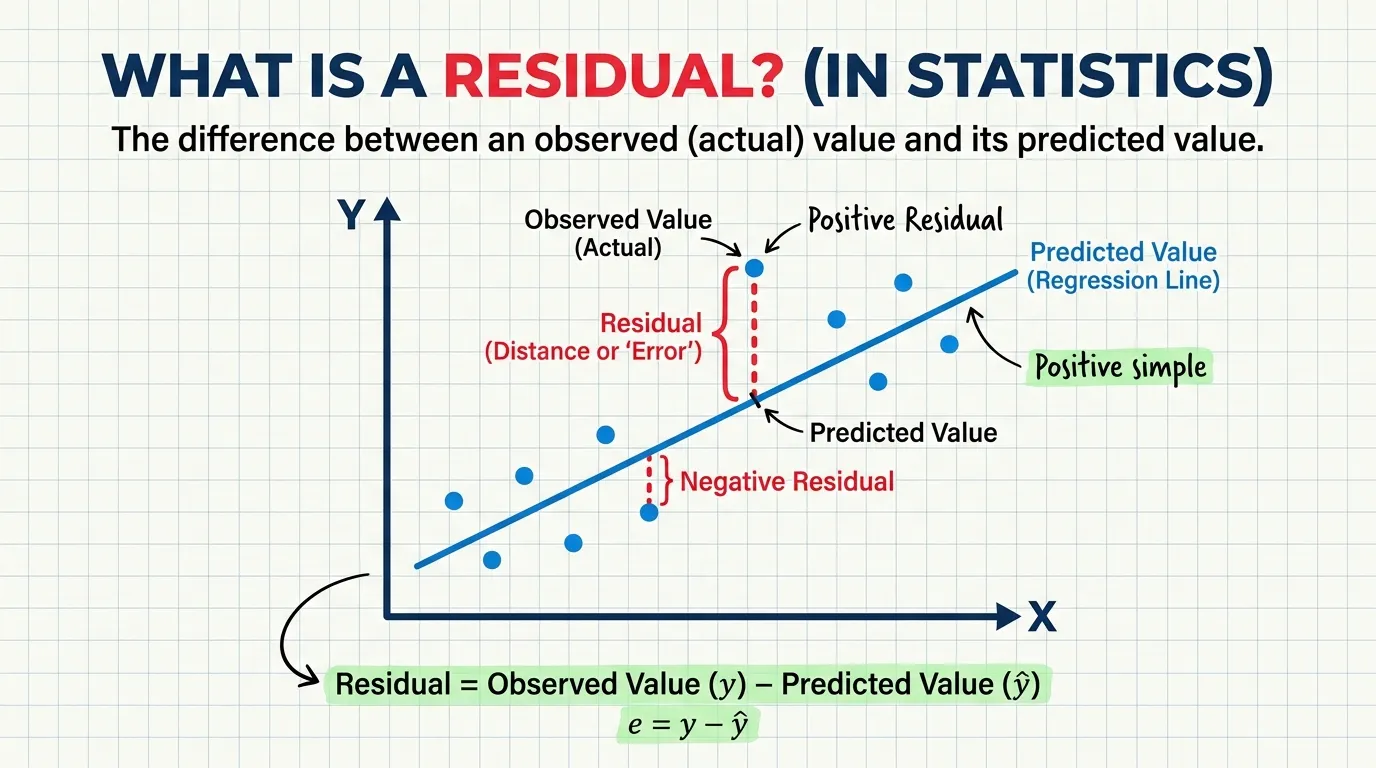
- In statistics: Residuals are the differences between actual values and values predicted by a model.
The easiest way to understand the word is to ask yourself one question: What remains, or what gets paid, after the original event or work?
Definition and Meaning of Residuals
Residuals is the plural form of residual. The word generally describes something that remains after most of the original amount, substance, or activity has gone.
Think about a glass that once held juice. After you pour the juice out, a small amount may remain at the bottom. That leftover amount is a simple example of a residual.
The word also appears in more technical settings. In entertainment, it often means additional payments for the reuse of creative work. In statistics, it describes a difference between an observed result and a predicted result.
Here are a few simple examples:
- “There was residual water in the bottle.” Some water remained.
- “The actor received residuals.” The actor received payments for eligible later uses of their work.
- “The test showed residual effects.” Some effects continued after the main event.
- “The model produced large residuals.” Some predictions differed greatly from the actual results.
Notice how the details change, but the main idea stays similar. Something remains, or a difference remains after a comparison.
What Does Residuals Mean in Text and Everyday Conversation?
When someone uses “residuals” in a text message, the meaning depends on the topic. It is not a common texting abbreviation like “LOL” or “BRB.” It is a regular English word that people may use in casual or professional conversations.
If the conversation concerns a job, a movie, music, or money, residuals may refer to repeat payments. If the conversation concerns a past event, the speaker may be talking about lingering effects.
Examples of residuals in text:
Example 1
Person A: “Does the actor still get paid for that old show?”
Person B: “Yes, they may still earn residuals.”
Meaning: The actor may receive payments when the show gets reused under the applicable payment rules.
Example 2
Person A: “Why are you still upset about what happened?”
Person B: “I guess there are some residual feelings.”
Meaning: Some feelings from the past event remain.
Example 3
Person A: “What is that extra payment on your statement?”
Person B: “Those are residuals from my previous work.”
Meaning: The payment relates to earlier work, though its exact source depends on the person’s agreement.
One important point: residuals does not have one special meaning in every text. Read the words around it before deciding what the sender means.
What Does Residuals Mean in Acting and Entertainment?
In the entertainment industry, residuals are payments made for certain later uses of creative work. Actors, writers, and other eligible workers may receive them when a movie, television show, or other covered work gets reused.
For example, an actor might film a television episode and receive an initial payment for the job. If the episode later airs again or reaches viewers through a covered distribution method, the actor may qualify for residual payments.
The rules depend on the type of work, the contract, the applicable union agreement, and how the work gets distributed. Not every performer receives residuals for every project or every replay. <
How Do Acting Residuals Work?
Here is a simple example:
Imagine an actor appears in a television series. The production pays the actor for the original work. Later, the studio licenses the show for another form of distribution.
If the applicable agreement provides residual payments for that use, the actor may receive additional money. The payment amount and timing depend on the rules that apply to the project.
Residuals can matter because a single performance may continue to reach audiences long after filming ends. However, they do not guarantee a steady income. Payments may change based on the work, the agreement, and the type of reuse.
Are Residuals the Same as Royalties?
The terms overlap, but they do not always mean the same thing.
Royalties generally refer to payments tied to the use, sale, or licensing of creative work or other property. Residuals often refer to payments under entertainment-industry agreements for certain later uses of a production.
The exact distinction depends on the industry and the contract. It is best to check the relevant agreement rather than assume the terms are interchangeable.
What Does Residual Income Mean?
Residual income can refer to money left after certain expenses or obligations have been paid. In some contexts, people also use the term to describe continuing earnings from work or assets that generate payments over time. These meanings are related, but they are not identical.
For example, a household may calculate how much money remains after paying its bills. In another situation, a musician may receive ongoing royalty payments from earlier work.
People sometimes call this kind of continuing income “passive income.” However, residual income does not always mean money earned without effort. A person may still need to manage a business, maintain an asset, or create new work.
Before relying on residual income, consider the costs, payment terms, taxes, and risk involved. Do not assume that an income stream will last forever.
What Does Residual Value Mean in Finance?
Residual value is the estimated value of an asset at the end of a specific period or its useful life. The term often appears in discussions about vehicles, equipment, leasing, and business assets.
For example, suppose a car costs $30,000 when new. A lender or leasing company estimates that it will be worth $15,000 after three years. That estimated future amount is its residual value.
The estimate may differ from the car’s actual market value when the three years end. Mileage, condition, demand, and market changes can affect the final price.
Residual value can help people compare lease offers or estimate the cost of owning an asset. Still, it is an estimate, not a promise that someone will pay that amount later.
What Does Residuals Mean in Statistics and Math?
In statistics, a residual is the difference between an actual observed value and the value predicted by a model. Researchers use residuals to understand where a model’s predictions miss the real results.
The basic formula is:
Residual = Actual value − Predicted value
Suppose a model predicts that a shop will sell 100 cups of coffee in one day. The shop actually sells 115 cups.
The residual is:
115 − 100 = 15
The positive residual means the actual sales were 15 cups higher than the prediction.
Now imagine the model predicts 100 cups, but the shop sells only 85. The residual is −15. This means actual sales were 15 cups lower than predicted.
Residuals help analysts study how well a model fits the data. Large or patterned residuals may suggest that the model misses an important factor. Small residuals alone do not prove that a model is correct, though. Analysts must also check the data, assumptions, and purpose of the model.
What Are Residual Effects?
Residual effects are results, feelings, or conditions that remain after the main event has passed.
For example, a person may finish a stressful project but still feel tired for a while. Someone may clean a surface but find that a faint stain remains. Both situations can involve something left over from an earlier event.
Here are a few common uses:
- Residual stress: Stress that remains after a difficult situation.
- Residual heat: Heat that remains after a source stops producing heat.
- Residual water: Water that remains after most of it has been removed.
- Residual damage: Damage that remains after an event or repair.
The word does not always suggest a problem. Residual heat may be useful, and residual income may help support a budget. The surrounding sentence tells you whether the remaining effect is helpful, harmful, or neutral.
Residuals vs. Similar Words: What’s the Difference?
Residuals can sound like several other words, but the terms have different uses. Knowing the difference can help you choose the right meaning.
| Term | Simple meaning | Example |
| Residuals | Things that remain or certain repeat payments | An actor receives residuals. |
| Residue | Material left behind | Soap residue remains on the glass. |
| Royalties | Payments tied to the use or sale of work or property | A writer earns royalties from book sales. |
| Remainder | What is left after subtraction or removal | Five is the remainder after subtracting three from eight. |
| Residual value | An asset’s estimated future or end-of-period value | A car has an estimated residual value. |
| Residual income | Money left after specified costs or obligations, depending on the context | A family calculates its income after bills. |
The main difference is context. Residuals is a broad term, while words like residue, royalties, and residual value have more specific uses.
Common Mistakes to Avoid When Using Residuals
People often misunderstand residuals because they assume the word always refers to money. It does not. It can describe remaining material, lingering effects, or differences in data.
| Common mistake | Correct understanding |
| Assuming residuals always mean extra money | The word can also refer to leftovers or statistical differences. |
| Thinking every actor gets residuals | Eligibility and payment rules depend on the work and applicable agreement. |
| Treating residuals and royalties as exact synonyms | Their meanings can overlap, but the payment rules may differ. |
| Assuming residual income is always passive | Some income streams still need time, work, or upkeep. |
| Thinking a positive statistical residual means a model is good | It only shows that the actual value exceeded the predicted value. |
| Treating residual value as a guaranteed sale price | It is an estimate that may differ from the final market value. |
Use the topic of the sentence to work out the intended meaning. If someone discusses a show, think about entertainment payments. If they discuss a model, think about the difference between actual and predicted results.
Quick Reference Checklist: How to Understand Residuals
Use this checklist whenever you come across the word.
- Step 1: Read the full sentence.
- Step 2: Look for clues about money, entertainment, science, or everyday life.
- Step 3: Ask whether the word describes something left over, a payment, or a difference.
- Step 4: Check the surrounding details if the meaning is still unclear.
- Step 5: Avoid assuming that the word has the same meaning in every field.
| Where you see it | Likely meaning | What to check |
| Movie or TV discussion | Payments for eligible later uses of a production | Contract or payment rules |
| Text about earnings | Continuing payments or money left over | Source of the income |
| Car lease | Estimated future asset value | Lease terms and mileage rules |
| Statistics report | Actual value minus predicted value | Model and data |
| Cleaning or science | Material or substance that remains | What was removed or changed |
| Everyday conversation | A lingering effect or feeling | The event being discussed |
This quick guide helps you narrow down the meaning without relying on guesswork.
FAQs:
1. What does residuals mean in simple words?
Residuals means things that remain after most of something has gone. The word can also refer to certain payments made when creative work gets used again. The topic tells you which meaning applies.
2. What does residuals mean in a text message?
In a text, residuals may refer to ongoing payments from earlier work or effects that remain after an event. It is not a standard texting abbreviation. Read the full message to understand the intended meaning.
3. What does residuals mean for actors?
For actors, residuals are payments they may receive when a film, show, or other covered work gets reused under applicable payment rules. The amount and eligibility depend on the agreement and type of use.
4. Are residuals the same as royalties?
Not always. Both can involve payments from creative work, but residuals often follow entertainment-industry agreements for later uses of a production. Royalties often relate to sales, licensing, or use of creative work or property.
5. What does residual income mean?
Residual income can mean money left after certain expenses or obligations. It can also describe continuing earnings from earlier work or an asset. The intended meaning depends on the financial context.
6. What does residual value mean for a car?
Residual value is an estimate of what a car will be worth at a future point, often at the end of a lease. The actual value may change with the car’s condition, mileage, and market demand.
7. What does residual mean in statistics?
A residual is the difference between an actual value and a model’s predicted value. A positive residual means the actual value is higher than the prediction. A negative residual means it is lower.
Conclusion:
The simplest way to understand residuals is to think about what remains after something else has happened.
In everyday speech, it may refer to lingering feelings or effects. In entertainment, it often means payments for eligible later uses of creative work. In finance, it can describe remaining money or an asset’s estimated future value. In statistics, it means the difference between an actual result and a prediction.
When you see the word, look at the topic and the words around it. That small step will help you choose the right meaning.

Hello, I am Daniel Brooks a passionate writer and educator with a deep love for language and creative expression. My work on similiezmeta.com focuses on helping kids and students explore the beauty of words through playful examples and practical explanations.