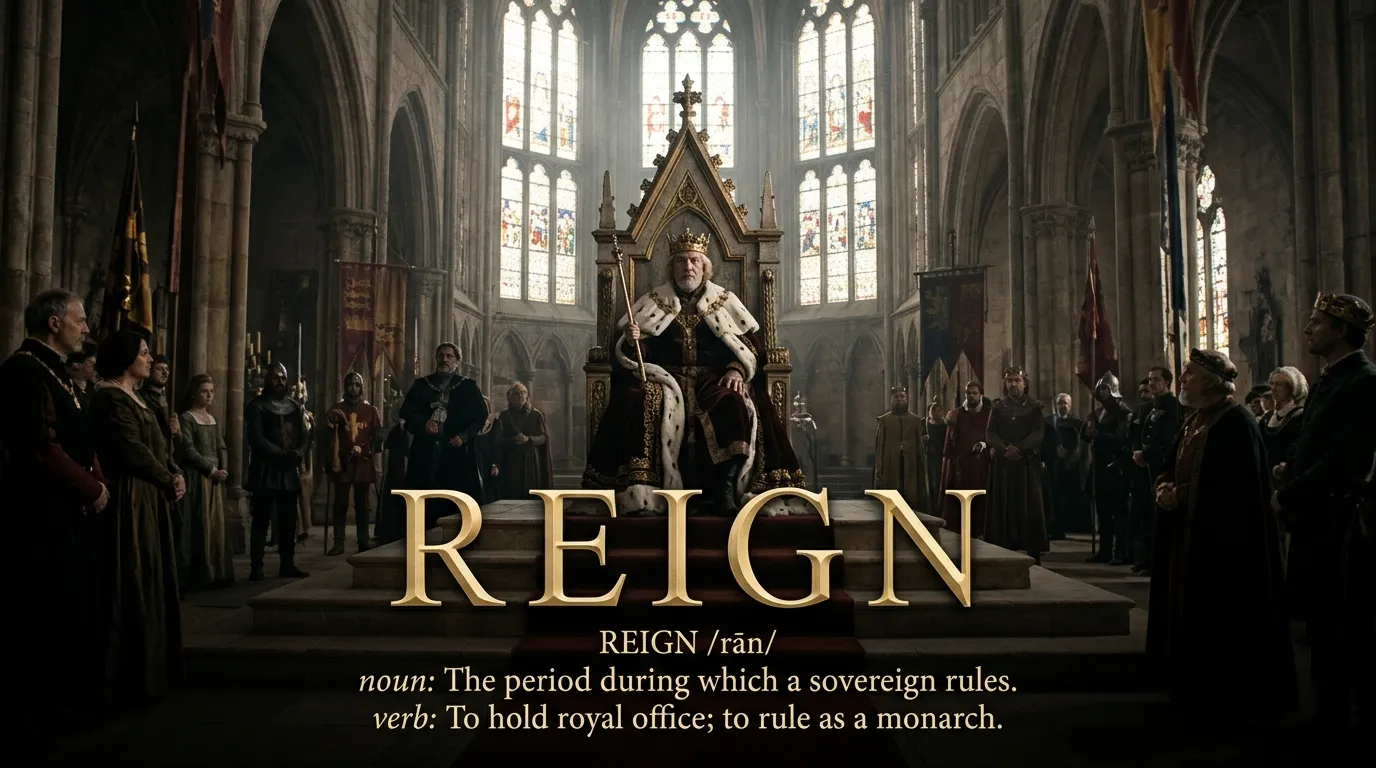
Have you ever heard someone say, “Her reign was long and peaceful,” or “Fear ruled the land during his reign”? The word reign often appears in books, history lessons, news stories, and daily talks. But what does it mean, and how can you use it in your own words?
The reign meaning is the period when a king, queen, or other ruler holds power. It can also mean the act of ruling a country or group. In a wider sense, reign can describe a strong feeling or force that seems to control a place or time. For example, you might hear that peace reigns in a town or that fear reigns in a home.
This guide explains the word in simple English. You will learn its main meanings, how to use it in a sentence, and which words have a similar meaning. You will also see the difference between reign, rein, and rule. These words may sound alike, but they do not always mean the same thing.
By the end, you will know when to use reign and how to avoid common mistakes.
Quick Answer: What Does Reign Mean?
Reign means to rule as a king, queen, or other leader, or the time during which that person rules.
For example:
- “Queen Victoria’s reign lasted many years.”
- “Peace reigns in the village.”
- “The king began his reign at a young age.”
The word can work as both a noun and a verb. As a noun, it often means a ruler’s time in power. As a verb, it means to rule or to hold power.
Reign Definition and Meaning
The word reign has two main uses. Its exact meaning depends on how it appears in a sentence.
1. Reign as a Noun
As a noun, reign means the time when a king, queen, or other ruler holds power.
Example: “The king’s reign lasted 30 years.”
This sentence tells us how long the king held power. It does not mean he lived for only 30 years. He may have lived longer than that.
You can use the word to talk about a ruler’s time in power, a period in history, or the time when a person or group has great influence.
More examples:
- Her reign brought peace to the kingdom.
- The ruler’s reign ended after a major change in the country.
- The team enjoyed a long reign as league champions.
In the last example, reign does not refer to a king or queen. It describes a period of success and control.
2. Reign as a Verb
As a verb, reign means to rule or hold power. It can also describe a feeling, condition, or force that is common or seems to control a place.
Example: “The queen reigned for many years.”
Here, reigned tells us what the queen did. She held power over her kingdom.
The word also appears in phrases such as “hope reigns” or “silence reigns.” These phrases mean that hope or silence is strong or widespread.
More examples:
- The new ruler reigned with care.
- Joy reigned in the room after the good news.
- Confusion reigned after the sudden change.
In these sentences, the word describes rule or a strong presence. It does not always refer to a person in charge.
Reign Meaning in Simple English
In simple English, reign means to rule or the time spent ruling.
Think of a king who takes the throne at age 25 and leaves it at age 55. His reign lasts 30 years. The word describes the time he held power, not his full life.
Now think of a room where everyone feels calm. You could say, “Peace reigns in the room.” This means that peace is the main feeling there.
The word often appears in formal writing, history, stories, and news. You may also see it in everyday speech when someone wants to describe a long period of success or control.
Reign Examples in Sentences
The best way to learn a word is to see it in use. These examples show how reign works in different settings.
Examples of Reign as a Noun
- The king’s reign began in 1990.
- Her reign changed the course of the nation’s history.
- The country enjoyed peace during his reign.
- The ruler’s reign came to an end after many years.
- The singer’s reign at the top of the charts lasted for months.
- The team hopes to continue its reign as champions.
In each sentence, reign names a period of power, rule, or success.
Examples of Reign as a Verb
- The queen reigned over the kingdom for decades.
- The king reigns with the support of his people.
- Hope reigned among the families after the news.
- Silence reigned in the hall as the speaker began.
- Fear reigned in the city during the conflict.
- Order reigned after the leaders reached an agreement.
These sentences show that the verb can describe a ruler’s power or a condition that fills a place.
Reign Synonyms and Similar Words
A synonym is a word with the same or a close meaning. The best synonym for reign depends on how you use it.
Here are some common choices:
- Rule: To hold power over a country, group, or people.
- Govern: To lead and manage a country or region.
- Domination: Strong control over others.
- Authority: The power or right to make decisions.
- Control: The power to direct or manage something.
- Leadership: The act of leading a person or group.
- Tenure: The period during which someone holds a position.
These words are related, but they are not always interchangeable.
For example, rule can describe the act of leading a country. Tenure can describe the time someone holds an office, even if that person is not a monarch. Domination often suggests strong or unfair control.
If you write about a king or queen’s time in power, reign is often the clearest word.
Reign vs. Rule: What Is the Difference?
Reign and rule are close in meaning, but they do not always work in the same way.
Reign often refers to a monarch’s time in power. It can also describe a strong condition, such as peace or fear. Rule has a wider use. It can mean leading a country, controlling a group, or setting a standard that people must follow.
For example:
- “The queen’s reign lasted 20 years.”
- “The queen ruled the country for 20 years.”
Both sentences describe her time in power, but the first focuses on her period as ruler. The second focuses more on the act of ruling.
The word rule also has another meaning. A rule can be a law or instruction, such as a school rule. You would not normally use reign in that sense.
Reign vs. Rein: How to Tell Them Apart
Reign and rein sound alike in common English pronunciation, but their meanings differ.
A reign relates to ruling or a period of power. A rein is a strap used to guide or control a horse. The word rein also appears in the phrase “rein in,” which means to limit or control something.
Compare these examples:
- “The king’s reign lasted for years.”
- “The rider held the reins tightly.”
- “The company needs to rein in its spending.”
A simple way to remember the difference is this: a king has a reign, while a rider holds the reins.
Do not confuse the two in writing. Spell-check tools may not catch the error because both are real words.
What Does “Reign of Terror” Mean?
The phrase “reign of terror” describes a period when people face widespread fear, threats, or harsh control.
The phrase is often linked to the Reign of Terror during the French Revolution. This period took place mainly from 1793 to 1794 and involved mass arrests and executions of people seen as enemies of the revolution.
Today, people also use the phrase in a wider sense. For example, a news story might describe a criminal’s “reign of terror” if that person caused fear in a community for a long time.
The phrase does not mean that a person must be a king or queen. It highlights a period of fear and control.
What Does “Let Peace Reign” Mean?
“Let peace reign” means to allow peace to guide a place, group, or situation.
People may use this phrase in speeches, prayers, songs, or personal messages. It expresses a wish for calm, kindness, and an end to conflict.
For example:
- “Let peace reign in every home.”
- “After the argument, the family hoped peace would reign again.”
The phrase uses reign in a figurative way. Peace does not hold a throne or issue laws. Instead, it becomes the main condition in a place.
You can use the same pattern with other words, such as hope, love, joy, or silence.
Common Mistakes When Using Reign
Even though reign is not a hard word to learn, some mistakes are common.
Mistake 1: Using “Reign” Instead of “Rein”
Incorrect: “The rider pulled the reigns.”
Correct: “The rider pulled the reins.”
Use reins when you mean the straps used to guide a horse.
Mistake 2: Thinking Reign Always Means a King or Queen
Incorrect idea: “Reign can only describe a royal ruler.”
Better understanding: The word often refers to a ruler, but it can also describe a strong feeling, condition, or period of success.
For example, “Silence reigned in the room” is correct.
Mistake 3: Using Reign When You Mean a Rule or Law
Incorrect: “The school has a new reign about phones.”
Correct: “The school has a new rule about phones.”
A rule can be an instruction or law. A reign is a period of power or the act of ruling.
Mistake 4: Confusing a Reign With a Lifetime
A ruler’s reign may be shorter than their life. A person may live for 80 years but rule for only 25 of them.
When you describe a reign, focus on the time in power.
Comparison Table: Reign vs. Rein vs. Rule
| Word | Main meaning | Example |
| Reign | A period of rule or the act of ruling | The queen’s reign lasted 20 years. |
| Rein | A strap used to guide a horse; also used in “rein in” | The rider held the reins. |
| Rule | To govern, control, or set a law | The king ruled the land. |
| Govern | To lead and manage a country or region | The council governs the city. |
| Tenure | The time someone holds a job or position | Her tenure as leader lasted five years. |
Use this table as a quick guide when you need to choose the right word.
Quick Reference Table: How to Use Reign
| If you want to describe… | Use this pattern | Example |
| A ruler’s time in power | The reign of + ruler | The reign of the queen was peaceful. |
| The act of ruling | Reign over + place or group | The king reigned over the kingdom. |
| A period of success | A reign as + title | The team began its reign as champions. |
| A strong feeling or state | [Feeling] reigns | Hope reigns in the town. |
| The end of a ruler’s time in power | A reign ends | His reign ended after 15 years. |
| A period of fear | Reign of terror | The town suffered during the reign of terror. |
These patterns can help you use the word in schoolwork, articles, stories, and everyday writing.
How to Use Reign in Everyday Writing
You do not need to use reign in every sentence about power. Choose it when it fits the meaning and tone.
Use reign when writing about kings, queens, or a long period of control. It also works well when you want to describe a feeling that seems to fill a place.
For simple, direct writing, rule or lead may sound more natural. For example, “She led the team” is often clearer than “She reigned over the team.” The second phrase may sound dramatic or suggest strong control.
Here are three quick steps to help you choose:
- Check the meaning. Are you talking about rule, time in power, or a strong condition?
- Check the word form. Use reign as a noun or reigns/reigned as a verb.
- Check the spelling. Use rein only when you mean the horse strap or the phrase “rein in.”
A good word choice makes your writing clear and natural.
FAQs:
1. What is the simple meaning of reign?
Reign means to rule as a king, queen, or other ruler. It can also mean the period during which that person holds power. For example, “The queen’s reign lasted 25 years.”
2. Is reign a noun or a verb?
Reign can be both a noun and a verb. As a noun, it means a period of rule. As a verb, it means to rule or to be strong and widespread. For example, “His reign was long” uses a noun, while “He reigned for years” uses a verb.
3. What is a synonym for reign?
Common synonyms include rule, govern, and dominate, depending on the sentence. For the time a person holds a position, tenure may fit. No single synonym works in every context.
4. What is the difference between reign and rule?
Reign often describes a monarch’s time in power or a condition that seems to control a place. Rule can describe governing, controlling, or a law or instruction. For example, a queen has a reign, while a school has rules.
5. What is the difference between reign and rein?
Reign relates to ruling or a period of power. A rein is a strap used to guide a horse. The phrase “rein in” means to limit or control something, such as spending or anger.
6. What does “reign supreme” mean?
“Reign supreme” means to be the strongest, most successful, or most important in a certain area. For example, “The team reigned supreme throughout the tournament” means the team stood above its rivals or dominated the competition.
7. What does “reign of terror” mean?
A “reign of terror” is a period marked by fear, threats, or harsh control. The phrase can refer to a historical event, such as the Reign of Terror during the French Revolution, or to a wider period when a person or group makes others afraid.
Conclusion:
The word reign means to rule or the period when a ruler holds power. It can also describe a strong feeling or condition, as in “peace reigns” or “fear reigned.” The meaning depends on how you use it in a sentence.
Remember the key difference between reign, rein, and rule. A ruler has a reign, a rider holds the reins, and a rule can be a law or an act of control.
To build your word skills, try writing three short sentences with reign: one about a ruler, one about a period of success, and one about a feeling. This simple practice can help you use the word with more confidence in your own writing.
If this guide helped you understand the word, use the examples and tables as a quick reference whenever you need them.

Hi, I’m Nathan Foster. I’m passionate about words, their meanings, and the different ways we use them in everyday communication. I enjoy explaining unfamiliar words in simple English so readers can understand them without confusion.
At SimiliezMeta.com, I focus on word meanings, definitions, synonyms, antonyms, and useful examples that show how words work in real sentences. I believe learning a new word should be simple, practical, and helpful for everyday life.


