Have you ever heard someone say, “The company got a lot of flack after the news came out”? You may have understood the sentence, but the word flack might have seemed confusing.
The word flack means strong criticism, blame, or negative comments from other people. People often use it when someone faces public complaints or gets judged for a choice, action, or mistake.
For example, a company may get flack for poor customer service. A famous person may get flack for a rude comment. Even your friend can get flack for canceling plans at the last minute.
But there is more to this word than its basic meaning. You may also see it spelled as flak, which has a similar meaning but a different history. This guide explains what flack means, where it comes from, how people use it, and how to avoid common spelling mistakes.
Quick Answer
Flack means strong criticism, blame, or negative reactions from people. It is often used when someone faces public disapproval for something they said or did.
Example: “The actor received a lot of flack for his comments.”
In simple words, getting flack means getting criticized by others.
Definition & Meaning of Flack
The word flack is an informal noun. It describes criticism or negative comments that someone receives.
It often appears in news stories, social media posts, workplace talks, and everyday conversations.
For example:
- The teacher got flack for changing the exam date.
- The brand faced flack over its new advertisement.
- He received flack for missing the meeting.
In each example, someone faces criticism because other people do not agree with their actions or decisions.
Flack can come from one person, a group, customers, fans, or the public. It does not always mean that the criticism is fair. It simply describes the negative reaction.
What Does Flack Mean in Everyday English?
In everyday English, flack usually refers to criticism that someone receives after doing something people dislike.
It can describe a small complaint or a strong public reaction. The meaning depends on the situation.
Here are three common situations:
1. Personal criticism
Someone may get flack from friends or family for making a poor choice.
Example: “I got flack from my friends for choosing the wrong restaurant.”
2. Public criticism
A famous person, company, or public figure may face flack after making a controversial choice.
Example: “The singer received flack for canceling the concert.”
3. Workplace criticism
An employee or manager may get flack for a decision that affects other people.
Example: “The manager took flack for changing the work schedule.”
In all three cases, flack describes a negative reaction from others.
Flack vs. Flak: What Is the Difference?
One common question is whether flack and flak mean the same thing.
The answer is yes, when you use them to mean criticism. Both spellings appear in English dictionaries. However, flak is the more established spelling for strong criticism, while flack also has other meanings.
The word flak first referred to anti-aircraft guns and the shells they fired. Later, English speakers began using it as a figure of speech for criticism.
English meaning – Cambridge Dictionary+2
| Flack | Flak |
| Can mean strong criticism | Means strong criticism |
| Can mean a press agent or publicist | Can mean anti-aircraft fire |
| Can also work as a verb meaning to promote | Does not normally mean to promote |
| Often appears as an alternative spelling of flak | The more established spelling for criticism |
Examples:
- Correct: “The company got a lot of flak for its new policy.”
- Also correct: “The company got a lot of flack for its new policy.”
- Correct: “The actor hired a flack to handle media questions.”
The last sentence uses flack to describe a person who works in public relations.
If you want the safest spelling for criticism in formal writing, choose flak.
What Does Flack Mean as a Noun?
A noun names a person, place, thing, or idea.
As a noun, flack has two main uses.
1. Criticism or negative reactions
This is the meaning many readers look for.
Example: “She received flack after sharing her opinion online.”
Here, flack means negative comments or criticism.
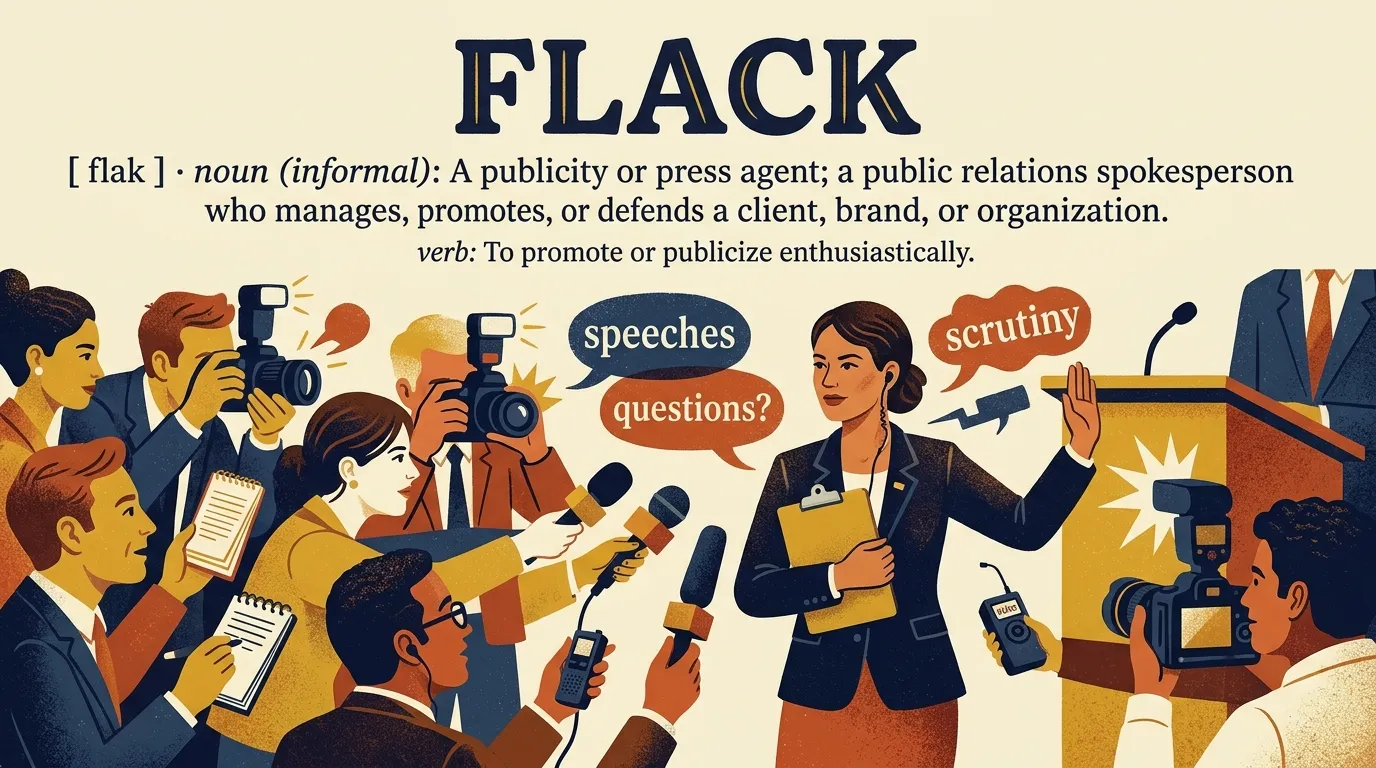
2. A press agent or publicist
In American English, flack can also mean a person who speaks for a company, public figure, or organization.
A flack may answer media questions, share official news, and help protect a client’s public image.
Example: “The actor’s flack spoke to reporters after the event.”
This meaning is informal and often appears in news or media writing. It can sometimes sound slightly negative or dismissive.
English meaning – Cambridge Dictionary+2
What Does Flack Mean as a Verb?
Although people use flack mainly as a noun, it can also work as a verb.
To flack means to promote someone or something, often by working as a publicist or press agent.
For example:
- She flacks for a new clothing brand.
- The publicist flacked the actor’s latest movie.
- He spent the week flacking a new book.
In these examples, the word describes publicity work.
You may see this verb in entertainment news, advertising, and public relations discussions.
It is informal, so words like promote, publicize, or represent may work better in formal writing.
Merriam-Webster+1
Common Phrases That Use Flack
The word often appears in short phrases. Learning these expressions will help you understand it in real conversations.
1. Get Flack
To get flack means to receive criticism from other people.
Example: “I got flack for arriving late to the party.”
This phrase focuses on the person who receives the criticism.
2. Take Flack
To take flack means to face or accept criticism.
Example: “The coach had to take flack after the team lost.”
It often describes someone who faces complaints because of a decision or event.
3. Catch Flack
To catch flack means to suddenly receive criticism or negative comments.
Example: “The restaurant caught flack for its poor service.”
People often use this phrase when a person or business becomes the target of complaints.
4. Draw Flack
To draw flack means to attract criticism.
Example: “The new school rule drew flack from parents.”
The criticism may come from a group of people who disagree with a decision.
5. A Lot of Flack
This phrase means a large amount of criticism.
Example: “The company received a lot of flack after the price increase.”
It is a common way to describe strong public disapproval.
15 Simple Examples of Flack in Sentences
The easiest way to learn a new word is to see how people use it.
Here are 15 original examples of flack in everyday English.
- He got flack for forgetting his best friend’s birthday.
- The company faced flack after raising its prices.
- She took flack for her comments on social media.
- The school received flack from parents over the new rules.
- The actor caught flack for his rude behavior.
- I got some flack for changing our travel plans.
- The coach received flack after losing the final game.
- The restaurant drew flack because of its slow service.
- The manager took flack for cutting staff hours.
- The singer faced flack after canceling the show.
- His new idea attracted flack from his coworkers.
- The brand got flack for using a confusing advertisement.
- She received flack for not attending the meeting.
- The mayor faced flack over the city plan.
- The team leader took flack for making a rushed decision.
Notice how the word often appears with verbs such as get, take, catch, receive, and draw.
These word combinations are useful to learn because they sound natural in everyday English.
Flack Synonyms and Similar Words
A synonym is a word with the same or a close meaning.
You can use several words instead of flack. However, each word has a slightly different tone.
- Criticism: Comments that point out faults or mistakes.
- Backlash: A strong negative reaction from a group of people.
- Disapproval: A feeling that something is wrong or unacceptable.
- Blame: Saying that someone is responsible for a problem.
- Complaint: A statement that something is wrong.
- Opposition: A strong disagreement with an idea or action.
- Reproach: Words that show disappointment or blame.
- Condemnation: Strong public disapproval of an action.
For example, you could say:
“The company received criticism for its new policy.”
You could also say:
“The company faced a public backlash over its new policy.”
Both sentences describe negative reactions, but backlash often suggests a stronger or wider response.
Flack vs. Criticism vs. Backlash
These words are related, but they do not always mean the same thing.
| Word | Main meaning | Simple example |
| Flack | Informal term for criticism | He got flack for his post. |
| Criticism | Comments that point out faults | She received criticism for her work. |
| Backlash | A strong negative public reaction | The brand faced a backlash. |
| Blame | Responsibility for a problem | He took the blame for the mistake. |
| Disapproval | A negative opinion about something | Her parents showed disapproval. |
Use criticism when you want a neutral word. Use flack in casual conversation. Use backlash when a negative reaction is strong or widespread.
Where Does the Word Flack Come From?
The history of flack is interesting because the word has more than one possible origin.
The spelling flak comes from the German term Fliegerabwehrkanone. This term referred to an anti-aircraft gun. German speakers shortened the long word to Flak.
English later adopted the term. During the Second World War, flak referred to gunfire aimed at enemy aircraft.
Over time, people began using the word in a figurative way. Instead of facing gunfire, someone could face a barrage of criticism.
This is why phrases such as “take flak” and “catch flak” make sense.
The word flack, when used for a press agent, has a separate and less certain history. It appeared in American publicity and entertainment language in the 1930s. Some stories link it to a person named Gene Flack, but dictionaries do not treat that explanation as proven.
Oxford Learner’s Dictionaries+2
Is Flack a Formal or Informal Word?
Flack is mainly an informal word.
You may hear it in conversations, online discussions, entertainment news, and casual workplace talks.
For example:
Informal: “The company got flack for its new prices.”
More formal: “The company faced strong criticism for its new prices.”
Both sentences express a similar idea. The second one sounds more suitable for a formal report, academic paper, or business document.
You should also think about your audience. A casual blog post may use flack naturally, while a legal report may need a more precise term.
Flack: Quick Reference Checklist
Use this table to remember the main meanings and correct usage of the word.
| What to remember | Quick answer |
| Main meaning | Criticism or negative reactions |
| Part of speech | Mainly a noun; also a verb |
| Common spelling | Flak for criticism |
| Alternative spelling | Flack |
| Another noun meaning | A press agent or publicist |
| Common phrases | Get, take, catch, and draw flack |
| Tone | Informal |
| Pronunciation | /flæk/ |
| Formal alternative | Criticism or opposition |
Common Mistakes to Avoid When Using Flack
Even people who speak English well can mix up this word.
Here are some mistakes worth avoiding.
Mistake 1: Thinking flack always means criticism
The word can also describe a press agent or publicist. Context helps you understand the intended meaning.
Mistake 2: Thinking flack and flak have different sounds
Both words have the same pronunciation: /flæk/. They sound alike when spoken.
Mistake 3: Using flack in every formal sentence
Flack is informal. In a formal report, criticism, opposition, or disapproval may sound clearer.
Mistake 4: Confusing flack with an insult
Flack does not automatically mean abuse, hate, or a personal attack. It can describe ordinary criticism or disagreement.
Mistake 5: Assuming criticism is always deserved
Someone can receive flack even when their decision is fair. The word describes the reaction, not whether the criticism is right.
FAQs:
1. What does flack mean in simple words?
Flack means criticism, blame, or negative comments from other people. It is an informal word that people use when someone faces disapproval for an action, statement, or decision.
Example: “He got flack for being late.”
2. Is flack a positive or negative word?
Flack is usually negative because it describes criticism or opposition. However, it does not always mean someone did something wrong. A person can receive unfair criticism, too.
Example: “She got flack for speaking up about an unfair rule.”
3. Does flack mean criticism?
Yes. Flack can mean strong criticism or negative reactions. It is also an alternative spelling of flak when used in this sense.
Example: “The company faced flack after its poor decision.”
4. What is the difference between flack and flak?
Both spellings can mean strong criticism, and they sound exactly alike. However, flak is the more established spelling for criticism. Flack can also mean a publicist or press agent.
Example: “The singer took flak from fans.”
5. What does getting flack mean?
Getting flack means receiving criticism or negative comments from other people.
Example: “I got flack from my friends for canceling our plans.”
It often describes a situation where someone faces complaints or disapproval.
6. What does flack mean on social media?
On social media, flack means negative comments, criticism, or public disapproval. Someone may get flack after posting an unpopular opinion, sharing a controversial video, or making an upsetting comment.
Example: “The influencer got flack for her latest post.”
7. What is another word for flack?
Some common alternatives include criticism, backlash, blame, opposition, disapproval, and complaints.
The best choice depends on the sentence. Criticism works in most situations, while backlash describes a strong negative reaction from a group.
Conclusion:
The word flack means criticism, blame, or negative reactions from other people. It is an informal word that often appears in everyday conversations, news, and social media.
You may also see it spelled as flak. Both spellings can describe criticism, but flak is the more established choice. Remember that flack can also mean a publicist or press agent.
The best way to learn this word is to practice common phrases such as “get flack,” “take flack,” and “catch flack.” These expressions will help you understand and use the word with confidence in daily English.

Hi, I’m Christopher Hayes. I’m interested in the words and expressions people use to share their thoughts, feelings, and experiences. I especially enjoy exploring idioms, everyday phrases, similes, and figurative language.
At SimiliezMeta.com, I help readers understand the meanings behind common expressions through simple explanations and relatable examples. I aim to explain not only what a phrase means but also how and when people use it naturally.


